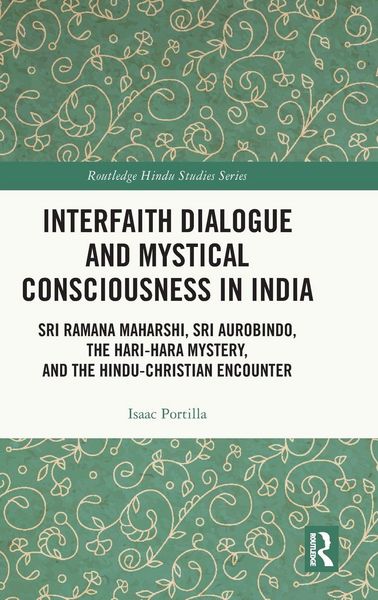
Produktbild: Interfaith Dialogue and Mystical Consciousness in India

Interfaith Dialogue and Mystical Consciousness in India Sri Ramana Maharshi, Sri Aurobindo, the Hari-Hara Mystery, and the Hindu-Christian Encounter

Fr. 273.00

inkl. gesetzl. MwSt., Versandkostenfrei


Beschreibung

Produktdetails

Einband

Gebundene Ausgabe

Erscheinungsdatum

31.01.2025

Verlag

Taylor & Francis

Seitenzahl

260

Maße (L/B/H)

24/16.1/1.9 cm

Gewicht

540 g

Sprache

Englisch

ISBN

978-1-03-278205-8

Beschreibung

Rezension

"Interfaith Dialogue and Mystical Consciousness in India is a remarkable book, a deep and perceptive study of two monumental spiritual giants of the last century, Sri Ramana Maharshi and Sri Aurobindo. The book is meticulous and scholarly, yet at the same time sensitive to the mystical currents flowing so vitally through those holy visionaries' lives and words. Isaac Portilla writes carefully, making his case point by point, and yet with great and bold imagination, as he aims to provide spiritual foundations for interreligious learning in the century to come, and indeed, nourishment for the spiritual journey to which we are all called."

-Francis X. Clooney, SJ, Parkman Professor of Divinity, Harvard University, USA

"In this at once very profound yet admirably clear work, Isaac Portilla dives deeply into a comparative study of Hindu and Christian mysticism. The author's masterful scholarship encompasses figures of both traditions such as, from the Hindu tradition, Sri Aurobindo, Sri Ramana Maharshi, and Sri Ramakrishna, and from the Christian tradition, Raimon Panikkar and Francis Clooney. Portilla is clearly drawing on a deep well of both scholarship and experience in his work. The book itself thus becomes an example of the methods it commends, helping to pave the way to the multifaith future that humanity must embrace if it is to survive the twenty-first century."

-Jeffery D. Long, Professor or Religion and Asian Studies, Elizabethtown College, USA

"Through the prism of "hermeneutic phenomenology", Isaac Portilla highlights the centrality of mystical consciousness across Hindu and Christian traditions, and its significance for an experientially grounded interfaith dialogue. In conversation with sage-mystics such as Sri Ramana Maharshi, Sri Aurobindo, and Henri Le Saux, Portilla configures - with interpretive insight and attention to sociohistorical context - thoughtful patterns of engaging with the "other" who may inhabit a rich continuum of mystical experience. Foregrounding the vital dimension of inwardness, Portilla gestures towards certain Hindu-Christian complementarities on the mystical path. This is a highly creative work of constructive theology which draws on Hindu conceptions of the triadic structure of ultimate reality and inflects them towards the horizon of the mystery of divine-human relationality."

-Ankur Barua, Senior Lecturer in Hindu Studies, University of Cambridge, UK

In "Interfaith dialogue and Mystical Consciousness in India: The Hindu Sages Sri Ramana Maharshi and Sri Aurobindo and the Christian Interfaith Tradition", Dr Portilla has provided a cogent and innovative analysis to blaze new ground on the important subject of interreligious dialogue and encounter, specifically Hindu-Christian, with potential repercussions for all such dialogue.

-William P. Hyland, OSB Oblate, Senior Lecturer in Church History, University of St. Andrews, UK

Produktdetails

Einband

Gebundene Ausgabe

Erscheinungsdatum

31.01.2025

Verlag

Taylor & Francis

Seitenzahl

260

Maße (L/B/H)

24/16.1/1.9 cm

Gewicht

540 g

Sprache

Englisch

ISBN

978-1-03-278205-8

EU-Ansprechpartner

Taylor & Francis Verlag GmbH
Kaufingerstraße 24
80331 München
DE
GPSR@taylorandfrancis.com

Herstelleradresse

Taylor & Francis Group
5 Howick Place
SW1P 1WG London
UK
GPSR@taylorandfrancis.com

Noch keine Bewertungen vorhanden

Verfassen Sie die erste Bewertung zu diesem Artikel

Helfen Sie anderen Kundinnen und Kunden durch Ihre Meinung.

Kundinnen und Kunden meinen

Bewertungen (0)

Die Leseprobe wird geladen.
  • Produktbild: Interfaith Dialogue and Mystical Consciousness in India
  • Abstract

    Introduction

    Preliminary Sections

    1. Exploring an Inter-religious Future

    2. Interfaith Dialogue and Mystical Consciousness

    3. Reflections on the Trinity

    4. The Hindu-Christian Context

    Special Section: Toward an Integrative Hermeneutical Phenomenology

    Introduction

    1. The Importance of the Study of Religion: Flood's Contribution to Hermeneutical Phenomenology

    2. The Importance of the Circumstance and Historical Context: Ortega y Gasset in Conversation with Heidegger, Gadamer, and Dilthey

    3. The Importance of Symbols and Narrative: Ricoeur's Hermeneutical Phenomenology and Its Application to the Study of Religion

    4. The Importance of a Phenomenology of Intersubjectivity: Toward a Balanced Hermeneutical Phenomenology

    5. The Importance of Phenomenology, Witness Consciousness, and Non-dual Consciousness: Reconsidering Husserl's Project

    Final Thoughts: Envisioning an Integrative Hermeneutical Phenomenology

    Chapter 1. Sri Ramana Maharshi and Sri Aurobindo in Context

    1.1. The Tradition of the Rishi

    1.2. The Hindu Context: Sacred Landscapes, Avatars, and Karma

    1.3. Worldly and Divine: Thresholds, Politics, and War

    Chapter Reflections

    Chapter 2. Sri Ramana Maharshi and Sri Aurobindo: An Inquiry Focused on Mystical Experience

    2.1. Sri Ramana Maharshi: Experiences and Realizations

    2.2. Sri Aurobindo: Experiences and Realizations

    2.3. Comparative Analysis of Ramana and Aurobindo

    Chapter Reflections

    Chapter 3. The Hari-Hara Mystery and Other Intra-Hindu Explorations

    3.1. The Hari-Hara Mystery and the Hindu Triad(s)

    3.2. The Ramana-Aurobindo Leela as an Enactment of the Hari-Hara Mystery (and the Triad)

    3.3. The Role of the Devotee in the Ramana-Aurobindo Leela

    Chapter Reflections

    Chapter 4. Hindu-Christian Interfaith Explorations

    4.1. I AM and Embodiment

    4.2. Matter and Descent

    4.3. Mystic Fire: The Primordial Experience

    Chapter Reflections

    Chapter 5. Existential Interfaith: A Practical Framework

    5.1. First Characteristic: Meeting in Being

    5.2. Second Characteristic: Experiential Inquiry

    5.3. Third Characteristic: Focus on Truest Meaning

    Conclusions:

    A Different Narrative

    Summary and Development of Ideas and Findings

    Essential Interfaith Insights

    Reflections on Method and Future Research

    Concluding Thoughts

    Note on Texts

    Sanskrit Transliteration

    Index