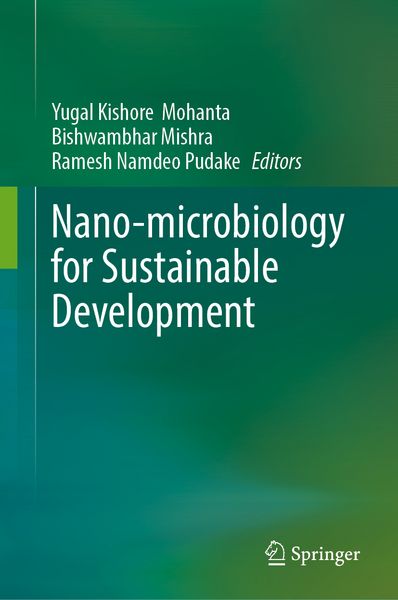
• Produktbild: Nano-microbiology for Sustainable Development
  • Produktbild: Nano-microbiology for Sustainable Development

Nano-microbiology for Sustainable Development

Fr. 219.00

inkl. gesetzl. MwSt., Versandkostenfrei


Beschreibung

Produktdetails

Einband

Gebundene Ausgabe

Erscheinungsdatum

26.02.2025

Abbildungen

XVII, 67 illus., 65 illus. in color., schwarz-weiss Illustrationen, farbige Illustrationen

Herausgeber

Yugal Kishore Mohanta + weitere

Verlag

Springer

Seitenzahl

430

Maße (L/B/H)

24.1/16/3 cm

Gewicht

838 g

Sprache

Englisch

ISBN

978-3-031-78844-4

Beschreibung

Portrait

Dr. Yugal Kishore Mohanta has more than 5 years of post-PhD teaching and research experience and currently holds the position of Assistant Professor at the Department of Applied Biology within the School of Biological Sciences at the University of Science and Technology, Meghalaya (USTM), India. Dr. Mohanta’s current area of research pertains to nano-biotechnology and sustainable development goals. Dr. Mohanta has international research experience as both a PhD visiting scholar and a postdoctoral fellow at KU Leuven, Belgium and the University of Nizwa, Sultanate of Oman, respectively. Dr. Mohanta has authored 100 research publications in peer-reviewed journals which are indexed in the SCIE. These papers have high impact factors and have garnered a total of 3000 citations having an h-index of 2 and an i10 index of 61. Additionally, he has served as a reviewer for over 30 international peer-reviewed journals from Springer, Elsevier, Wiley, Frontiers, and MDPI and holds the position of associate editor for four SCIE-indexed journals. Additionally, Dr. Mohanta has made contributions to 16 book chapters, edited books for CRC Press and Elsevier-Academic Press, and authored numerous articles on scientific topics for national science publications. Dr. Mohanta currently holds the position of group leader at the Nano-biotechnology and Translational Knowledge Laboratory and serves as the principal investigator for the SERB-DST project, a start-up research grant funded by the Government of India in New Delhi. Dr. Mohanta is also working as the Chief Coordinator of the Microbiologist Society in India for the North-East States of India.

Dr. Bishwambhar Mishra brings over a decade of post-PhD experience in teaching and research and is currently an Assistant Professor in the Department of Biotechnology at Chaitanya Bharathi Institute of Technology in Hyderabad, India. His primary research areas include industrial microbiology and nanobiotechnology, with a focus on their applications. His work is aimed at harnessing the potential of microorganisms and nanotechnology to address pressing global challenges such as environmental sustainability, food security, and resource management. Dr. Mishra has made significant contributions to the scientific community, authoring 60 research publications in high-impact, SCIE-indexed journals, with his work garnering 1,047 citations, an h-index of 18, and an i10-index of 33. These publications reflect the high caliber of his research, spanning various interdisciplinary domains. In addition to his extensive publication record, he has authored 20 book chapters that further advance knowledge in the field. Dr. Mishra has served as a reviewer for over 27 prestigious international journals, including those published by renowned publishers such as Springer, Elsevier, Wiley, Frontiers, and MDPI. His expertise is further recognized through his role as Topical Editor and Editorial board member of SCIE-indexed journals, where he plays a critical role in shaping scientific discourse and guiding future research.

Dr. Ramesh Namdeo Pudake is an Assistant Professor in Amity University, Uttar Pradesh, one of the top ranked private universities in India. Dr. Pudake is a PhD from China Agricultural University, Beijing, PRC. After his PhD, he engaged in research in a range of topics in biotechnology. He has also worked in the Department of Agronomy at Iowa State University Ames, IA, USA on functional genomics. Currently, he is focusing on the research on different applications of nanotechnology in agriculture. Dr Pudake has published more than 45 research publications, 8 books, and 25 book chapters. He also has one scholarship award from the Chinese Government for pursuing his doctoral studies. He is an expert reviewer and guest editor for several journals of repute.

Produktdetails

Einband

Gebundene Ausgabe

Erscheinungsdatum

26.02.2025

Abbildungen

XVII, 67 illus., 65 illus. in color., schwarz-weiss Illustrationen, farbige Illustrationen

Herausgeber

Verlag

Springer

Seitenzahl

430

Maße (L/B/H)

24.1/16/3 cm

Gewicht

838 g

Sprache

Englisch

ISBN

978-3-031-78844-4

Herstelleradresse

Springer-Verlag GmbH
Tiergartenstr. 17
69121 Heidelberg
DE

Email: GPSR Kontakt

Kundinnen und Kunden meinen

0 Bewertungen

Informationen zu Bewertungen

Zur Abgabe einer Bewertung ist eine Anmeldung im Konto notwendig. Die Authentizität der Bewertungen wird von uns nicht überprüft. Wir behalten uns vor, Bewertungstexte, die unseren Richtlinien widersprechen, entsprechend zu kürzen oder zu löschen.

Die Bewertungen sind nach Format, Anzahl Sterne und Datum sortiert.

Verfassen Sie die erste Bewertung zu diesem Artikel

Helfen Sie anderen Kund*innen durch Ihre Meinung

Kundinnen und Kunden meinen

0 Bewertungen filtern

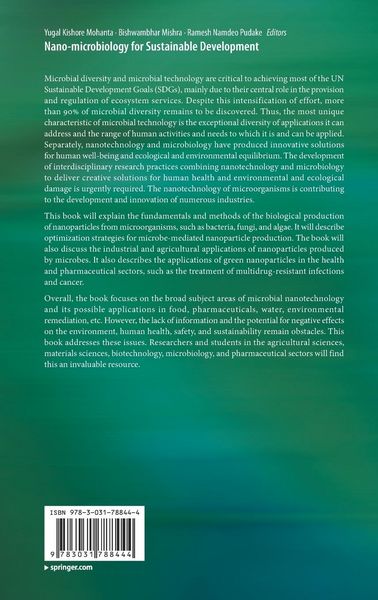
  • Produktbild: Nano-microbiology for Sustainable Development
  • Produktbild: Nano-microbiology for Sustainable Development
  • Chapter 1. Contribution of Microbial Nanotechnology to Sustainable Development Goals.- Chapter 2. Microbial nanotechnology: a potentially useful tool for environmental sustainability.- Chapter 3. Algal-mediated nanoparticle synthesis for environmental sustainability.- Chapter 4. Sustainable Production of Nanoparticles from Fungi and Their Agricultural Applications.- Chapter 5. Biorefining Agro-Industrial Waste into Green Nanomaterials for Sustainable Agriculture.- Chapter 6. Nanobiotechnology for sustainable food preservations and shelf-life enhancement.- Chapter 7. Eco-friendly production of antimicrobial nanoparticles for sustainability.- Chapter 8. Nano-Biosensors for Detecting Microbial Pathogens in Agriculture.- Chapter 9. Revolutions in Biotic Stress Management and Sustainable Agriculture through microbial-mediated Nanoformulation.- Chapter 10. From Lab to Landfill: Exploring Nanobiotechnological Approaches for E-Waste Remediation and Environmental Sustainability.- Chapter 11. Impact of microbial nanobiotechnology on the economy of developing countries.- Chapter 12. Nanotechnology and Microbes: Revolutionizing Water Management.- Chapter 13. Bioengineered Nano-sorbents: Microbial Allies in Pollutant Sequestration.- Chapter 14. Bioremediation of various industrial effluents utilizing microorganism-assisted nanotechnology within a circular economy.- Chapter 15. Microorganism-assisted bionanotechnology for textile dye wastewater treatment.