Rezension
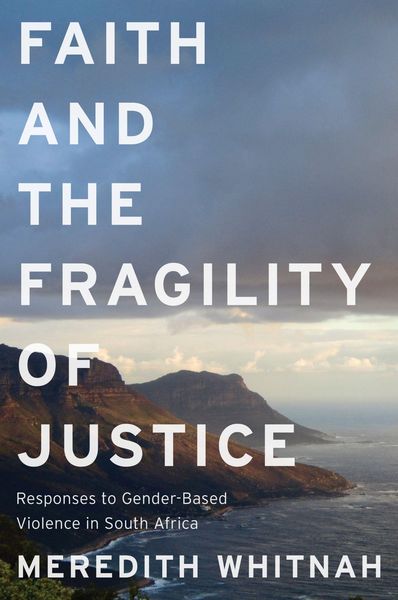
"Whitnah offers a candid look at the role of faith-based organizations in the struggle to eradicate gender-based violence in the South African context. As evident in the title, this pursuit of justice is fragile indeed. However, Whitnah's monograph shows how these organizations continue reinventing themselves in the pursuit of gender justice. As the battle cry resounds: a luta continua!" - Juliana Claassens (professor of Old Testament at Stellenbosch University, South Africa) "Theologies are not equal in their capacity to address injustice. Whitnah's sharply analytical book reveals how theological frameworks that focus on racial justice vary in their convictions on issues of gender and helps us to better discern religion's role in both challenging and reinforcing intersecting systems of oppression, illuminating the contingent and often fragile nature of faith-based pursuits of justice." - Gerardo Martí (William R. Kenan, Jr. Endowed Professor of Sociology at Davidson College) "While there has been extensive scholarship examining how religious groups opposed apartheid, no scholar has attempted to trace how religious organizations addressed gender inequality and gender-based violence throughout apartheid and into the new democratic dispensation. With clear and engaging prose, Whitnah showcases her precise analytical skills as well as her commitment to amplifying the voices and work of South Africa religious leaders and activists." - Hannah Britton (author of Ending Gender-Based Violence: Justice and Community in South Africa) "A beautifully crafted, breathtakingly lucid, and profoundly artistic work. Whitnah does not just explore gender-based violence in South Africa-she dismantles it, refusing to carry forward the language of violence in her writing. Through each sentence, she exposes gender-based violence not merely as an atrocity against women but as a fundamental violation of humanity itself. This book is not just a must-read; it demands to be devoured, contemplated, and absorbed into the very fiber of your understanding." - Chammah J. Kaunda (associate professor and academic dean at Oxford Centre for Mission Studies, UK) "Whitnah takes us into three different South African religious groups, all of which opposed apartheid, showing us how their theological cultures, their social positioning, and the contingencies of history shape very different responses to rampant gender-based violence. Deeply researched and engagingly written, this book asks important questions about how religions pursue justice in the world." - Nancy T. Ammerman (professor emerita of sociology of religion at Boston University) "In a context where racial and gender-based violence are a tragically all-too-common part of life, why might some religious institutions resist one form of violence, but not the other? Whitnah finds the answer in the interplay between theological cultures and social conditions. Drawing on rich qualitative data and written with compassion and nuance, Whitnah has given us an invaluable set of conceptual tools for understanding the varied responses of religious institutions to injustice." - Samuel L. Perry (professor of sociology at the University of Oklahoma) "Why did religious organizations in South Africa that opposed racial apartheid have differing responses to gender-based violence? Whitnah insightfully answers this question through impressive in-depth research. She takes us on an important journey into the pathways of religious belief and practice that help or hinder gender justice. A truly significant work that should be read widely." - Michael O. Emerson (Harry and Hazel Chavanne Fellow in Religion and Public Policy at the Baker Institute for Public Poli)