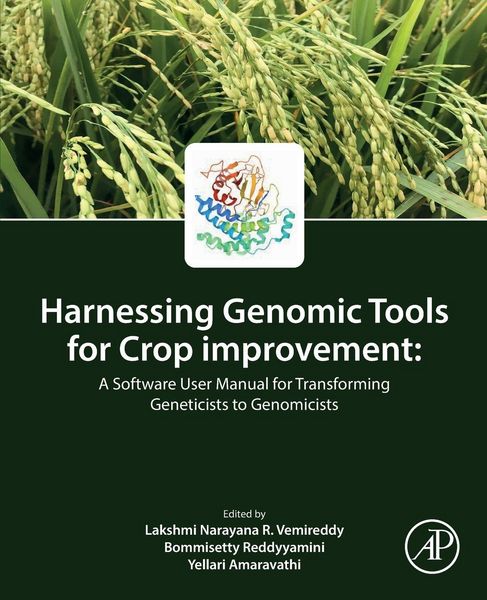
Produktbild: Harnessing Genomic Tools for Crop Improvement

Harnessing Genomic Tools for Crop Improvement A Software User Manual for Transforming Geneticists to Genomicists

Fr. 233.00

inkl. gesetzl. MwSt., Versandkostenfrei


Beschreibung

Produktdetails

Einband

Taschenbuch

Erscheinungsdatum

27.11.2025

Herausgeber

Lakshmi Narayana R. Vemireddy + weitere

Verlag

Elsevier Science & Technology

Seitenzahl

468

Maße (L/B/H)

23.4/19.3/2.5 cm

Gewicht

990 g

Sprache

Englisch

ISBN

978-0-443-29281-1

Beschreibung

Portrait

Dr. Lakshmi Narayana R. Vemireddy is a leading molecular geneticist and professor at Acharya N.G. Ranga Agricultural University (ANGRAU), India, with over 15 years of experience in teaching and research. He specializes in genomic tools such as QTL mapping, molecular breeding, genome-wide association studies (GWAS), QTL-seq and transcriptomics techniques like RNA-Seq. His key contributions include the discovery of novel QTLs for drought tolerance, grain quality, and yield, the development of DNA fingerprinting for Basmati rice authentication, and the creation of cultivar-specific QR codes for rice, sesame and little millet. He has also identified alternate dwarfing gene and employs marker-assisted breeding to enhance popular rice varieties in India. With numerous publications in high-impact journals, he has been instrumental in advancing genomic tools for crop improvement. As a dedicated mentor, he has supervised numerous Master’s and Ph.D. students, shaping the next generation of geneticists.

Dr. Bommisetty Reddyyamini earned her postgraduate degree from Agricultural College, Mahanandi, and her Doctoral degree from S.V. Agricultural College, Tirupati, ANGRAU, India. She has extensive teaching and research experience in advanced plant breeding methods, specializing in genomics-assisted breeding. Her research led to the identification of novel QTLs for grain number and grain weight in rice using QTL-Seq. She has published several research articles in reputed peer-reviewed journals. In recognition of her contributions, she received the “Outstanding Ph.D. Thesis Award” at the Second International Conference on Advancement of Science and Technology for Environment, Society, and People (ICASTESP-2023).

Dr. Yellari Amaravathi has extensive research experience in molecular breeding, tissue culture, genetic engineering, and genomics. She earned her M.Sc. (Ag) in Plant Genetic Resources from the National Bureau of Plant Genetic Resources (NBPGR), IARI, New Delhi, and completed her doctoral studies at the National Institute of Plant Biotechnology, IARI, New Delhi. She began her career as a Scientist at the Defence Agricultural Research Laboratory (DARL), Ministry of Defence, where she worked on genetic engineering for cold tolerance in vegetable crops such as tomatoes, bell peppers, cucumbers, and radishes. In 2013, she joined ANGRAU engaging in both teaching and research. Her research focuses on understanding molecular mechanisms in plant-pathogen interactions, identifying genes for durable resistance, and leveraging advanced technologies such as CRISPR/Cas9 for crop improvement.

Produktdetails

Einband

Taschenbuch

Erscheinungsdatum

27.11.2025

Herausgeber

Verlag

Elsevier Science & Technology

Seitenzahl

468

Maße (L/B/H)

23.4/19.3/2.5 cm

Gewicht

990 g

Sprache

Englisch

ISBN

978-0-443-29281-1

EU-Ansprechpartner

Zeitfracht Medien GmbH
Ferdinand-Jühlke-Straße 7
99095 Erfurt
DE
produktsicherheit@zeitfracht.de

Herstelleradresse

Elsevier Science & Technology
London Wall 125
EC2Y 5AS London
GB
tradeorders@elsevier.com

Noch keine Bewertungen vorhanden

Verfassen Sie die erste Bewertung zu diesem Artikel

Helfen Sie anderen Kundinnen und Kunden durch Ihre Meinung.

Kundinnen und Kunden meinen

Bewertungen (0)

Die Leseprobe wird geladen.
  • Produktbild: Harnessing Genomic Tools for Crop Improvement
  • 1. Basic bioinformatics software: Sequence retrieval and sequence submission
    2. SSR and SNP identification and marker development
    3. NGS analysis: Variant calling and genome assembly
    4. Genetic diversity and population structure analysis-DARwin, MEGA, and STRUCTURE
    5. QTL Mapping-QTL IciMapping, Windows QTL Cartographer and Mapchart
    6. Genome-wide association mapping tools: TASSEL and GAPIT
    7. Statistical models for genomic selection: Practical implementation using R
    8. Haplotype analysis software: HAPLOTYPE ANALYSIS, DnaSP, Haploview, and PopART
    9. Analysis of transcription factor (TF)-target gene regulatory networks
    10. Transcriptome analysis: RT-PCR and RNA-seq analysis
    11. MiRNA structure and target prediction tools
    12. Designing of guide RNA for CRISPR gene editing: A web based foundational approach
    13. Protein interaction network analysis: STRING and CYTOSCAPE
    14. Navigating in silico drug discovery: A hands-on guide with autodock vina and discovery studio
    15. Machine learning techniques for gene prediction