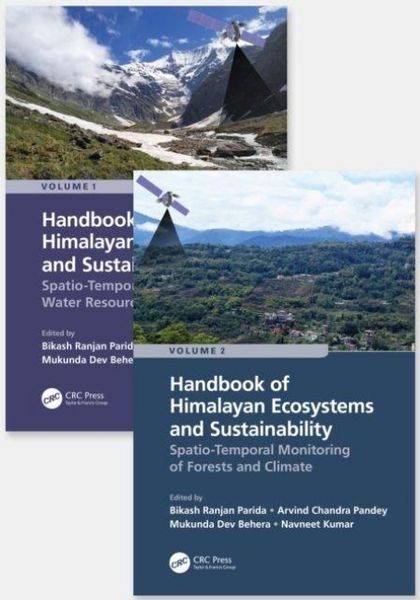
Produktbild: Handbook of Himalayan Ecosystems and Sustainability, Two Vol

Handbook of Himalayan Ecosystems and Sustainability, Two Vol

Fr. 112.00

inkl. gesetzl. MwSt., Versandkostenfrei


Beschreibung

Produktdetails

Einband

Taschenbuch

Erscheinungsdatum

16.04.2025

Herausgeber

Arvind Chandra Pandey + weitere

Verlag

Taylor & Francis

Seitenzahl

784

Maße (L/B)

23.4/15.6 cm

Gewicht

1450 g

Sprache

Englisch

ISBN

978-1-03-222034-5

Beschreibung

Produktdetails

Einband

Taschenbuch

Erscheinungsdatum

16.04.2025

Herausgeber

Verlag

Taylor & Francis

Seitenzahl

784

Maße (L/B)

23.4/15.6 cm

Gewicht

1450 g

Sprache

Englisch

ISBN

978-1-03-222034-5

Kundinnen und Kunden meinen

0 Bewertungen

Informationen zu Bewertungen

Zur Abgabe einer Bewertung ist eine Anmeldung im Konto notwendig. Die Authentizität der Bewertungen wird von uns nicht überprüft. Wir behalten uns vor, Bewertungstexte, die unseren Richtlinien widersprechen, entsprechend zu kürzen oder zu löschen.

Die Bewertungen sind nach Format, Anzahl Sterne und Datum sortiert.

Verfassen Sie die erste Bewertung zu diesem Artikel

Helfen Sie anderen Kund*innen durch Ihre Meinung

Kundinnen und Kunden meinen

0 Bewertungen filtern

  • Produktbild: Handbook of Himalayan Ecosystems and Sustainability, Two Vol
  • Introduction. Land Use and Land Cover Dynamics in Himalaya 2001 - 2020. Shifting Cultivation Dynamics in Northeastern India. Lesser Known Unique Ecosystems of Indian Himalayas. Spaceborne Bistatic Polarimetric Interferometric SAR Modelling for Vegetation Height Estimation. Estimating Aboveground Biomass of Sal and Teak Forests Using Terrasar-X and Semi-Empirical Model. Vegetation Biophysical Parameters and GPP Estimation Using Satellite-Driven LUE Model Urban Ecosystem and Air Pollution. Driving Factors of Changing Rainfall Pattern in Meghalaya. Assessment of the Effects of Land Use Land Cover Changes on Surface Temperature Trends. Effect of Lockdown on Aerosol Optical Depth and NO2 Over Major Cities of Indian Himalayan Region. Study on Spatial Distribution, Temporal Variation and Growth Trends of Particulate Matter, Sulfur Dioxide, Nitrogen Oxides and Ammonia from Anthropogenic Sources Over India. Prediction of Response to Change in Land Use Land Cover Patterns on the Hydrology of Himalayan River. Management Issues of Wetlands in Himalayan Foothills. Impact of Structural Barriers on The Morphology and Ecology of The Himalayan Rivers. Use of Satellite Remote Sensing for Water Resources Management in Data- Scarce Watersheds. Monitoring Spatio-Temporal Glacier Dynamics and Snow Cover Variability. Glacier Velocity Estimation Over Select Large Glaciers in Himalaya. Rate of Expansion of Glacial Lake in Sikkim Himalayas. Appraisal of Forest Fire Risk Through Geospatial Techniques in Uttarakhand Himalayan Region. Disentangle the Short and Long-Term Forest Degradation Over Most Fire Affects Parts of Western Himalaya. Identification of Flood Hotspot Zone Using GIS-Based Spatial Statistical Technique. Ecosystem-Human- Climate Interaction and Sustainability. Climate Forcing on Photosynthetic Variability Across Relief Zones in Himalayas. Vegetation Trend Analysis and Seasonal Changes Quantification Based on Time-Series Satellite Images for North-East India. Floristic Shifting of Endemic Species in Eastern Himalayas Due to Climate Change. Landscape Restoration in the Indian Himalayan Region.