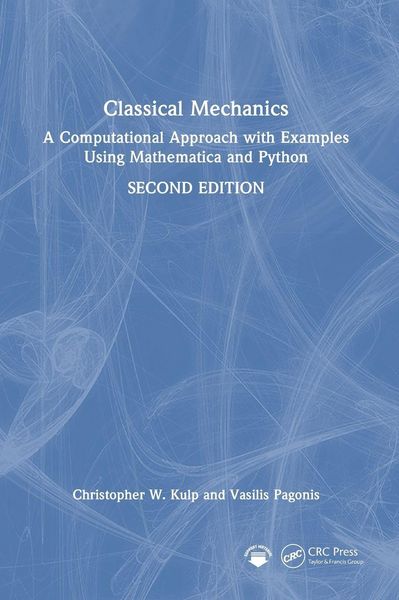
Classical Mechanics A Computational Approach with Examples Using Mathematica and Python
-
- Hardcover ausgewählt
- Taschenbuch
- eBook
-
Sprache:Englisch
-
Verlag:Taylor & Francis
- Taylor & Francis Fr. 319.00 ausgewählt
- CRC Press Fr. 322.00
Fr. 319.00
inkl. gesetzl. MwSt.,
Beschreibung
Produktdetails
Einband
Gebundene Ausgabe
Erscheinungsdatum
22.08.2025
Abbildungen
schwarz-weiss Illustrationen, farbige Illustrationen, Raster, farbig, Zeichnungen, schwarz-weiss, Zeichnungen, farbig, Tabellen, schwarz-weiss
Verlag
Taylor & FrancisSeitenzahl
608
Maße (L/B/H)
26/18.3/3.7 cm
Gewicht
1320 g
Auflage
2. Auflage
Sprache
Englisch
ISBN
978-1-03-259475-0
Classical Mechanics: A Computational Approach with Examples using Python and Mathematica provides a unique, contemporary introduction to classical mechanics, with a focus on computational methods. In addition to providing clear and thorough coverage of key topics, this textbook includes integrated instructions and treatments of computation.
This newly updated and revised second edition includes two new appendices instructing the reader in both the Python and Mathematica languages. All worked example problems in the second edition contain both Python and Mathematica code. New end-of-chapter problems explore the application of computational methods to classical mechanics problems.
Full of pedagogy, it contains both analytical and computational example problems within the body of each chapter. The example problems teach readers both analytical methods and how to use computer algebra systems and computer programming to solve problems in classical mechanics. End-of-chapter problems allow students to hone their skills in problem solving with and without the use of a computer. The methods presented in this book can then be used by students when solving problems in other fields both within and outside of physics.
It is an ideal textbook for undergraduate students in physics, mathematics, and engineering studying classical mechanics.
Key Features:
- Gives readers the "big picture" of classical mechanics and the importance of computation in the solution of problems in physics
- Numerous example problems using both analytical and computational methods, as well as explanations as to how and why specific techniques were used
- Online resources containing specific example codes to help students learn computational methods and write their own algorithms
A solutions manual is available via the Routledge Instructor Hub and all example codes in the book are available via the Support Material tab, and at the book's GitHub page: https://github.com/vpagonis/Classical_Mechanics_2nd_Edition
Noch keine Bewertungen vorhanden
Verfassen Sie die erste Bewertung zu diesem Artikel
Helfen Sie anderen Kundinnen und Kunden durch Ihre Meinung.