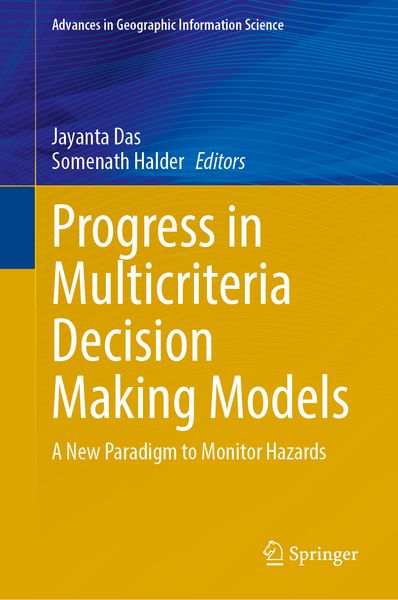
Produktbild: Progress in Multicriteria Decision Making Models

Progress in Multicriteria Decision Making Models A New Paradigm to Monitor Hazards

Fr. 219.00

inkl. gesetzl. MwSt., Versandkostenfrei


Beschreibung

Produktdetails

Einband

Gebundene Ausgabe

Erscheinungsdatum

15.06.2025

Abbildungen

XLII, 151 illus., 147 illus. in color., farbige Illustrationen, schwarz-weiss Illustrationen

Herausgeber

Jayanta Das + weitere

Verlag

Springer

Seitenzahl

524

Maße (L/B/H)

24.1/16/3.4 cm

Gewicht

1056 g

Sprache

Englisch

ISBN

978-3-031-89245-5

Beschreibung

Portrait

Dr. Jayanta Das is an Assistant Professor at the Department of Geography in Rampurhat College, University of Burdwan, West Bengal, India. He has completed his Post Graduate and PhD degrees from the Department of Geography and Applied Geography, University of North Bengal, India. Dr. Das’s broad area of PhD thesis is covering the broader theme of applied geography and GIScience. His research interest includes geomorphology, hydro-geomorphology, mountain geomorphology, coastal geomorphology, groundwater, flood, drought analysis, climate change, watershed management, hydrological modeling, water quality, geospatial data analysis, data mining, and GIS applications with more than 17 academic years of experience. Dr. Jayanta Das has published more than 70 scholarly articles in peer-reviewed journals, focusing mainly on: climate change, agricultural suitability analysis, natural and man-made hazards analysis, risk management, and spatial data analysis. Recently, Dr. Das has published an edited book entitled Monitoring and Managing Multi-hazards: A Multidisciplinary Approach jointly with Dr. Sudip Kumar Bhattacharya from Springer Nature, and Advancement of GI-Science and Sustainable Agriculture: A Multi-Dimensional Approach and New Advancements in Geomorphological Research: Issues & Challenges in Quantitative Spatial Science with Dr. Somenath Halder from Springer. Dr. Das has led special issues in journals like Environmental Science and Pollution Research and contributed to multiple volumes with Springer.

Dr. Somenath Halder is an Assistant Professor at the Department of Geography in Kaliachak College, University of Gour Banga, West Bengal, India. He has completed his PG from Department of Geography and Applied Geography, University of North Bengal, India, and PhD from Department of Geography, Visva-Bharati, India. Dr. Halder’s field of interest includes multi-dimensional data modeling connecting to socio-political agenda, conflicting issues with laws and ecology, community practices, crisis management, spatio-temporal analysis, environmental management, policy science, climate change, watershed management, hydrological modeling, geospatial data analysis, and GIS applications with more than 15 academic years of experience. Dr. Halder has published more than 48 research articles in peer-reviewed reputed journals. Meanwhile, he performs his academic endeavor as peer-reviewer in number of Scopus and Web of Science indexed prestigious journals like, Modeling Earth System and Environment, Journal of Environment, Development and Sustainability, Internal Journal of Geoheritage and Parks, GeoJournal, South Asian Survey, Research in Globalization, Current Psychology, Sage Open, and may more. Recently Dr. Halder published an edited book entitled Advancement of GI-Science and Sustainable Agriculture: A Multi-Dimensional Approach and New Advancements in Geomorphological Research: Issues & Challenges in Quantitative Spatial Science jointly with Dr. Jayanta Das from Springer.

Produktdetails

Einband

Gebundene Ausgabe

Erscheinungsdatum

15.06.2025

Abbildungen

XLII, 151 illus., 147 illus. in color., farbige Illustrationen, schwarz-weiss Illustrationen

Herausgeber

Verlag

Springer

Seitenzahl

524

Maße (L/B/H)

24.1/16/3.4 cm

Gewicht

1056 g

Sprache

Englisch

ISBN

978-3-031-89245-5

Herstelleradresse

Springer-Verlag GmbH
Tiergartenstr. 17
69121 Heidelberg
DE

Email: ProductSafety@springernature.com

Kundinnen und Kunden meinen

0 Bewertungen

Informationen zu Bewertungen

Zur Abgabe einer Bewertung ist eine Anmeldung im Konto notwendig. Die Authentizität der Bewertungen wird von uns nicht überprüft. Wir behalten uns vor, Bewertungstexte, die unseren Richtlinien widersprechen, entsprechend zu kürzen oder zu löschen.

Die Bewertungen sind nach Format, Anzahl Sterne und Datum sortiert.

Verfassen Sie die erste Bewertung zu diesem Artikel

Helfen Sie anderen Kund*innen durch Ihre Meinung

Kundinnen und Kunden meinen

0 Bewertungen filtern

  • Produktbild: Progress in Multicriteria Decision Making Models
  • Part 1: Observatory Persuasion.- Chapter 1: Introduction to Multicriteria Decision Making in Hazard Monitoring.- Chapter 2: Overview of The Holistic Approach and Book Structure.- Part 2: Multicriteria Decision Making Models.- Chapter 3: Multi-Criteria Decision-Making Framework For Identifying Multi-Hazard Risk Hotspots In Coastal Plains of South India.- Chapter 4: Flood Susceptibility Mapping In The Kaljani River Basin: Insights From AHP-PROMETHEE II and AHP Methods.- Chapter 5: Assessment of Landslide Susceptibility Along NH27 and NH627 In Assam, India Using GIS Based Multi Criteria Decision Making and Analytical Hierarchy Process.- Chapter 6: Assessment of Groundwater Potential Zone After Rohingya Rehabilitation Using GIS and Analytic Hierarchy Process (AHP) Techniques In Ukhia Sub-District, Cox’s Bazar.- Chapter 7: GIS-Integrated Landslide Susceptibility Mapping In Teesta River Basin of Darjeeling-Sikkim Himalaya: A Comparative Analysis of Frequency Ratio, Logistic Regression Models, and Analytical Hierarchy Process.- Chapter 8: Spatial Assessment of Urban Resilience In The City District of Lahore Using GIS and Multicriteria Decision-Making Tools.- Chapter 9: Integrated Geomorphological and Hydrological Analysis for Flood Hazard Assessment in the Ngawun River Basin, Ayeyarwady Region, Myanmar.- Chapter 10: Flash Flood Susceptibility and Inundation Mapping Using Shannon's Entropy, Statistical Index, and HEC-RAS.- Part 3: Integrated Multicriteria Decision Making Models.- Chapter 11: An Application of MARCOS, CoCoSo, and GRA MCDM Models In A Hybrid Approach For Landslide Susceptibility Assessment In Wayanad District, Kerala (India).- Chapter 12: Utilizing Multicriteria Decision-Making Techniques For Computing Composite Vulnerability Over A Severely Flood-Prone Multi-Hazard Catchment.- Chapter 13: Flood Susceptibility Modelling of Tripura, India: An Application of Preference Selection Index (PSI) and Geospatial Technology.- Chapter 14: Socio-economic-cum-Physical Vulnerabilities To Riverine Floods Over Large Watersheds: A Comprehensive Framework By Leveraging Shannon Entropy and TOPSIS.- Chapter 15: Enhanced Landslide Susceptibility Assessment along Transport Infrastructures Through Hybrid Ensembled Learning Techniques.- Chapter 16: Advanced Optimization Techniques for Parameter Calibration In The DRASTIC Model: A Multi-Criteria Decision Analysis Approach To Groundwater Vulnerability Assessment.- Chapter 17: A Hybrid Novel Ensemble of Prediction Indices For GIS-Based Flood Susceptibility Zonation.- Chapter 18: GIS-Based Multi-Hazard Risk Analysis and Disaster Risk Reduction Planning Using Coupled Multi-Hazard Assessment Method.- Chapter 19: Hybrid Ensemble Approaches To Landslide Susceptibility Mapping: Fusing Advanced Multi-Criteria-Decision-Making With Machine Learning In Darjeeling Himalayas.- Part 4: Conclusion.- Chapter 20: Shifting Paradigms: The Rise of Multi-Criteria-Decision-Making Models Over Bivariate Statistical Approaches In Hazard Risk Assessment.- Chapter 21: Advancements In Multi-Criteria Decision-Making Models: A New Paradigm for Monitoring Flood Risks In Algeria.-Chapter 22: Usage and Future Path of MCDM For Hazard Monitoring and Risk Assessment.