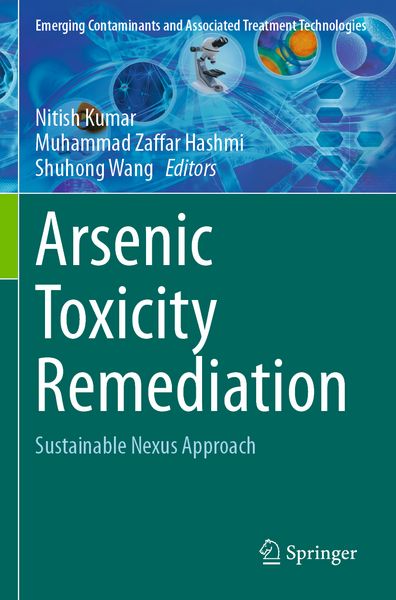
Arsenic Toxicity Remediation Sustainable Nexus Approach
-
- Hardcover
- Taschenbuch ausgewählt
- eBook
-
Sprache:Englisch
Fr. 191.00
inkl. gesetzl. MwSt.,
Beschreibung
Produktdetails
Einband
Taschenbuch
Erscheinungsdatum
13.03.2025
Herausgeber
Nitish Kumar + weitereVerlag
SpringerSeitenzahl
294
Maße (L/B/H)
23.5/15.5/1.7 cm
Gewicht
464 g
Sprache
Englisch
ISBN
978-3-031-52616-9
Arsenic contamination in drinking water and crops is a major health issue in many countries worldwide, threatening the health of millions of people due to arsenic’s toxicity and carcinogenicity. This edited volume brings together a diverse group of environmental science, sustainability and health researchers to address the challenges posed by arsenic contamination. The book sheds light on this global environmental issue and proposes solutions to aquatic contamination through multi-disciplinary sustainable approaches and case studies from different parts of the world. The chapters contained here present the status quo in different parts of the world and provide essential information on arsenic exposure risks for humans as well as possible measures for tackling arsenic poisoning. The mechanisms of arsenic uptake, translocation and distribution in plants and grains are also explained. In closing, the book reviews a variety of prospective sustainable solutions to the problem of arsenic accumulation in soil and water.
The book is comprised of three sections. The first section describes the routes of exposure to environmental arsenic and its transport in soil and aquatic ecosystems. The second section explains the health risks linked to arsenic exposure in food and the environment. The third section addresses sustainable arsenic contamination mitigation strategies using the potential applications of recent biological technology such as biotechnology, bioremediation, phytoremediation, biochar, absorbent, genetic engineering, and nanotechnology approaches. The book is intended for a broad audience including researchers, scientists, and readers with diverse backgrounds.
The book is comprised of three sections. The first section describes the routes of exposure to environmental arsenic and its transport in soil and aquatic ecosystems. The second section explains the health risks linked to arsenic exposure in food and the environment. The third section addresses sustainable arsenic contamination mitigation strategies using the potential applications of recent biological technology such as biotechnology, bioremediation, phytoremediation, biochar, absorbent, genetic engineering, and nanotechnology approaches. The book is intended for a broad audience including researchers, scientists, and readers with diverse backgrounds.
Kundinnen und Kunden meinen
Verfassen Sie die erste Bewertung zu diesem Artikel
Helfen Sie anderen Kund*innen durch Ihre Meinung