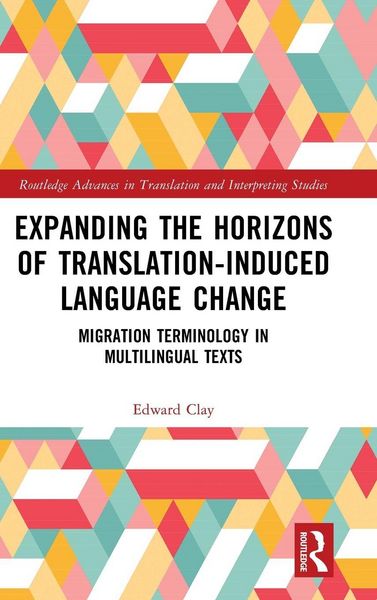
Produktbild: Expanding the Horizons of Translation-Induced Language Change

Expanding the Horizons of Translation-Induced Language Change Migration Terminology in Multilingual Texts

Fr. 253.00

inkl. gesetzl. MwSt., Versandkostenfrei


Beschreibung

Produktdetails

Einband

Gebundene Ausgabe

Erscheinungsdatum

14.11.2025

Abbildungen

schwarz-weiss Illustrationen, Zeichnungen, schwarz-weiss, Tabellen, schwarz-weiss

Verlag

Taylor & Francis

Seitenzahl

142

Maße (L/B/H)

23.5/15.7/1.3 cm

Gewicht

440 g

Sprache

Englisch

ISBN

978-1-03-291124-3

Beschreibung

Produktdetails

Einband

Gebundene Ausgabe

Erscheinungsdatum

14.11.2025

Abbildungen

schwarz-weiss Illustrationen, Zeichnungen, schwarz-weiss, Tabellen, schwarz-weiss

Verlag

Taylor & Francis

Seitenzahl

142

Maße (L/B/H)

23.5/15.7/1.3 cm

Gewicht

440 g

Sprache

Englisch

ISBN

978-1-03-291124-3

Herstelleradresse

Libri GmbH
Europaallee 1
36244 Bad Hersfeld
DE

Email: gpsr@libri.de

Kundinnen und Kunden meinen

0 Bewertungen

Informationen zu Bewertungen

Zur Abgabe einer Bewertung ist eine Anmeldung im Konto notwendig. Die Authentizität der Bewertungen wird von uns nicht überprüft. Wir behalten uns vor, Bewertungstexte, die unseren Richtlinien widersprechen, entsprechend zu kürzen oder zu löschen.

Die Bewertungen sind nach Format, Anzahl Sterne und Datum sortiert.

Verfassen Sie die erste Bewertung zu diesem Artikel

Helfen Sie anderen Kund*innen durch Ihre Meinung

Kundinnen und Kunden meinen

0 Bewertungen filtern

  • Produktbild: Expanding the Horizons of Translation-Induced Language Change
  • Part I: Theoretical Considerations Chapter 1. Introduction 1.1 Outline of the book Chapter 2. Terminology and translation-induced language change 2.1 What is terminology? 2.1.1 Concepts and terms 2.1.2 Terminological variation 2.1.3 Interlingual variation in terminology 2.1.4 Determinologisation 2.2 Translation-induced language change 2.2.1 Language change and language contact 2.2.2 Translation as a contact scenario 2.2.3 Case studies: Discursive features 2.2.4 Case studies: Morphosyntax and lexis 2.2.5 Limitations and counterarguments 2.2.6 Possible causes 2.3 Concluding remarks Chapter 3. Multilingual legal text production - a site for translation-induced language change? 3.1 Legal translation 3.2 The EU translation process 3.3 Term formation and translation in the EU 3.4 Translation technology in the EU 3.5 Concluding remarks Chapter 4. The language of migration law and migration in the press 4.1 The language of migration law 4.2 Migration in the press Part II: Empirical Applications Chapter 5. Observing translation-induced language change in EU legal discourse on migration 5.1 Corpus-based approach 5.2 The EUMigrLaw corpus 5.2.1 Defining legal discourse 5.2.2 Creating the EUMigrLaw corpus 5.2.3 The development of EU migration and asylum law 5.3 The EUMigrLaw corpus analysis 5.3.1 Methodology 5.3.2 Quantitative analysis - Intralingual terminological variation 5.3.3 Quantitative analysis - Interlingual terminological variation 5.3.4 Qualitative analysis - General observations 5.3.5 Influence of English terminology 5.3.6 The case of IRREGULAR MIGRANT 5.4 Summary of results 5.5 Discussion Chapter 6. Crossing genre boundaries - Expanding the research scope 6.1 The MigrationInTheNews corpus 6.2 Building the MigrationInTheNews corpus 6.3 Methodology 6.3.1 Three indicators of terminological convergence/divergence 6.4 Quantitative results on terminological convergence/divergence 6.5 Terminological trends 6.5.1 THIRD-COUNTRY NATIONAL 6.5.2 IRREGULAR MIGRANT 6.5.3 UNION CITIZEN 6.5.4 ASYLUM SEEKER and REFUGEE 6.5.5 MIGRANT WORKER 6.6 Discussion 6.6.1 Translation-induced language change and determinologisation 6.6.2 Factors preventing cross-over 6.6.3 A widening terminological gap 6.6.4 The influence of the media on legal discourse Chapter 7. Conclusion