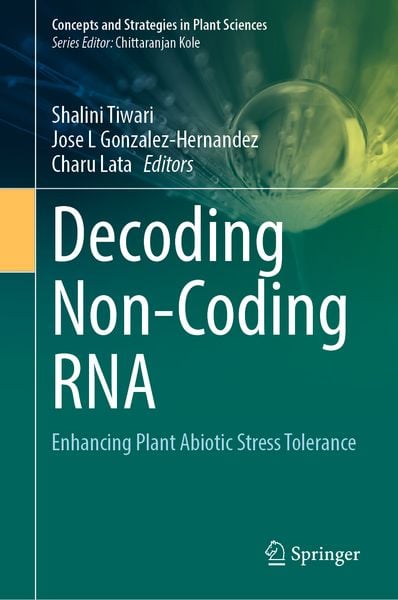
Produktbild: Decoding Non-Coding RNA

Decoding Non-Coding RNA Enhancing Plant Abiotic Stress Tolerance

Fr. 242.00

inkl. gesetzl. MwSt., Versandkostenfrei


Beschreibung

Produktdetails

Einband

Gebundene Ausgabe

Erscheinungsdatum

24.08.2025

Abbildungen

XII, 19 illus., 16 illus. in color., farbige Illustrationen, schwarz-weiss Illustrationen

Herausgeber

Shalini Tiwari + weitere

Verlag

Springer Singapore

Seitenzahl

301

Maße (L/B/H)

24.1/16/2.3 cm

Gewicht

584 g

Auflage

1. Auflage

Sprache

Englisch

ISBN

978-981-9698-58-5

Beschreibung

Portrait

Dr. Shalini Tiwari is a Post-Doctoral Research Associate at the South Dakota State University, USA. Her research interest is in the area of plant stress signaling and plant-microbe interaction. She has worked on how interactions between plants and PGPR (Plant Growth-Promoting Rhizobacteria) can enhance resilience to abiotic stresses. One of her notable achievements lies in elucidating these mechanisms by employing cutting-edge techniques such as transcriptomics and comprehensive profiling of non-coding RNAs, including long non-coding RNAs (lncRNA) and microRNAs (miRNA), particularly under stressful conditions. She actively contributes to the scientific community by advancing her understanding of environmental microbiology, plant biology, stress responses, and symbiotic relationships.

Dr. Jose L. Gonzalez Hernandez is working as a Professor at the South Dakota State University, USA. His research area is in the field of Plant Genetics and Genomics. His research focuses on unraveling the genetic basis of complex plant traits essential for agricultural sustainability and food security. Dr. Jose also utilizes state-of-the-art Next-Generation Sequencing (NGS) technologies to conduct comprehensive analyses of genomic regions associated with traits such as yield, disease resistance, and stress tolerance. His commitment to advancing scientific understanding and practical applications in plant genetics and genomics is crucial for addressing global challenges and fostering innovation in agricultural biotechnology.


Dr. Charu Lata is a Principal Scientist at the CSIR - National Institute of Science Communication and Policy Research, New Delhi. Her research interest has been in the field of crop improvements especially abiotic stress responses and tolerance in crop plants. She is primarily focusing in the research areas pertaining to the elucidation of mechanisms regulating abiotic stress tolerance in legumes and cereal crops through transcriptomics, small RNA profiling, and genome editing. Her research underscores the critical role of genomics and molecular biology in addressing global agricultural challenges and advancing crop improvement strategies.

Produktdetails

Einband

Gebundene Ausgabe

Erscheinungsdatum

24.08.2025

Abbildungen

XII, 19 illus., 16 illus. in color., farbige Illustrationen, schwarz-weiss Illustrationen

Herausgeber

Verlag

Springer Singapore

Seitenzahl

301

Maße (L/B/H)

24.1/16/2.3 cm

Gewicht

584 g

Auflage

1. Auflage

Sprache

Englisch

ISBN

978-981-9698-58-5

Herstelleradresse

Springer-Verlag KG
Sachsenplatz 4-6
1201 Wien
AT

Email: ProductSafety@springernature.com

Kundinnen und Kunden meinen

0 Bewertungen

Informationen zu Bewertungen

Zur Abgabe einer Bewertung ist eine Anmeldung im Konto notwendig. Die Authentizität der Bewertungen wird von uns nicht überprüft. Wir behalten uns vor, Bewertungstexte, die unseren Richtlinien widersprechen, entsprechend zu kürzen oder zu löschen.

Die Bewertungen sind nach Format, Anzahl Sterne und Datum sortiert.

Verfassen Sie die erste Bewertung zu diesem Artikel

Helfen Sie anderen Kund*innen durch Ihre Meinung

Kundinnen und Kunden meinen

0 Bewertungen filtern

  • Produktbild: Decoding Non-Coding RNA
  • 1. Introduction to Non-Coding Regions.- 2. Structural and Functional Diversity of Non-Coding Regions.- 3. Promoter regulatory regions of abiotic stress responses.- 4. Long Non-Coding RNAs (lncRNAs) in Abiotic Stress Adaptation.- 5. Epigenetic Regulation of Abiotic Stress Responses.- 6. Mobile Genetic Elements and Abiotic Stress Tolerance.- 7. Genome-Wide Profiling of Abiotic Stress-Responsive Non-Coding RNAs.- 8. Non-Coding RNA-Mediated Signaling Pathways in Abiotic Stress Tolerance.- 9. Evolutionary Dynamics of Stress-Responsive Non-Coding Regions.- 10. Genomic Resources for Studying Stress-Responsive Non-Coding Regions.- 11. Utilization of non-coding regions for enhancing stress resilience in crop species.- 12. Challenges and Future Directions in Non-Coding Region Research for Stress Tolerance.