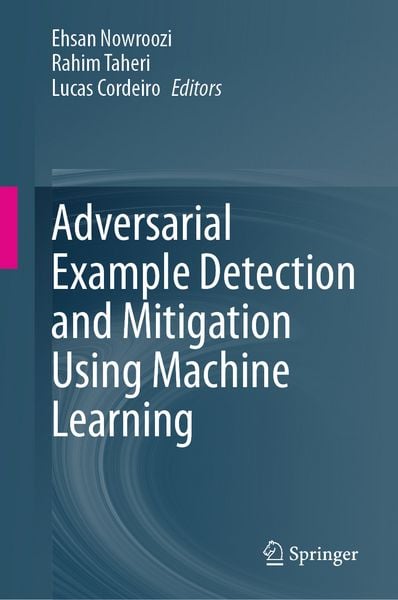
Produktbild: Adversarial Example Detection and Mitigation Using Machine Learning

Adversarial Example Detection and Mitigation Using Machine Learning DE

Fr. 192.00

inkl. gesetzl. MwSt., Versandkostenfrei


Beschreibung

Produktdetails

Einband

Gebundene Ausgabe

Erscheinungsdatum

22.01.2026

Abbildungen

XXI, 1 illus., schwarz-weiss Illustrationen

Herausgeber

Ehsan Nowroozi + weitere

Verlag

Springer

Seitenzahl

304

Maße (L/B/H)

24.1/16/2.4 cm

Gewicht

656 g

Sprache

Englisch

ISBN

978-3-031-99446-3

Beschreibung

Portrait

Dr. Ehsan Nowroozi is a Senior Lecturer in Cybersecurity at the University of Greenwich, UK. He holds a PhD in Information Engineering and Mathematics from the University of Siena, Italy. His research focuses on adversarial machine learning, multimedia and digital forensics, and secure federated learning. He has held academic and research positions at Ravensbourne University London, Queen’s University Belfast, Bahçeşehir University, Sabanci University, and the University of Padua. Dr. Nowroozi has co-authored numerous high-impact publications, contributed to projects like DARPA MediFor and EU’s PREMIER, and holds patents in AI-based network security. He is an Associate Editor for IEEE Transactions on Network and Service Management and actively reviews for top-tier journals. A Senior Member of IEEE and an ACM member, he teaches modules in Digital Forensics, Secure Programming, and AI for Security.

Dr. Rahim Taheri is a Senior Lecturer at the University of Portsmouth with a PhD in Computer Science and over a decade of experience in academia. His research spans secure and privacy-preserving AI, federated learning, adversarial machine learning, and AI sustainability. He has held research roles at King’s College London and the University of Padua, working with labs such as KCLIP and SPRITZ. Dr. Taheri is especially interested in developing defenses against data poisoning and adversarial threats in IoT and distributed systems. He has mentored PhD students, published in top journals and conferences, and is an active member of the IEEE (Senior Member) and ACM. His work is dedicated to exploring ethical, robust AI solutions for security challenges in modern digital infrastructures.

Dr. Lucas C. Cordeiro is a Full Professor at the University of Manchester (UoM), where he leads the Systems and Software Security (S3) Research Group. He also serves as the Business Engagement and Innovation Director and the Arm Centre of Excellence Director at UoM. Prof. Cordeiro is a globally recognized researcher in formal methods, software verification, and secure AI. He has published over 170 peer-reviewed papers and received prestigious awards, including Most Influential Paper at ASE'23 and Distinguished Paper Awards at ICSE and ASE. As the CTO of VeriBee, a UoM spinout, he drives innovation in software testing. His research funding exceeds $13M, sourced from EPSRC, Intel, Samsung, the British Council, and others. He is affiliated with the Trusted Digital Systems Cluster and postgraduate programs at the Federal University of Amazonas, Brazil.

Produktdetails

Einband

Gebundene Ausgabe

Erscheinungsdatum

22.01.2026

Abbildungen

XXI, 1 illus., schwarz-weiss Illustrationen

Herausgeber

Verlag

Springer

Seitenzahl

304

Maße (L/B/H)

24.1/16/2.4 cm

Gewicht

656 g

Sprache

Englisch

ISBN

978-3-031-99446-3

Herstelleradresse

Springer-Verlag KG
Sachsenplatz 4-6
1201 Wien
AT

Email: ProductSafety@springernature.com

Kundinnen und Kunden meinen

0 Bewertungen

Informationen zu Bewertungen

Zur Abgabe einer Bewertung ist eine Anmeldung im Konto notwendig. Die Authentizität der Bewertungen wird von uns nicht überprüft. Wir behalten uns vor, Bewertungstexte, die unseren Richtlinien widersprechen, entsprechend zu kürzen oder zu löschen.

Die Bewertungen sind nach Format, Anzahl Sterne und Datum sortiert.

Verfassen Sie die erste Bewertung zu diesem Artikel

Helfen Sie anderen Kund*innen durch Ihre Meinung

Kundinnen und Kunden meinen

0 Bewertungen filtern

  • Produktbild: Adversarial Example Detection and Mitigation Using Machine Learning
  • Preface.- Part I Foundations of Adversarial Machine Learning.- Chapter 1 A Brief Survey of Emerging Threats to AI Security.- Chapter 2 Ethical Considerations and Regulatory Standards for Adversarial Defense.- Chapter 3 Vulnerability Detection: From Formal Verification to Large Language Models and Hybrid Approaches: A Comprehensive Overview.- Part II Attacks on AI Systems.- Chapter 4 Backdoor Attacks in Text Classification: Threats, Methods, and Emerging Challenges.- Chapter 5 Biometric Template-Based Reconstruction Attack in Machine Learning.- Chapter 6 Security Weaknesses of Code Generated by Generative AI.- Chapter 7 No More Paper Tigers: A Taxonomy of Realistic Adversarial Attacks on Machine Learning based Malware Detection.- Chapter 8 Adversarial Threats to Digital Twin Technology: A Taxonomy of Vulnerabilities and Attack Surfaces.- Chapter 9 Quantum Adversarial Artificial Intelligence in Secure Internet of Things Networks.- Part III Defense Techniques and Robustness Strategies.- Chapter 10 Detecting and Mitigating Adversarial Examples in Neural Networks: An Enhanced PGD Approach.- Chapter 11 The Role of Explainable AI (XAI) in Enhancing the Security of Machine Learning Systems Against Adversarial Attacks.- Chapter 12 Neurodevelopmental-Inspired Training Enhances Adversarial Robustness of a Primary Visual Cortex-Based Model.- Chapter 13 Evaluating and Defending Against Adversarial Attacks on LLM-Generated LSTM Models.- Chapter 14 Statistical Feature-Based Detection of Adversarial Noise and Patch Attacks in Image and Deepfake Analysis.- Chapter 15 Probabilistic Robustness in Deep Learning: A Concise yet Comprehensive Guide.- Part IV Federated Learning under Attack and Defense.- Chapter 16 Enhancing Federated Learning Security: Cluster-Based Strategies to Counter GAN-Poisoned Attacks.- Chapter 17 Defense Strategies in Federated Learning Against Adversarial Attacks.- Chapter 18 Dual Perspectives on GAN-Based Data Poisoning in Federated Learning: VagueGAN Attacks and Data Poisoning Detection.- Part V Applications and Case Studies.- Chapter 19 Cyber Risk Assessment in IT/OT Convergence using Machine Learning.- Chapter 20 Anomaly Detection Techniques in IoT Networks: Review and Comparative Analysis.- Chapter 21 Bridging the Gap from Research to Reality: Methods for Fortifying Mitigation Measures against Adversarial AI.- Index.