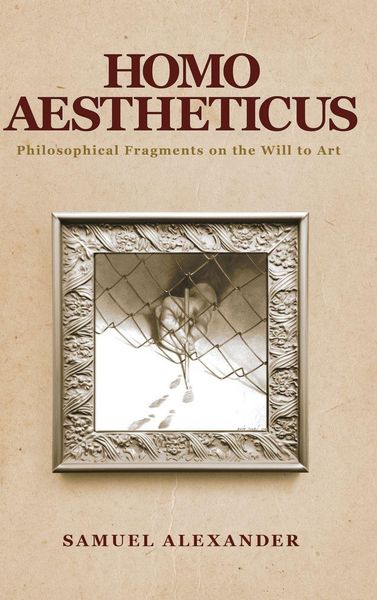
Homo Aestheticus Philosophical Fragments on the Will to Art
-
- Englisch ausgewählt
Fr. 29.90
inkl. gesetzl. MwSt.,
-
Kostenlose Lieferung ab Fr. 30 Einkaufswert
Schweiz & Liechtenstein:
Versandkostenfrei ab Fr. 30.00
Versandkosten bis Fr. 30.00: Fr. 3.50Andere Lieferländer
Fr. 18.00 unabhängig vom Warenwert
Beschreibung
Produktdetails
Einband
Gebundene Ausgabe
Erscheinungsdatum
30.06.2025
Verlag
Simplicity InstituteSeitenzahl
74
Maße (L/B/H)
23.5/15.7/1 cm
Gewicht
323 g
Sprache
Englisch
ISBN
978-1-76414-111-6
This collection of philosophical fragments presents an aesthetics of existence called the 'Will to Art'. Readers are invited to consider the possibility that the universe is fundamentally an aesthetic phenomenon, understood as a process of creative evolution that is moving, albeit agonistically, towards ever-increasing opportunities for artistic expression and aesthetic experience. In Homo Aestheticus, Samuel Alexander offers an understanding of the human condition when situated in such an aesthetic universe. In presenting his case, Alexander acknowledges debts to Arthur Schopenhauer - for his lucid statement of the problem of pessimism - to Friedrich Nietzsche - for formulating the 'aesthetic justification' of existence - to Friedrich Schiller - for revealing how the origin of humanity's self-awareness was born of the experience of beauty - and to William Morris - for collapsing the distinction between artist and artisan, and for beginning to unpack the ecological and socio-political implications of doing so. By synthesising these traditions in novel ways, Alexander presents an original counter-narrative to the disenchanted materialism that defines modernity. Two premises guide the development of this vision: first, that material sufficiency is all that is needed for human beings to live rich, meaningful, and artful lives; and second, that material sufficiency is all that is possible, over the long term, on a finite planet in an age of environmental limits. Based on those premises, Alexander proposes and defends a conception of ecological civilisation which he calls SMPLCTY. This is an anarcho-communitarian society of poet-farmers that sustainably provides all people with opportunities to find meaning and pleasure through creative labour and aesthetic experience. Further detail on the present work can be found in the much larger companion volume, S M P L C T Y: Ecological Civilisation and the Will to Art (2023), from which the ideas herein have been distilled. 'If we are to solve the political problem in practice, [we must] follow the path of aesthetics, since it is through Beauty that we arrive at Freedom.' - Friedrich Schiller
Kundinnen und Kunden meinen
Verfassen Sie die erste Bewertung zu diesem Artikel
Helfen Sie anderen Kund*innen durch Ihre Meinung