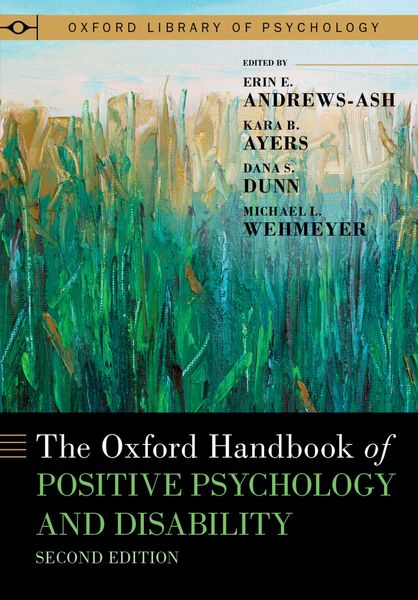
Produktbild: The Oxford Handbook of Positive Psychology and Disability

The Oxford Handbook of Positive Psychology and Disability

Fr. 213.00

inkl. gesetzl. MwSt., Versandkostenfrei


Beschreibung

Produktdetails

Einband

Gebundene Ausgabe

Erscheinungsdatum

27.02.2026

Herausgeber

Erin E. Andrews-Ash + weitere

Verlag

Oxford Academic

Seitenzahl

516

Maße (L/B/H)

25.3/18.2/3.8 cm

Gewicht

1012 g

Auflage

2nd edition

Sprache

Englisch

ISBN

978-0-19-774976-0

Beschreibung

Produktdetails

Einband

Gebundene Ausgabe

Erscheinungsdatum

27.02.2026

Herausgeber

Verlag

Oxford Academic

Seitenzahl

516

Maße (L/B/H)

25.3/18.2/3.8 cm

Gewicht

1012 g

Auflage

2nd edition

Sprache

Englisch

ISBN

978-0-19-774976-0

Herstelleradresse

Libri GmbH
Europaallee 1
36244 Bad Hersfeld
DE

Email: gpsr@libri.de

Kundinnen und Kunden meinen

0 Bewertungen

Informationen zu Bewertungen

Zur Abgabe einer Bewertung ist eine Anmeldung im Konto notwendig. Die Authentizität der Bewertungen wird von uns nicht überprüft. Wir behalten uns vor, Bewertungstexte, die unseren Richtlinien widersprechen, entsprechend zu kürzen oder zu löschen.

Die Bewertungen sind nach Format, Anzahl Sterne und Datum sortiert.

Verfassen Sie die erste Bewertung zu diesem Artikel

Helfen Sie anderen Kund*innen durch Ihre Meinung

Kundinnen und Kunden meinen

0 Bewertungen filtern

  • Produktbild: The Oxford Handbook of Positive Psychology and Disability
    • Part I: Introduction to Positive Psychology and Disability

    • Chapter 1: Embracing Disability Identity: A Positive Psychology Perspective

    • Erin E. Andrews and Jaylene M. Lee

    • Chapter 2: A Brief History of Positive Psychology and Its Application to Disability

    • Dana S. Dunn and Michael L. Wehmeyer

    • Chapter 3: Conceptualizing Disability: Positive Psychology and the ICF Models

    • Michael L. Wehmeyer and Dana S. Dunn

    • Chapter 4: Positive Deviance: Character Strength Development at the Intersectionality of Disability

    • Dan Tomasulo

    • Chapter 5: Cultural Diversity, Equity, and Inclusion in Positive Psychology and Disability

    • Chandra Donnell Carey and Tyra A Bernard-Watts

    • Part II: Application of Positive Psychological Constructs to Disability

    • Chapter 6: Optimism Within the Context of Disability

    • Kevin L. Rand and Naheeda Ahamadeen

    • Chapter 7: Disability and Hope: The Neurodevelopmental Disorder Perspective

    • Malka Margalit and Michal Al-Yagon

    • Chapter 8: Coping and Disability: A Positive Psychology Perspective

    • Ella McNeil, Abigail Wang, Kaitlin Gelman, Jack Holloway, Gissette Noriega, and Michele M. Tugade

    • Chapter 9: Social Well-Being and Friendship

    • Carli Friedman

    • Chapter 10: Self-Determination and Self-Determined Learning

    • Sheida K. Raley, Michael L. Wehmeyer, and Todd D. Little

    • Chapter 11: Resilience, Problem Solving, and the Experience of Disability: A Positive Psychological Perspective

    • Dana S. Dunn and Kara B. Ayers

    • Chapter 12: Interpersonal Decision Making in Individuals With Intellectual and Developmental Disabilities

    • Ishita Khemka

    • Chapter 13: Character Strengths

    • Ryan M. Niemiec

    • Chapter 14: Mindfulness and Disability

    • Nirbhay N. Singh, Giulio E. Lancioni, Rachel E. Myers, Yoon-Suk Hwang, and Oleg N. Medvedev

    • Chapter 15: Disability and Sexual Positivity: The Right to Sexual Citizenship

    • Roxanna Nasseri Pebdani, Rachel Cuesta, Gabrielle Ficchi, Jolie Chantharath, Margaret McGrath

    • Chapter 16: Disability and the Virtues of Interdependency

    • Shane Clifton and Jemma Clifton

    • Chapter 17: A Social Identity Approach to Positive Education: Toward New Sources of Life Satisfaction for Students with Disabilities

    • Jeffrey G. Noel, Thomas P. Dirth, and Michelle R. Nario-Redmond

    • Chapter 18: Understanding and Increasing Well-Being in People With Disabilities and/or Chronic Illness

    • Barry Nierenberg and D'anna Sydow

    • Part III. Strengths-based Processes, Approaches, and Systems

    • Chapter 19: Supports and Support Needs

    • Virginia Walker, Megan E. Carpenter, Yuwadee Viriyangkura, and James R. Thompson

    • Chapter 20: Positive Psychology Measurement and Assessment

    • Lauren A. Stutts and Erin E. Andrews

    • Chapter 21: Micro, Meso, and Macro Actions for an Inclusive and Sustainable Career Future

    • Laura Nota, Maria Cristina Ginevra, Sara Santilli, Denise Zucchini, and Salvatore Soresi

    • Chapter 22: Powering up Family Systems Using Systems-Informed Positive Psychology: Parent-Peer Workers as Levers for Change

    • Sylvana Mahmic, Margaret L. Kern, Annick Janson, Danielle Tracey, and Christine Johnston

    • Chapter 23: Aging With Disability

    • Tamar Heller, Lieke van Heumen, and Abby Schindler

    • Chapter 24: Social Support and Disability

    • Kathleen R. Bogart, Brooke A Bryson, and Amanda Hemmesch

    • Part IV. Positive Psychology and Disability Disciplines

    • Chapter 25: Positive Rehabilitation Psychology: Prospects, Progress, and Potential

    • Dana S. Dunn and Timothy R. Elliott

    • Chapter 26: Disability Studies

    • Brenda Jo Brueggemann and Jessica Gallagher

    • Chapter 27: Positive Psychological Mechanisms and Interventions in Chronic Pain

    • Jennifer G. Pearston and Dawn M. Ehde

    • Chapter 28: Positive Psychology and Brain Injury Systems

    • Jed N. McGiffin, Whitney Morean, and David Sheppard

    • Part V. Considerations in Positive Psychology and Disability

    • Chapter 29: Positive Psychology and Disability Ethics: Foundations and Principles

    • Emily M. Lund

    • Chapter 30: Adaptation and Disability Identity

    • Toni Saia, Joseph Stramondo, Abraham Graber, and Kathleen Green

    • Chapter 31: Toxic Positivity: The Pitfalls of Positivity in the Context of Disability

    • Carrie R. Pilarski and Miso Kwak

    • Chapter 32: Conclusions and Future Directions

    • Erin Andrews, Kara Ayers, Dana S. Dunn, and Michael L. Wehmeyer