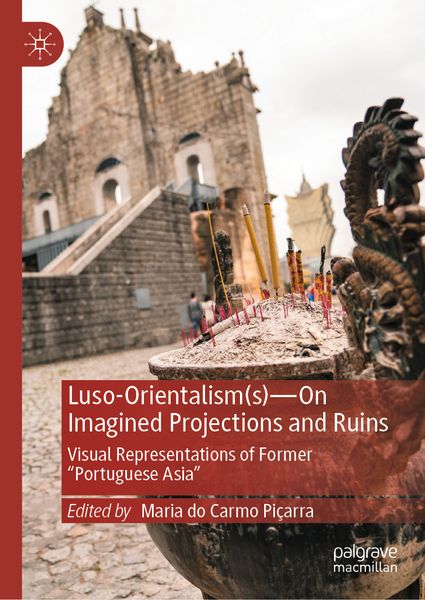
Produktbild: Luso-Orientalism(s)—On Imagined Projections And Ruins

Luso-Orientalism(s)—On Imagined Projections And Ruins Visual Representations Of Former “Portuguese Asia”

Fr. 202.00

inkl. gesetzl. MwSt., Versandkostenfrei


Beschreibung

Produktdetails

Einband

Gebundene Ausgabe

Erscheinungsdatum

03.01.2026

Abbildungen

XIX, 59 illus., 33 illus. in color., schwarz-weiss Illustrationen, farbige Illustrationen

Herausgeber

Maria do Carmo Piçarra

Verlag

Springer

Seitenzahl

354

Maße (L/B/H)

21.6/15.3/2.5 cm

Gewicht

601 g

Sprache

Englisch

ISBN

978-3-032-03268-3

Beschreibung

Portrait

Maria do Carmo Piçarra is vice-coordinator of ICNOVA, an assistant professor at UAL, and a film curator. Her academic interests include (post)colonial filmic representations, film propaganda and censorship, women in decolonisation and militant uses of the image. Her book Easterly Wind: Luso-Orientalism(s) in the Dictatorship's Films is scheduled for publication in 2025.

Produktdetails

Einband

Gebundene Ausgabe

Erscheinungsdatum

03.01.2026

Abbildungen

XIX, 59 illus., 33 illus. in color., schwarz-weiss Illustrationen, farbige Illustrationen

Herausgeber

Maria do Carmo Piçarra

Verlag

Springer

Seitenzahl

354

Maße (L/B/H)

21.6/15.3/2.5 cm

Gewicht

601 g

Sprache

Englisch

ISBN

978-3-032-03268-3

Herstelleradresse

Springer-Verlag GmbH
Tiergartenstr. 17
69121 Heidelberg
DE

Email: ProductSafety@springernature.com

Kundinnen und Kunden meinen

0 Bewertungen

Informationen zu Bewertungen

Zur Abgabe einer Bewertung ist eine Anmeldung im Konto notwendig. Die Authentizität der Bewertungen wird von uns nicht überprüft. Wir behalten uns vor, Bewertungstexte, die unseren Richtlinien widersprechen, entsprechend zu kürzen oder zu löschen.

Die Bewertungen sind nach Format, Anzahl Sterne und Datum sortiert.

Verfassen Sie die erste Bewertung zu diesem Artikel

Helfen Sie anderen Kund*innen durch Ihre Meinung

Kundinnen und Kunden meinen

0 Bewertungen filtern

  • Produktbild: Luso-Orientalism(s)—On Imagined Projections And Ruins
  • Part I: Contributions to a Genealogical Analysis of Luso-Orientalist Representations.- Chapter 1: “Luso-orientalist” Visions of “Portuguese Asia”: An Imaginary Shrouded in Ruins.- Chapter 2: Goa in Black and White: Souza & Paul’s Photographs in Catalogues, Albums, Exhibitions and Archives, In and Out of India.- Chapter 3: Colonial Representations of Macau and the Macanese: Circulation, Knowledge, Identities and Challenges for the Future.- Chapter 4: Photographic Representations of Timor at the Turn of the 19 th Century.- Chapter 5: Macau in the Movies: “Portugal in the far east” or “gambling hell”?.- Chapter 6: The India of Augusto Cabrita.- Part II: Anti-(Post)Colonial Ruptures and Persistences.- Chapter 7: Re-envisioning a Portuguese Colony: Indonesian Photographic Representations of East Timor.- Chapter 8:  Liberating Memories of India and Goa: The Politics of Edila Gaitonde’s Anticolonial Life Writing.- Chapter 9: Índia (1973-1975) de António Faria. Luso-orientalism and the Persistence of Empire in Portuguese Society.- Chapter 10: Reappropriating the Colonial Neutral Gaze: Macau’s Filmic Representation.- Chapter 11: All Cultures, all Arts, all Styles: Paulo Rocha’s A Ilha dos Amores and its Singularity.- Chapter 12: Representing the Voyage of Voyages: the Orient and the Imaginary of the “Discoveries” in Contemporary Portuguese Travel Writing.- Chapter 13: R. V. Pandit and Yao Feng: Two Asian Poets of the Image.- Chapter 14: Acts of Random Archiving.