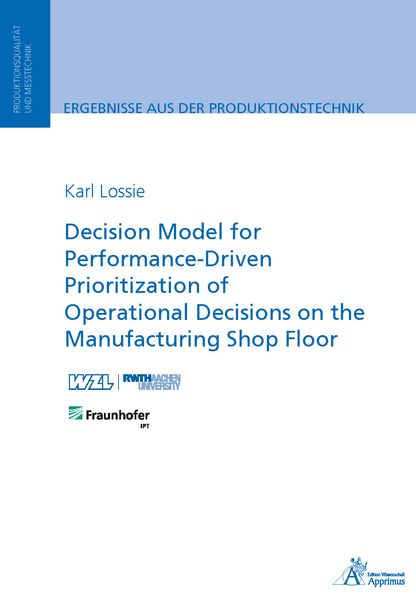
Band 17
Decision Model for Performance-Driven Prioritization of Operational Decisions on the Manufacturing Shop Floor DE
Aus der Reihe
Ergebnisse aus der Produktionstechnik
-
- Englisch ausgewählt
Fr. 74.90
inkl. gesetzl. MwSt.,
Beschreibung
Produktdetails
Einband
Taschenbuch
Erscheinungsdatum
29.09.2025
Verlag
ApprimusSeitenzahl
266
Maße (L/B/H)
21/14.8/1.7 cm
Gewicht
390 g
Auflage
1. Auflage
Sprache
Englisch
ISBN
978-3-9855530-5-1
Manufacturing shop floors are becoming increasingly complex as technology and organization evolve through concepts such as Industry 4.0. Nevertheless, human operators and their decisions remain crucial for operational performance — defined by dimensions like cost, flexibility, quality, safety, sustainability, and time. Many of these decisions are made under risk or ignorance, often leading to suboptimal outcomes because of inherent human cognitive biases.
This dissertation aims to systematically prioritize the numerous operational decisions on the shop floor with respect to their impact on performance. First, the research clarifies the nature of modern manufacturing environments, describing how direct (e.g., fabrication, assembly) and indirect (e.g., maintenance, quality control) areas interact in a socio-technical system. It establishes key performance goals and explores why human decisions are still at the center of manufacturing operations.
Next, a decision model is developed to enable shop floor managers to identify which operational decisions offer the greatest potential improvement in overall performance. Using the Analytical Hierarchy Process, the model organizes performance into a three-layer target hierarchy, comprising six main targets (cost, flexibility, quality, safety, sustainability, and time) and 16 specific sub-targets (e.g., scrap ratio, first pass yield, adherence to delivery dates). Simultaneously, 31 major shop-floor decisions — ranging from setting machining parameters to scheduling maintenance — are defined and compared against these performance goals.
The model is implemented as a web application to guide users through pairwise comparisons, ensuring consistent and rational weighting of goals and decisions. Additionally, group decision-making features and methods for aggregating individual priorities further increase the decision process’s objectivity. Verification and validation activities — such as expert interviews, a scenario-based study, sensitivity analysis, and correlation analysis — confirm the model’s consistency, applicability, plausibility, clarity, and rationality.
In conclusion, it is demonstrated that a structured decision model can effectively prioritize operational decisions for further improvement and potential decision support system implementation. This supports shop floor managers in focusing on those decisions with the highest impact on overall performance, thus bridging a critical gap in industrial practice.
This dissertation aims to systematically prioritize the numerous operational decisions on the shop floor with respect to their impact on performance. First, the research clarifies the nature of modern manufacturing environments, describing how direct (e.g., fabrication, assembly) and indirect (e.g., maintenance, quality control) areas interact in a socio-technical system. It establishes key performance goals and explores why human decisions are still at the center of manufacturing operations.
Next, a decision model is developed to enable shop floor managers to identify which operational decisions offer the greatest potential improvement in overall performance. Using the Analytical Hierarchy Process, the model organizes performance into a three-layer target hierarchy, comprising six main targets (cost, flexibility, quality, safety, sustainability, and time) and 16 specific sub-targets (e.g., scrap ratio, first pass yield, adherence to delivery dates). Simultaneously, 31 major shop-floor decisions — ranging from setting machining parameters to scheduling maintenance — are defined and compared against these performance goals.
The model is implemented as a web application to guide users through pairwise comparisons, ensuring consistent and rational weighting of goals and decisions. Additionally, group decision-making features and methods for aggregating individual priorities further increase the decision process’s objectivity. Verification and validation activities — such as expert interviews, a scenario-based study, sensitivity analysis, and correlation analysis — confirm the model’s consistency, applicability, plausibility, clarity, and rationality.
In conclusion, it is demonstrated that a structured decision model can effectively prioritize operational decisions for further improvement and potential decision support system implementation. This supports shop floor managers in focusing on those decisions with the highest impact on overall performance, thus bridging a critical gap in industrial practice.
Noch keine Bewertungen vorhanden
Verfassen Sie die erste Bewertung zu diesem Artikel
Helfen Sie anderen Kundinnen und Kunden durch Ihre Meinung.