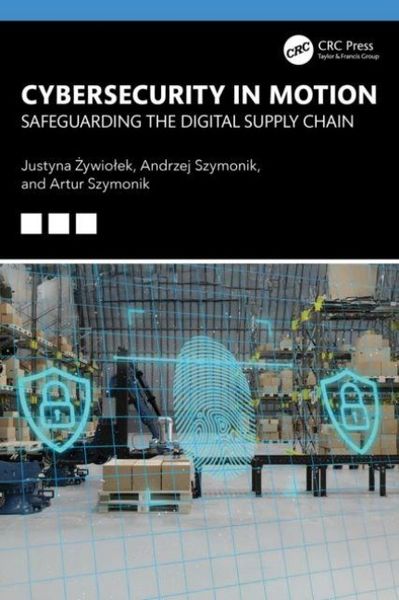
Cybersecurity in Motion Safeguarding the Digital Supply Chain
-
- Englisch ausgewählt
Fr. 78.90
inkl. gesetzl. MwSt.,
Beschreibung
Produktdetails
Einband
Taschenbuch
Erscheinungsdatum
18.08.2026
Abbildungen
schwarz-weiss Illustrationen, Raster, schwarz-weiss, Zeichnungen, schwarz-weiss, Tabellen, schwarz-weiss
Verlag
Taylor & FrancisSeitenzahl
12
Maße (L/B)
23.4/15.6 cm
Sprache
Englisch
ISBN
978-1-04-116671-9
This book advances a central and urgent thesis: in the hyperconnected economy of Logistics 4.0, cybersecurity is no longer a technical safeguard at the periphery of logistics systems but the primary infrastructure of supply chain continuity, economic security and sustainable development. Digital logistics has evolved into a cyber-physical ecosystem in which data flows, autonomous decisions and algorithmic coordination shape material reality. In this environment, cyber risk becomes systemic risk, transforming security from an operational concern into a strategic determinant of organisational legitimacy, competitiveness and resilience. The monograph reframes cybersecurity as a governance architecture integrating digital infrastructure, risk intelligence, institutional accountability and technological foresight.
The book offers a synthesis, demonstrating that digitalisation, cybersecurity and sustainability are mutually reinforcing rather than competing agendas. Without secure digital architectures, transparent ESG reporting, reliable traceability and accountable automation remain unattainable. Trust is the scarcest resource in digital supply chains, generated through verifiable data, secure infrastructures and credible governance.
More than a catalogue of tools or regulatory recommendations, the volume delivers an integrated analytical architecture for understanding and governing cyber risk in Logistics 4.0 environments. It shows that digital transformation restructures supply chains into cyber-physical systems whose stability, efficiency and legitimacy depend on the integrity of their digital foundations, and that cybersecurity is a collective supply-chain capability rather than an individual organisational attribute.
The work sets out a governance logic that guides organisations from digitalisation to resilience, treating Information Security Management Systems, standards and security operations frameworks as instruments for stabilising inter-organisational cooperation, maintaining service continuity and sustaining market legitimacy. It also outlines practitioner and research pathways centred on federated logistics data governance, scenario-based cyber resilience exercises, digital traceability architectures and integrating cybersecurity metrics into ESG reporting.
Noch keine Bewertungen vorhanden
Verfassen Sie die erste Bewertung zu diesem Artikel
Helfen Sie anderen Kundinnen und Kunden durch Ihre Meinung.