Gutscheinbedingungen

*Gültig bis 20.07.2026 auf alle Bücher. Ausgeschlossen sind Zeitschriften, Prozentbücher und Abos | Einlösbar in allen Buchhandlungen von Orell Füssli, Barth Bücher, Buchladen Rapunzel, Papeterie Köhler, Schuler Orell Füssli, Stauffacher und ZAP unter Vorweisung des Gutscheins, auf www.orellfüssli.ch durch Eingabe des Gutscheincodes. Beim Service „eBooks verschenken“ und bei eBook-Käufen via eReader nicht einlösbar | Mindesteinkaufswert: Fr. 30.- | Nicht mit anderen Rabatten kumulierbar.

Produktbild: Literature, Language and Computing

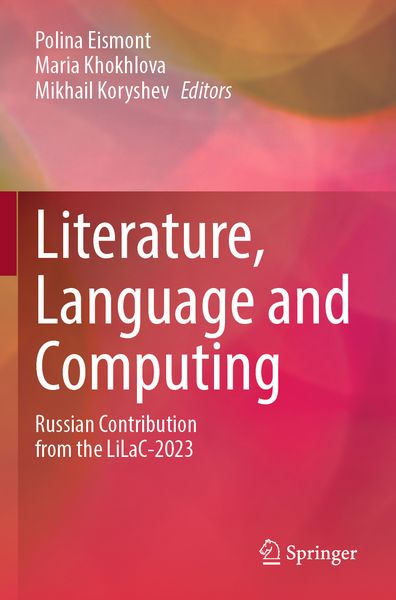
Literature, Language and Computing Russian Contribution from the LiLaC-2023

Fr. 191.00

inkl. gesetzl. MwSt., Versandkostenfrei


Beschreibung

Produktdetails

Einband

Taschenbuch

Erscheinungsdatum

27.03.2026

Herausgeber

Polina Eismont + weitere

Verlag

Springer Singapore

Seitenzahl

241

Maße (L/B/H)

23.5/15.5/1.5 cm

Gewicht

400 g

Sprache

Englisch

ISBN

978-981-9609-92-5

Beschreibung

Portrait

Polina Eismont is an associate professor at the Department of General Linguistics, St. Petersburg State University. Her research interests include language acquisition and psycholinguistics, text linguistics, cognitive linguistics, event structure, music semantics, and syntax of nulls.  She obtained her Ph.D. from St. Petersburg State Univeррrsity in 2008. She is the author of more than 40 papers in domestic and international journals and volumes and the co-editor of two CCIS volumes “Language, Music, and Computing” (Springer Verlag, 2015, 2019) and a book “Language, Music and Gesture: Informational Crossroads (LMGIC 2021)” (Springer Singapore, 2021).


Maria Khokhlova is an associate professor at the Department of Mathematical Linguistics, St. Petersburg State University. Her research lies at the intersection of natural language processing, corpus linguistics, and machine learning and was supported by grants and scholarships awarded by Russian and international foundations (RSF, DAAD, Visegrad Fund, Erasmus). She holds a Ph.D. from St. Petersburg State University (2011) and was awarded the St. Petersburg Government Prize for Science and Teaching (2020, 2022). She is the author of more than 100 articles in domestic and international refereed journals and volumes.

Mikhail Koryshev is an associate professor at the Department of Comparative Studies of Languages and Cultures and the Dean of the Faculty of Philology, St. Petersburg State University. His research interests focus on German language and culture, literary studies, as well as on Catholic hymnography and liturgiology. He obtained a Ph.D. in Philology from St. Petersburg State University in 2005. He was a visiting lecturer in Germany; his research was supported by Erasmus and DAAD-Stiftung. He is the author of more than 60 papers in Russian and international peer-reviewed journals and book series.


Produktdetails

Einband

Taschenbuch

Erscheinungsdatum

27.03.2026

Herausgeber

Verlag

Springer Singapore

Seitenzahl

241

Maße (L/B/H)

23.5/15.5/1.5 cm

Gewicht

400 g

Sprache

Englisch

ISBN

978-981-9609-92-5

Herstelleradresse

Springer-Verlag KG
Sachsenplatz 4-6
1201 Wien
AT

Email: GPSR Kontakt

Noch keine Bewertungen vorhanden

Verfassen Sie die erste Bewertung zu diesem Artikel

Helfen Sie anderen Kundinnen und Kunden durch Ihre Meinung.

Kundinnen und Kunden meinen

Bewertungen (0)

  • Produktbild: Literature, Language and Computing
  • Part 1. Quantitative methods in literary studies.- Chapter 1. Jorge Luis Borges’ poetry periodisation: a quantitative approach.- Chapter 2. Corpus of the Russian Short Stories (1900 –1930). Validity of Lingvo-Stastistical Parameters.- Chapter 3. Sentiment Analysis in Literary Texts: A Study of Theme and Reader Preferences in Russian Short Stories from 1900-1930s.- Chapter 4. Over the Rainbow: Colour Terms in Russian Literature of the Early 20th Century.- Chapter 5. Russian-language Electronic Fanfiction Database: Creation Principles and Quantitative Metadata Analysis.- Part 2. Quantitative methods in language studies.- Chapter 6. History of Russia in the XVII-XVIII Centuries in the Texts of School Textbooks of Different Years through the Prism of Sentiment and Topic Modeling Analysis.- Chapter 7. Disambiguation of Russian Homographs with Transformers.- Chapter 8. Idioms Database: Evidence from 19th Century Russian Texts.- Chapter 9. Possessor Doubling Strategies in Modern Vernacular Russian as Represented in the “One Speech Day” Oral Corpus.- Part 3. Spoken corpora: phonetics studies.- Chapter 10. Formant trajectories in different languages.- Chapter 11. Russian Backchannel Vocalizations: Approaches to Description.- Chapter 12. Phonetic Realisation of the High Rising Terminal in English Dialects (a case of Belfast and Newcastle dialects).- Chapter 13. Unveiling the Power of Hesitation: Exploring Vocalizations in the Speech of Introverts and Extroverts.- Part 4. Communicative interfaces.- Chapter 14. This robot smiles so nicely. I don’t trust him – the Effect of Robot’s Smiles on User’s Trust.- Chapter 15. The Botik of Peter the Great: Creating a Virtual Assistant for the Applicants of St Petersburg State University.- Chapter 16. Creating the mined QA corpus in Russian based on Oral History Archives.- Part 5. Corpora in teaching and translation.- Chapter 17. Contrastive analysis to identify cross-linguistic correspondences for translation purposes.- Chapter 18. Semantically Bleached Words of Everyday Russian Speech: The Problem of Translation into Other Languages (a Pilot Study Based on the Material of the Buryat Language).- Chapter 19. Evaluating the history of liturgical culture: a multilingual comparable corpus and a new look at familiar things.- Chapter 20. Transformations of Precedent Phenomena in the Polycode Internet Meme (Based on the Cats and Fishes Meme).