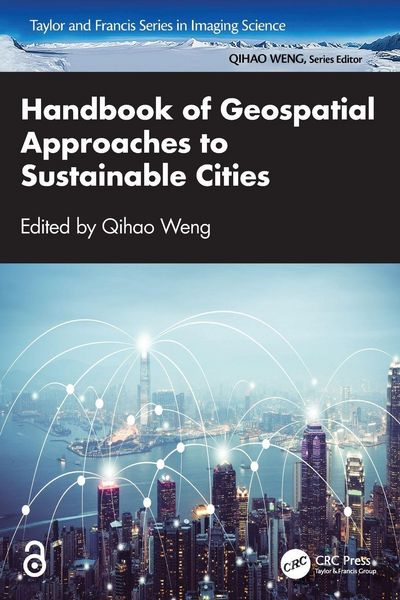
Handbook of Geospatial Approaches to Sustainable Cities
-
- Englisch ausgewählt
Fr. 103.00
inkl. gesetzl. MwSt.,
Portrait
Qihao Weng, a Foreign Member of The Academy of Europe (Academia Europaea) and a Fellow of IEEE, AAAS, AAG, ASPRS, and AAIA, is currently a Chair Professor at the Hong Kong Polytechnic University and has worked as the Director of the Center for Urban and Environmental Change and a Professor of Geography at Indiana State University, 2001-2021, and a Senior Fellow at the National Aeronautics and Space Administration from 2008 to 2009. He received his Ph.D. in geography from the University of Georgia in 1999. Weng is the Lead of GEO Global Urban Observation and Information Initiative, 2012-2022, and an Editor-in-Chief of ISPRS Journal of Photogrammetry and Remote Sensing. Additionally, he serves as the Series Editor of Taylor & Francis Series in Remote Sensing Applications, and Taylor & Francis Series in Imaging Science. Weng has been the Organizer and Program Committee Chair of the biennial IEEE/ISPRS/GEO sponsored International Workshop on Earth Observation and Remote Sensing Applications conference series since 2008; a National Director of American Society for Photogrammetry and Remote Sensing from 2007 to 2010; and a panelist of U.S. DOE's Cool Roofs Roadmap and Strategy in 2010.
Cheolhee Yoo is currently a Research Assistant Professor at the Hong Kong Polytechnic University. He earned his Bachelor of Engineering and Ph.D. from the Department of Urban and Environmental Engineering at the Ulsan National Institute of Science and Technology (UNIST), South Korea, in 2017 and 2022, respectively. In 2019, he further expanded his research experience as a research intern at the RIKEN Center for Advanced Intelligence Project (AIP) in Japan. Following the completion of his doctoral studies, Dr. Yoo served as a Postdoctoral Fellow at the Hong Kong Polytechnic University from April to September 2022. He is currently an Editorial Board Member of the ISPRS Journal of Photogrammetry and Remote Sensing and GIScience & Remote Sensing.
Produktdetails
Einband
Taschenbuch
Erscheinungsdatum
22.05.2026
Abbildungen
schwarz-weiss Illustrationen, farbige Illustrationen, Raster, farbig, Zeichnungen, schwarz-weiss, Zeichnungen, farbig, Tabellen, schwarz-weiss
Herausgeber
Weng QihaoVerlag
Taylor and FrancisSeitenzahl
352
Maße (L/B/H)
23.4/15.6/2 cm
Gewicht
690 g
Sprache
Englisch
ISBN
978-1-03-215534-0
Qihao Weng, a Foreign Member of The Academy of Europe (Academia Europaea) and a Fellow of IEEE, AAAS, AAG, ASPRS, and AAIA, is currently a Chair Professor at the Hong Kong Polytechnic University and has worked as the Director of the Center for Urban and Environmental Change and a Professor of Geography at Indiana State University, 2001-2021, and a Senior Fellow at the National Aeronautics and Space Administration from 2008 to 2009. He received his Ph.D. in geography from the University of Georgia in 1999. Weng is the Lead of GEO Global Urban Observation and Information Initiative, 2012-2022, and an Editor-in-Chief of ISPRS Journal of Photogrammetry and Remote Sensing. Additionally, he serves as the Series Editor of Taylor & Francis Series in Remote Sensing Applications, and Taylor & Francis Series in Imaging Science. Weng has been the Organizer and Program Committee Chair of the biennial IEEE/ISPRS/GEO sponsored International Workshop on Earth Observation and Remote Sensing Applications conference series since 2008; a National Director of American Society for Photogrammetry and Remote Sensing from 2007 to 2010; and a panelist of U.S. DOE's Cool Roofs Roadmap and Strategy in 2010.
Cheolhee Yoo is currently a Research Assistant Professor at the Hong Kong Polytechnic University. He earned his Bachelor of Engineering and Ph.D. from the Department of Urban and Environmental Engineering at the Ulsan National Institute of Science and Technology (UNIST), South Korea, in 2017 and 2022, respectively. In 2019, he further expanded his research experience as a research intern at the RIKEN Center for Advanced Intelligence Project (AIP) in Japan. Following the completion of his doctoral studies, Dr. Yoo served as a Postdoctoral Fellow at the Hong Kong Polytechnic University from April to September 2022. He is currently an Editorial Board Member of the ISPRS Journal of Photogrammetry and Remote Sensing and GIScience & Remote Sensing.
Kundinnen und Kunden meinen
Verfassen Sie die erste Bewertung zu diesem Artikel
Helfen Sie anderen Kund*innen durch Ihre Meinung