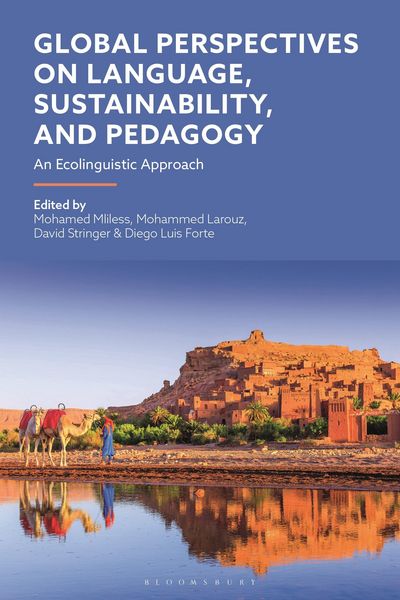
Produktbild: Global Perspectives on Language, Sustainability, and Pedagogy
Vorbesteller Neu

Global Perspectives on Language, Sustainability, and Pedagogy An Ecolinguistic Approach

Fr. 158.00

inkl. gesetzl. MwSt., Versandkostenfrei


Beschreibung

Produktdetails

Einband

Gebundene Ausgabe

Erscheinungsdatum

18.02.2027

Herausgeber

Mohamed Mliless + weitere

Verlag

Bloomsbury

Seitenzahl

296

Maße (L/B/H)

23.4/15.6/1.6 cm

Gewicht

420 g

Sprache

Englisch

ISBN

978-1-350-61268-6

Beschreibung

Portrait

Mohamed Mliless is an independent researcher in Ecolinguistics and Critical Environmental Discourse Analysis based in Meknes, Morocco.
Mohammed Larouz is Dean of the School of Arts and Humanities at Moulay Ismail University of Meknès, Morocco.
David Stringer is Associate Professor of Second Language Studies at Indiana University Bloomington, USA.
Diego Luis Forte is an academic consultant for the Ministry of Agriculture of Argentina, Argentina.

Produktdetails

Einband

Gebundene Ausgabe

Erscheinungsdatum

18.02.2027

Herausgeber

Verlag

Bloomsbury

Seitenzahl

296

Maße (L/B/H)

23.4/15.6/1.6 cm

Gewicht

420 g

Sprache

Englisch

ISBN

978-1-350-61268-6

Herstelleradresse

Libri GmbH
Europaallee 1
36244 Bad Hersfeld
DE

Email: gpsr@libri.de

Noch keine Bewertungen vorhanden

Verfassen Sie die erste Bewertung zu diesem Artikel

Helfen Sie anderen Kundinnen und Kunden durch Ihre Meinung.

Kundinnen und Kunden meinen

Bewertungen (0)

  • Produktbild: Global Perspectives on Language, Sustainability, and Pedagogy
  • Introduction
    Part I: Theoretical Foundations and Critical Frames
    1. Critical Trans/Multilingualism in Ecolinguistics, Kate Alice Garnett (Kansai Gaidai University in Osaka, Japan)
    2. The Place of Foreign Language Teaching in Contemporary Ecolinguistics: Some Theoretical and Practical Reflections, Davi Albuquerque (Nankai University, China)
    3. Integrating the Anthropocene into Curricula for Stronger Sustainability Education, Mohamed Mliless and Elhoucine Echougrani (Cadi Ayyad University, Morocco)
    4. Eco Perspectives, Periphery and Colonial Identity: Higher Education in Argentina and the Climate Change Debate, Diego Forte
    Part II: Frameworks, Methods and Tools
    5. AI Adaptive Assistants for Ecolinguistic Education, Jorge Vallego
    6. An Ecolinguistic Approach to Measuring Environmental Literacy Among EFL Students at the School of Arts and Humanities, Meknes, Maryam Charafi (Ismail University of Meknes, Morocco)
    Part III: Pedagogies and Curriculum Integration
    7. Eco-Critical Thinking and Environmental Awareness: The Role of Educational Textbooks, Drissia Ounnich Drissia Ounnich (Moulay Ismail University, Morocco)
    8. English Language Teaching and Environmental Awareness: Iranian Students' Perspectives on Integrating Environmental Education into ELT Textbooks, Amir Ghorbanpour (Tarbiat Modares University in Tehran, Iran), Ghodrat Hassani (Damghan University, Iran), Hossein Davari (Damghan University, Damghan, Iran), Abutaleb Iranmehr(Shahrood University of Technology, Iran)
    9. Architecture Ecoliteracy: Moroccan student perspectives, Mohamed Mliless, Mohammed Larouz (Moulay Ismail University, Morocco) and Mohamed Messaoudi (Moulay Ismail University, Morocco)
    10. Bridging Environmental Awareness and Sustainable Practices: A Qualitative Study of University Students' Perceptions and Engagement, Benzehaf Bouchaib, Razkane Hassane and Benzehaf Oumaima (Chouaïb Doukkali University, Morocco)
    Part IV: Discourse and Regional Case Studies
    11. A Positive Discourse Analysis of Reader's Digest Articles: An Eco-Critical Perspective, Ammara Sharif (Riphah International University, Pakistan), Gul-E-Raana Qureshi (Riphah International University, Pakistan) and Maimoona Abdulaziz (Faisalabad Campus, Pakistan)
    12. Learning Through Living Traditions: An Ecolinguistic EFL Study of Bali's Ritual Plants, I Gusti Agung Sri Rwa Jayantini, Sang Putu Kaler Surata, Putu Desi Anggerina Hikmaharyanti and Ni Nyoman Deni Ariyaningsih (Universitas Mahasaraswati Denpasar, Indonesia)
    Conclusion