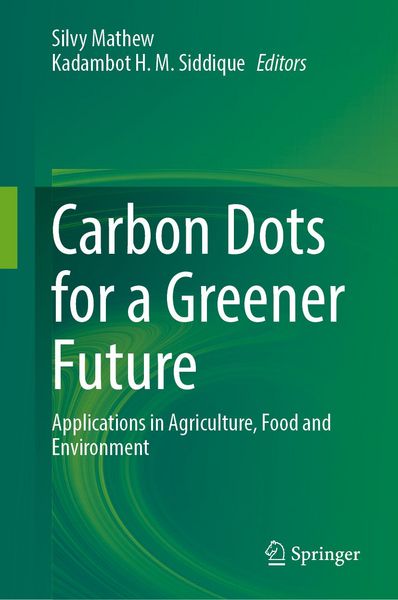
Produktbild: Carbon Dots for a Greener Future
Vorbesteller Neu

Carbon Dots for a Greener Future Applications in Agriculture, Food and Environment

Fr. 241.00

inkl. gesetzl. MwSt., Versandkostenfrei


Beschreibung

Produktdetails

Einband

Gebundene Ausgabe

Erscheinungsdatum

14.08.2026

Abbildungen

X, 73 illus., 69 illus. in color., farbige Illustrationen, schwarz-weiss Illustrationen

Herausgeber

Silvy Mathew + weitere

Verlag

Springer Singapore

Seitenzahl

374

Maße (L/B)

23.5/15.5 cm

Sprache

Englisch

ISBN

978-981-9220-28-1

Beschreibung

Portrait

Dr. Silvy Mathew is currently working as an Assistant Professor & Research Guide in the Department of Botany, Vimala College (Autonomous), Kerala, Affiliated to the University of Calicut, India. She holds a bachelor's and master's degree from Mahatma Gandhi University, Kerala, and earned MPhil and her Ph.D. from Bharathidasan University, Tamil Nadu, India. Her research interests encompass quantum carbon dots, bioengineered cancer inhibitor formulations derived from indigenous plant metabolites, COX-2/5-LOX anti-inflammatory effects of alkaloid-enriched fractions from fruits, and plant-based nanoparticle synthesis. She has contributed 32 DNA sequences to GenBank and has published over 28 research papers in international journals, along with 12 books and 10 book chapters. She has completed eight major and minor projects funded by DST, DBT, and KSCSTE. holds three published patents titled as A vision-Language Model Based Explainable Artificial Intelligence System for Retinal Disease Risk Interpretation, AI-Driven IoT System for Real-Time Disaster Prediction and Autonomous Emergency Response and  Innovative Robotic System for AI-Driven Vertical Harvesting and Crop Health Management.


Professor Kadambot H.M Siddique   is an agricultural scientist with over 35 years of experience in research and teaching. As the Hackett Professor and Director of the UWA Institute of Agriculture, he has significantly contributed to dryland agriculture, particularly in crop physiology, agronomy and breeding. His work has led to the development and commercial release of multiple chickpea, lentil and Lathyrus cultivars. His research focuses on crop adaptation to water deficits and abiotic stresses, contributing to improved cereal and grain legume production in challenging environments. He has authored over 1,000 scientific publications and is well-recognized as a highly cited researcher in agricultural sciences from 2019 to 2023.

Produktdetails

Einband

Gebundene Ausgabe

Erscheinungsdatum

14.08.2026

Abbildungen

X, 73 illus., 69 illus. in color., farbige Illustrationen, schwarz-weiss Illustrationen

Herausgeber

Verlag

Springer Singapore

Seitenzahl

374

Maße (L/B)

23.5/15.5 cm

Sprache

Englisch

ISBN

978-981-9220-28-1

Herstelleradresse

Libri GmbH
Europaallee 1
36244 Bad Hersfeld
DE

Email: gpsr@libri.de

Kundinnen und Kunden meinen

0 Bewertungen

Informationen zu Bewertungen

Zur Abgabe einer Bewertung ist eine Anmeldung im Konto notwendig. Die Authentizität der Bewertungen wird von uns nicht überprüft. Wir behalten uns vor, Bewertungstexte, die unseren Richtlinien widersprechen, entsprechend zu kürzen oder zu löschen.

Die Bewertungen sind nach Format, Anzahl Sterne und Datum sortiert.

Verfassen Sie die erste Bewertung zu diesem Artikel

Helfen Sie anderen Kund*innen durch Ihre Meinung

Kundinnen und Kunden meinen

0 Bewertungen filtern

  • Produktbild: Carbon Dots for a Greener Future
  • Part I. Carbon Dots in Sustainable Soil and Crop Management.- Chapter 1. Introduction to Carbon Dots Fundamentals, Properties, and Synthesis.- Chapter 2. Green Synthesis of Carbon Dots for Sustainable Applications.- Chapter 3. Carbon Dots in Enhancing Agricultural Productivity.- Chapter 4. Carbon Dots in Soil and Water Remediation for Sustainable Agriculture.- Chapter 5. Carbon Dots for Wastewater Treatment and Purification.- Part II. Carbon Dots in Food Safety, Preservation, and Packaging.- Chapter 6. Carbon Dots in Food Safety: Preservation and Packaging.- Chapter 7. Antimicrobial and Antifungal Properties of Carbon Dots: Implications for Food and Agriculture.- Chapter 8.    Toxicology, Biocompatibility, and Regulatory Aspects of Carbon Dots in Agriculture and Food Industry.- Chapter 9. Role of Carbon Dots in Plant Genetic Engineering.- Part III. Carbon Dots in Environmental Management and Related Applications.- Chapter 10. Nano-Fertilizers and Carbon Dots: A Sustainable Approach to Crop Nutrition.- Chapter 11. Carbon dots in pesticide degradation and residue analysis.- Chapter 12. Role of Carbon Dots in Sustainable Agriculture.- Chapter 13. Industrial Applications and Commercialization of Carbon Dot-Based Technologies.- Chapter 14. Concerns and Future Perspective of Carbon Dots.