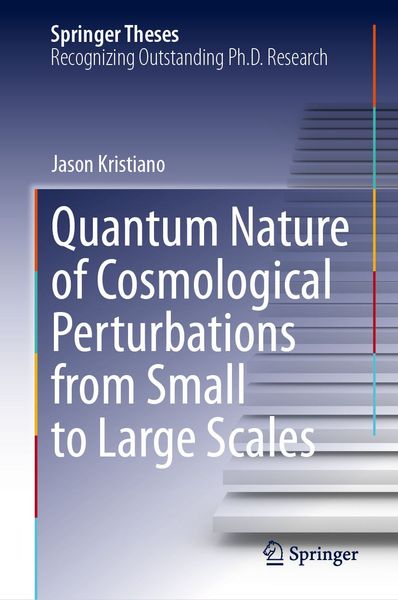
Quantum Nature of Cosmological Perturbations from Small to Large Scales
-
- Englisch ausgewählt
Fr. 171.00
inkl. gesetzl. MwSt.,
Beschreibung
Produktdetails
Einband
Gebundene Ausgabe
Erscheinungsdatum
24.08.2026
Abbildungen
XVII, 1 illus., schwarz-weiss Illustrationen
Verlag
Springer SingaporeSeitenzahl
129
Maße (L/B)
23.5/15.5 cm
Sprache
Englisch
ISBN
978-981-9225-79-8
This book presents cosmological perturbation stretched by inflation in the early universe which is the leading theory to explain the origin of structures in our universe. Perturbation with wavelength as long as the size of observable universe can explain the origin of cosmic microwave background (CMB) anisotropy. The amplitude of this long-wavelength perturbation is tightly constrained by CMB observation. However, on a smaller scale, there are almost no strict observational constraints on the amplitude of the perturbation. This leads to the possibility that the amplitude of small-scale perturbation is large enough so it can collapse into primordial black holes (PBHs) after it reenters the horizon during radiation-dominated universe. In order to produce an appreciable amount of PBHs, the square amplitude of the curvature perturbation must take an extremely large value, that is, seven digits larger than the value observed by cosmic microwave background radiation (CMB) on large scales. Such a large fluctuation can be achieved by violating the slow-roll (SR) condition within a short duration. The best known of such possibilities is ultraslow-roll (USR) inflation, which can be realized if there is an extremely flat region on the inflationary potential. Due to an extremely large amplitude of the perturbation, the evolution of the perturbation is expected to be highly nonlinear. So far, observables in such a theory have been mostly predicted by linear perturbation theory.
Noch keine Bewertungen vorhanden
Verfassen Sie die erste Bewertung zu diesem Artikel
Helfen Sie anderen Kundinnen und Kunden durch Ihre Meinung.