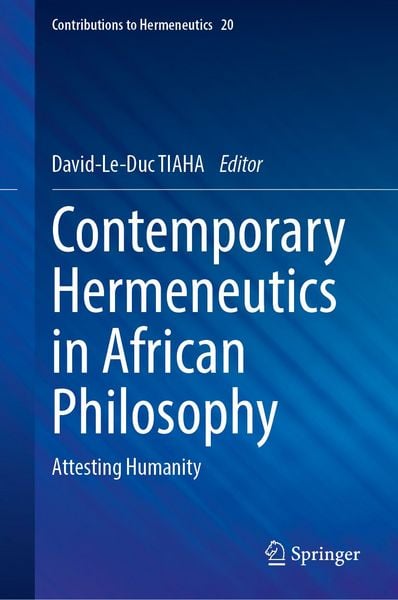
Produktbild: Contemporary Hermeneutics in African Philosophy
Vorbesteller Neu

Contemporary Hermeneutics in African Philosophy Attesting Humanity

Fr. 181.00

inkl. gesetzl. MwSt., Versandkostenfrei


Beschreibung

Produktdetails

Einband

Gebundene Ausgabe

Erscheinungsdatum

19.09.2026

Abbildungen

XXVIII, 22 illus., schwarz-weiss Illustrationen

Herausgeber

David-Le-Duc TIAHA

Verlag

Springer

Seitenzahl

453

Maße (L/B)

23.5/15.5 cm

Sprache

Englisch

ISBN

978-3-032-31696-7

Beschreibung

Portrait

A philosopher and physicist, David-Le-Duc TIAHA is Program Director at the Collège International de Philosophie and a member of the Fonds Ricœur-CRAL-EHESS research team as well as of its scientific advisory board at the Institut Protestant de Théologie de Paris. Author of Paul Ricœur et le paradoxe de la chair (2009). His work explores the often neglected relationship between ethics and hermeneutics, the postcolonial condition and Negro-African clinical anthropology, as well as forms of self-attestation, articulating affects and discourse, implicit in biblical hermeneutics.

Across these different fields, his research is driven by a sustained inquiry into processes of emergence, resonance, event, and interpretation. This concern gives coherence to his dual engagement with philosophy and physics: in phenomenology, hermeneutics, and African philosophy, he examines how meaning, selfhood, and relation come into appearance; in the philosophy of quantum physics, he investigates the passage from the intuition of the quantum event or phenomenon to the interpretation of its reality within theoretical and experimental contexts.

His work thus unfolds as a continuous reflection on the conditions under which phenomena become intelligible, whether in lived experience, textual interpretation, intercultural encounter, or physical reality—the latter, moreover, being re-engaged from physical existence through flesh and body. David-Le-Duc TIAHA thereby brings a transdisciplinary perspective that opens new vistas on both sides, reconnecting philosophy with its organic function of mediation between the human and social sciences and STEM, conceived as a continuum.

Produktdetails

Einband

Gebundene Ausgabe

Erscheinungsdatum

19.09.2026

Abbildungen

XXVIII, 22 illus., schwarz-weiss Illustrationen

Herausgeber

David-Le-Duc TIAHA

Verlag

Springer

Seitenzahl

453

Maße (L/B)

23.5/15.5 cm

Sprache

Englisch

ISBN

978-3-032-31696-7

Herstelleradresse

Springer International Publishing AG
Gewerbestr. 11
6330 Cham
Schweiz
Url: www.springer.com

Noch keine Bewertungen vorhanden

Verfassen Sie die erste Bewertung zu diesem Artikel

Helfen Sie anderen Kundinnen und Kunden durch Ihre Meinung.

Kundinnen und Kunden meinen

Bewertungen (0)

  • Produktbild: Contemporary Hermeneutics in African Philosophy
  •  Part I — Sources, Traditions, and Conditions of Possibility (Chapters 1–4).- Chapter  1 Egyptian hermeneutics and its African, Greek, and Semitic reappropriations.- Chapter  2 Orality in African Philosophy: The Epistemization of Oral Data in Henry Odera Oruka and Sophie Olúwọlé.- Chapter  3 The history of ideas in the context of orality as a condition of African hermeneutics.- Chapter  4 From an Epistemology of Interpretation to an Ontology of Understanding: Sketch of a Dialogue between the Textual Hermeneutics of Amo and Ricœur.- Part II — Symbols, Myths, and Proverbs: Toward an Ecological Hermeneutics (Chapters 5–7).- Chapter  5 African Mythologies In Search of Meaning and Intelligibility in Contemporary Thought.- Chapter  6 From symbol to proverb Semantics for an ecological hermeneutics.- Chapter  7 Sapiential and Practical Hermeneutics Symbolic Trajectory of African Oral Traditions in Basile-Juléat Fouda.- Part III — Subject, Narrative, and Discursivity: Attestation and Authenticity (Chapters 8–11).- Chapter  8 Africa as Interpreting Subject: Ricœur and the Dignity of the African Narrative.- Chapter  9 Hermeneutics of the Postcolonial Condition.- Chapter  10 Discursivity, Authenticity, and Intersubjectivity: A Hermeneutics of the Imaginary in Kinyongo Jeki and Nkombe Oleko.- Chapter  11 Narrations and Horizons of Literary Hermeneutics: From André Schwarz-Bart, What African Conversations?.- Part IV — Transcendental Critique, Lateralism, and the Lived Body (Chapters 12–14).- Chapter  12 The Transcendental Anthropology of Souleymane Bachir Diagne in Universaliser: “Humanity through the Means of Humanity”.- Chapter  13 Hermeneutical Critique or Ontogenetic Hermeneutics of African Traditions: An Analysis of the Views of Ernst Cassirer and Basile-Juléat Fouda.- Chapter  14 The Lived Body as a Matrix of Mythic Meaning: A Phenomenological Approach.- Part V — Memory, Cultural Restitution, and Bib-lical Hermeneutics: The Demand for the Universal (Chapters 15–17).- Chapter  15 Wounded memories, unfulfilled promises in light of the issue of restitution of works of art from Black Africa.- Chapter  16 Hermeneutics of Facture: Swahili Territorial, Urban, Architectural, and Social Productions as Embodied Universalism.- Chapter  17 Ethics in African Biblical Hermeneutics: between Universalism and Cultural Clashes of Interpretation..- Chapter  Conclusions. Going back to start over: At the origins of a narrative hermeneutics.