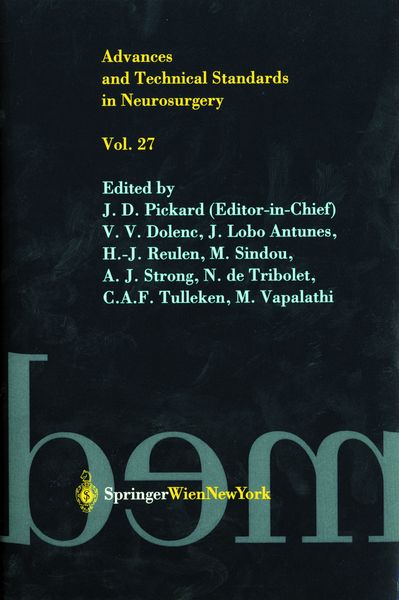

• Produktbild: Advances and Technical Standards in Neurosurgery
  • Produktbild: Advances and Technical Standards in Neurosurgery
Band 27

Advances and Technical Standards in Neurosurgery

Fr. 192.00

inkl. gesetzl. MwSt., Versandkostenfrei


Beschreibung

Produktdetails

Einband

Gebundene Ausgabe

Erscheinungsdatum

07.01.2002

Abbildungen

XIV, 143 illus., 28 illus. in color., farbige Illustrationen, schwarz-weiss Illustrationen

Verlag

Springer Wien

Seitenzahl

244

Maße (L/B/H)

24.6/17.3/2.2 cm

Gewicht

696 g

Auflage

1. Auflage

Sprache

Englisch

ISBN

978-3-211-83605-7

Beschreibung

Rezension

"The series should be required reading for all neurosurgeons in training and a core part of every neurosurgical departmental library." British Journal of Neurosurgery

Produktdetails

Einband

Gebundene Ausgabe

Erscheinungsdatum

07.01.2002

Abbildungen

XIV, 143 illus., 28 illus. in color., farbige Illustrationen, schwarz-weiss Illustrationen

Verlag

Springer Wien

Seitenzahl

244

Maße (L/B/H)

24.6/17.3/2.2 cm

Gewicht

696 g

Auflage

1. Auflage

Sprache

Englisch

ISBN

978-3-211-83605-7

Herstelleradresse

Springer Wien
Prinz-Eugen-Str. 8-10
1040 Wien
AT
buchhandel-buch@springer.com

Kundinnen und Kunden meinen

0 Bewertungen

Informationen zu Bewertungen

Zur Abgabe einer Bewertung ist eine Anmeldung im Konto notwendig. Die Authentizität der Bewertungen wird von uns nicht überprüft. Wir behalten uns vor, Bewertungstexte, die unseren Richtlinien widersprechen, entsprechend zu kürzen oder zu löschen.

Die Bewertungen sind nach Format, Anzahl Sterne und Datum sortiert.

Verfassen Sie die erste Bewertung zu diesem Artikel

Helfen Sie anderen Kund*innen durch Ihre Meinung

Kundinnen und Kunden meinen

0 Bewertungen filtern

  • Produktbild: Advances and Technical Standards in Neurosurgery
  • Produktbild: Advances and Technical Standards in Neurosurgery
  • A. Advances.- Neurobiology of Epileptogenesis in the Temporal Lobe.- Reorganisation of Neuronal Circuitries Underlying Epileptogenesis in the Hippocampus.- Anatomy.- Neuronal Loss.- Neurogenesis.- Gliosis.- Axonal Plasticity.- Dendritic Plasticity.- Reorganisation of Neuronal Circuitries in the Amygdala.- Anatomy.- Neuronal Loss.- Reorganisation of Neuronal Circuitries in the Entorinal Cortex.- Anatomy.- Neuronal Loss and Sprouting.- Conclusions.- Acknowledgements.- References.- Diffuse Axonal Injury after Head Trauma. A Review.- Fundamental Structure and Function of the Central Nervous System Axon.- The Axonal Membrane (Axolemma).- Microtubules and Neurofilaments. The Neuronal Cytoskeleton.- Axonal Transport and its Mechanisms.- Calcium and Calcium-Dependent Breakdown of Neurofilaments.- Physiopathology of Head Injury. Diffuse Versus Focal Injuries.- Post-Traumatic Cellular Events and the Concept of Traumatic Penumbra.- Classical Definition of Traumatic Diffuse Axonal Injury.- Biomechanics of Diffuse Axonal Injury.- Characteristics of Mechanical Loading.- The Centripetal Theory of Ommaya.- The Centripetal Theory and the Concept of Primary Brainstem Injury.- The Reticular Formation and the Primary Brainstem Damage Saga.- Clinical and Experimental Validation of the Centripetal Theory.- The Neuropathological Spectrum of DAI.- Focal Lesions Observed in the Brain in DAI.- Pathogenesis of the Corpus Callosum Hemorrhages.- Neuropathological Grading of DAI.- Axonal Retraction Balls, Microglial Stars and Wallerian Degeneration.- Axonal Retraction Balls.- Microglial Clusters (Microglial Stars).- Wallerian Degeneration.- Experimental Models of DAI.- Marmarou’s Rodent Model of DAI.- Changing Concepts in Diffuse Axonal Injury. Is DAI Always a Primary Lesion?.- Experimental Evidence of Secondary Axotomy in Closed Head Injuries.- Pathogenesis of Diffuse Axonal Injury.- Stage I: Axonal Membrane Injury and Alterations in Ionic Fluxes.- Stage II: Reversible Cytoskeletal Damage.- Stage III: Secondary Axotomy.- Stage IV: Primary Axotomy.- Mechanoporation, Calcium Influx and Cytoskeletal Abnormalities.- Is Diffuse Axonal Injury a Universal Finding after Severe Head Injury?.- Clinico-Radiological Diagnosis of Diffuse Axonal Injury.- Cranial Fractures in Patients with Diffuse Axonal Injury.- CT Scan Findings.- The Role of MRI in the Study of Postraumatic DAI.- Diffuse Axonal Injury in Minor Head Injuries.- Late Consequences of DAI.- Specific Therapies that may be Effective Against DAI.- Magnesium—the Magic Bullet?.- Neuroprotective Effects of Hypothermia.- Cyclosporin-A and its Effect on DAI.- Hope for the Future.- Acknowledgments.- References.- Multi-Modal Monitoring of Acute Brain Injury.- Abstract.- Aspects of Cerebral Pathophysiology.- Relationships Between ICP, CPP and Cerebral Blood Flow.- Transcranial Doppler Ultrasonography for Assessing Autoregulation.- Static Test of Autoregulation.- TCD Reactivity of Changes in Arterial Carbon PaCO2.- Dynamic Test of Autoregulation.- Transient Hyperaemic Response Test.- Continuous analysis of TCD Using Respiratory Waves.- Continuous analysis of TCD Flow Velocity Waveform.- Non-Invasive Assessment of Brain Perfusion.- Computer Support for Data Analysis.- Continuous EEG monitoring.- Aspects of Cerebral Oxygenation—Brain Gas Analysis.- Jugular Bulb Oximetry.- Normal Values and Ischaemic Thresholds.- Arteriovenous Difference in Oxygen Content.- Factors which Influence SjvO2.- Arterial Oxygen Content.- Cerebral Blood Flow and Perfusion Pressure.- Cerebral Metabolic Rate.- Clinical Use of SjvO2.- Brain Tissue Oxygen Probes.- Normal Values for PtiO2.- Ischaemic Thresholds of PtiO2.- Factors that Influence PtiO2.- Hypoxia.- Cerebral Perfusion Pressure.- Hypocapnia.- Cerebral Blood Flow.- Cerebral Metabolic Rate.- Hyperoxia.- Probe Depth.- Aspects of Cerebral Metabolism—Microdialysis.- Methodology.- Microdialysis Pumps.- Microdialysis Catheters.- Chemical Analysis.- Catheter Fixation.- Clinical Applications.- Conclusion.- Acknowledgements.- References.- B. Technical Standards.- Endoscopic Endonasal Transsphenoidal Surgery.- History.- Pre-Operative Study.- Indications.- Surgical Technique.- Nasal Phase.- Natural Ostium Enlargement.- Preparation of the Sphenoid Sinus and Opening of the Sella.- Tumor Removal.- Clinical Material.- Discussion.- Acknowledgments.- References.- Extracranial Vertebral Artery Anatomy and Surgery.- Surgical Anatomy.- Surgical Exposure.- Anterolateral Approach (ALA).- First Segment.- Second Segment.- Third Segment.- Posterolateral Approach (PLA).- Indications of VA Surgical Exposure.- Intrinsic Lesions.- Extrinsic Lesions.- Intermittent Compression.- Permanent Compression.- Improvement of Exposure.- Anterior Part of the Spinal Canal.- Foramen Magnum.- Jugulare Foramen Tumors — Juxtacondylar Approach.- Personal Experience.- Conclusion.- References.- Neurosurgical Management of Pineal Tumours.- Incidence of Pineal Tumours.- Surgical Strategy with Consideration of Postsurgical Adjuvant Therapies.- Surgical Anatomy.- Selection of Approaches.- Surgical Approaches.- Instrumentation.- Occipital Transtentorial Approach.- Infratentorial Supracerebellar Approach.- Complications.- Conclusion.- Acknowledgment.- References.