KI-Beratung Beta

  • Produktbild: Discovering Mathematics with Maple
  • Produktbild: Discovering Mathematics with Maple

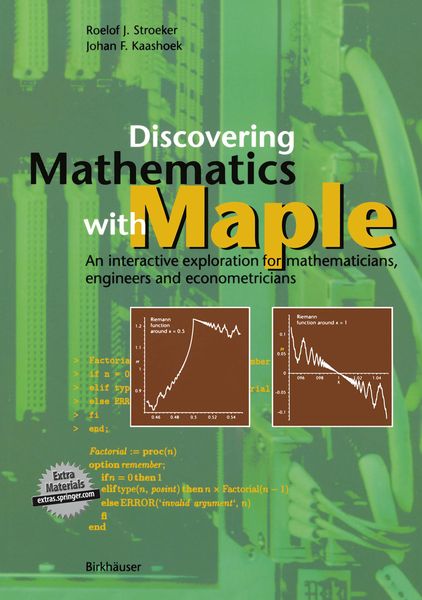
Discovering Mathematics with Maple An interactive exploration for mathematicians, engineers and econometricians

Fr. 76.90

inkl. gesetzl. MwSt., Versandkostenfrei


Beschreibung

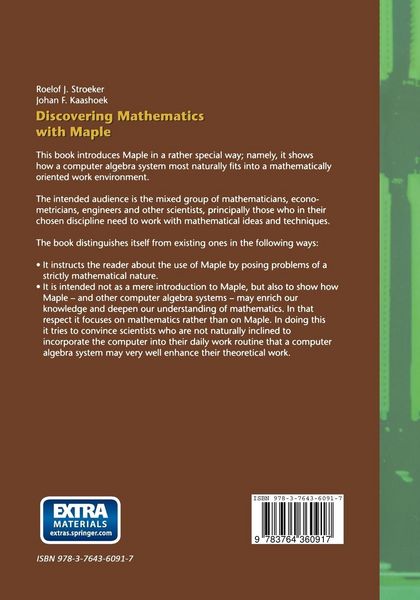
his book grew out of the wish to let students of econometrics get acquainted T with the powerful techniques of computer algebra at an early stage in their curriculum. As no textbook available at the time met our requirements as to content and presentation, we had no other choice than to write our own...

Beschreibung

his book grew out of the wish to let students of econometrics get acquainted T with the powerful techniques of computer algebra at an early stage in their curriculum. As no textbook available at the time met our requirements as to content and presentation, we had no other choice than to write our own course material. The try-out on a group of 80 first year students was not without success, and after adding some necessary modifications, the same material was presented to a new group of students of similar size the year after. Some more adjustments were made, and the final result now lies before you. Working with computer algebra packages like Derive, Mathematica, and Maple over many years convinced us of the favourable prospects of computer algebra as a means of improving the student's understanding of the difficult concepts on which mathematical techniques are often based. Moreover, advanced mathematical ed ucation, be it for mathematics itself or for mathematical statistics, operations research and other branches of applied mathematics, can greatly profit from the large amount of non-trivial mathematical knowledge that is stored in a computer algebra system. Admittedly, the fact remains that many a tough mathematical problem, such as solving a complicated non-linear system or obtaining a finite ex pression for a multiple parameter integral, can not easily be handled by computer algebra either, if at all.

Rezension

"This book distinguishes itself... [the] reader learns how to use MAPLE® by posing problems of strictly mathematical nature, and—as a result—the reader gets insight into the practical and theoretical framework mathematics... Highly recommended."


-Simulation News Europe

Produktdetails

Einband

Set mit diversen Artikeln

Erscheinungsdatum

01.04.1999

Abbildungen

XVI, 229 p. 11 illus. With CD-ROM.

Verlag Springer Basel

Produktdetails

Einband

Set mit diversen Artikeln

Erscheinungsdatum

01.04.1999

Abbildungen

XVI, 229 p. 11 illus. With CD-ROM.

Verlag Springer Basel
Seitenzahl

229

Maße (L/B/H)

25.4/17.8/1.4 cm

Gewicht

474 g

Auflage

1999

Sprache

Englisch

ISBN

978-3-7643-6091-7

EU-Ansprechpartner

IBS Logistics
Benzstr. 21
48619 Heek
DE
contact@ibs-logistics.de

Herstelleradresse

Springer Basel
Picassoplatz 4
4052 Basel
CH
buchhandel-buch@springer.com

Noch keine Bewertungen vorhanden

Verfassen Sie die erste Bewertung zu diesem Artikel

Helfen Sie anderen Kundinnen und Kunden durch Ihre Meinung.

Kundinnen und Kunden meinen

Bewertungen (0)

  • Produktbild: Discovering Mathematics with Maple
  • Produktbild: Discovering Mathematics with Maple
  • 1 A Tour of Maple V.- 1.1 Introduction.- 1.2 Maple’s User Interface.- 1.3 Just a Maple Session.- 1.4 Worksheets and Assignments.- 1.5 Exercises.- 1.6 Survey of Used Maple Expressions.- 2 Functions and Sequences.- 2.1 Introduction.- 2.2 Selected Concepts from Analysis.- 2.3 A Tricky Probability Function.- 2.4 Worksheets and Assignments.- 2.5 Exercises.- 2.6 Survey of Used Maple Expressions.- 3 Matrices and Vectors.- 3.1 Introduction.- 3.2 Selected Concepts from Linear Algebra.- 3.3 A Least Squares Filter.- 3.4 Worksheets and Assignments.- 3.5 Exercises.- 3.6 Survey of Used Maple Expressions.- 4 Counting and Summation.- 4.1 Introduction.- 4.2 Selected Concepts from Discrete Mathematics.- 4.3 Binomial Coefficients.- 4.4 Worksheets and Assignments.- 4.5 Exercises.- 4.6 Survey of Used Maple Expressions.- 5 Derivative and Integral.- 5.1 Introduction.- 5.2 Further Concepts from Analysis.- 5.3 Riemann’s Non-differentiable Function.- 5.4 Worksheets and Assignments.- 5.5 Exercises.- 5.6 Survey of Used Maple Expressions.- 6 Vector Spaces and Linear Mappings.- 6.1 Introduction.- 6.2 Further Concepts from Linear Algebra.- 6.3 Diagonalization and the SVD.- 6.4 Worksheets and Assignments.- 6.5 Exercises.- 6.6 Survey of Used Maple Expressions.- A Exercises in Experimentation.- A.1 Upper Bound for a Parameterized Function.- A.2 Matrix Differentiation.- A.3 Chaotic Sequences.- B Hints and Answers.- B.1 Exercises 1.5.- B.2 Exercises 2.5.- B.3 Exercises 3.5.- B.4 Exercises 4.5.- B.5 Exercises 5.5.- B.6 Exercises 6.5.- C Quick Guide to Selected Maple Commands.- C.1 Linear Algebra.- C.1.1 Elementary Matrix Algebra.- C.1.2 Elementary Vector Algebra.- C.1.4 Eigenvalues and Eigenvectors.- C.2 Mathematical Analysis.- C.2.1 Writing Your Own Procedures.- C.2.2 Plotting the Graph of aFunction.- C.2.3 Computing Limits.- C.2.4 Differential Calculus.- C.2.5 Integration.- C.2.6 Solving Equations.- C.2.7 Solving Differential/Difference Equations.- C.3 Statistics.- C.3.1 Probabilities.- C.3.2 Generating Random Numbers.- C.3.3 Analysis of Statistical Data.- C.4 Linear Programming.- C.5 Mathematical Finance.