Gutscheinbedingungen

*Gültig bis 18.08.2026 auf (fast) alles. Ausgeschlossen sind Smartboxen, Zeitschriften, Tickets, Lebensmittel, Gaming-Elektroartikel, Tinte/Toner, Gutscheine, Geschenkkarten, Blumen und Abos | Einlösbar in allen Buchhandlungen von Orell Füssli, Barth Bücher, Buchladen Rapunzel, Schuler Orell Füssli, Stauffacher und ZAP unter Vorweisung des Gutscheins, auf www.orellfüssli.ch durch Eingabe des Gutscheincodes. Beim Service „eBooks verschenken“ und bei eBook-Käufen via eReader nicht einlösbar | Mindesteinkaufswert: Fr. 100.- | Nicht mit anderen Rabatten kumulierbar.

Produktbild: Dangerous Markets
Band 123

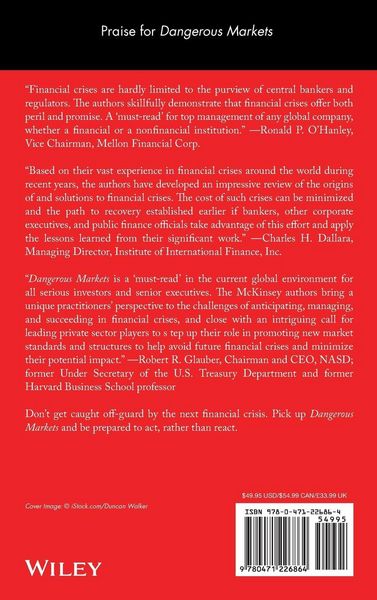
Dangerous Markets Managing in Financial Crises. McKinsey & Co.

Aus der Reihe Wiley Finance Series

Fr. 72.90

inkl. gesetzl. MwSt., Versandkostenfrei


Beschreibung

Produktdetails

Einband

Gebundene Ausgabe

Abbildungen

w. figs.

Verlag

John Wiley & Sons Inc

Seitenzahl

300

Maße (H)

23.9 cm

Gewicht

552 g

Auflage

1. Auflage

Sprache

Englisch

ISBN

978-0-471-22686-4

Beschreibung

Rezension

"an intriguing methodology to spot pre-crisis warning signs... some practical solutions" (Financial Times, 30 December 2002)
"offers a practical guide for all major participants in a financial crisis." Foreign Affairs , March 2003 (United States).

"a hefty chuck of valuable intelligence that deserves the hours of serious study it demands of a reader." Far East Economic Review, February 27, 2003 (Asia).

"highly readable and actually a quick read. . . a management toolkit, with all the tools neatly arranged. . ." Business World, October 16, 2002 (Philippines).

". . . an intriguing methodology to spot pre-crisis warning signs . . ." Financial Times, December 30, 2002 (United Kingdom).

"popular in German banking circles. . . deals with the warning signals relating to financial crises. . . and ways of dealing with them. . ." Handelsblatt, February 21/22, 2003 (Germany).

"The timing . . .couldn't be better. As political crises continue to escalate . . . companies need all the help they can get." Business Finance, February 2003 (United States).

". . .while many books discuss financial crises. . . [ Dangerous Markets presents] an action plan for managing them." Business World , October 15, 2002 (Philippines).

". . .point[s] to companies that have prospered in the past by seeing crisis as an opportunity to gain on . . . competitors." Wall Street Journal , October 14, 2002 (Asia).

". . . the ability of managers to . . . turn [changes] into opportunities . . . leads to many successful stories of companies highlighted in the book." Jakarta Post , October 12, 2002 (Indonesia).

Produktdetails

Einband

Gebundene Ausgabe

Abbildungen

w. figs.

Verlag

John Wiley & Sons Inc

Seitenzahl

300

Maße (H)

23.9 cm

Gewicht

552 g

Auflage

1. Auflage

Sprache

Englisch

ISBN

978-0-471-22686-4

Noch keine Bewertungen vorhanden

Verfassen Sie die erste Bewertung zu diesem Artikel

Helfen Sie anderen Kundinnen und Kunden durch Ihre Meinung.

Kundinnen und Kunden meinen

Bewertungen (0)

  • Produktbild: Dangerous Markets
  • Preface.

    Why Manage Financial Crises Proactively?

    Why We Wrote Dangerous Markets.

    Acknowledgments.

    CHAPTER 1: Introduction to Dangerous Markets.

    Financial Storms Are Destabilizing.

    Financial Crises Can Be Understood, Anticipated, Managed, and Prevented.

    What This Book Is and Is Not.

    Who Needs to Read Dangerous Markets?

    Part I: Understanding Financial Crises.

    Part II: Earning the Right to Win.

    Part III: Managing Unique Banking Risks.

    Part IV: Building for the Future.

    PART I: Understanding Financial Crises.

    CHAPTER 2: Recognizing New Global Market Realities.

    Increasing Risk of Financial Crises.

    Why Financial Crises Are on the Rise.

    You Can Run, But You Can t Hide From Crises.

    Looking Ahead.

    CHAPTER 3: Using Crisis Dynamics to See Growing Risks.

    The Chronology of a Crisis.

    The Dynamics of a Financial Crisis.

    The Corporate Sector: Assessing Value Destruction.

    The Financial Sector: Banks in Distress.

    Understanding the Impact of Macroeconomic Catalysts, Foreign Funding, and Asset Bubbles.

    Conclusions and Outlook for Future Crises.

    Appendix 3.1: Ten Warning Signs of a Financial Crisis.

    Appendix 3.2: Estimating Value Destruction in the Economy.

    Appendix 3.3: Why Corporate Sectors Underperform in Crisis Economies.

    PART II: Earning the Right to Win.

    CHAPTER 4: Managing the First Hundred Days.

    Taking Five Tactical Steps When a Crisis Hits.

    Developing a Crisis Management Approach.

    Managing the CEO Agenda.

    Appendix 4.1: Painting the Picture of a Financial Crisis.

    Appendix 4.2: How Companies Can Strengthen Funding Before a Crisis.

    Appendix 4.3: Using Scenario Planning in Financial Crises.

    CHAPTER 5: Capturing Strategic Opportunities After the Storm.

    Recognizing Significant Opportunities in a Crisis.

    Moving from Boundaries to Greater Degrees of Freedom.

    Executing Successfully to Capture Crisis Opportunities.

    Appendix 5.1: Leveraging Strategic Opportunities in Financial Crises: The Successful Story of NCNB.

    PART III: Managing Unique Banking Risks.

    CHAPTER 6: Driving Successful Bank Turnarounds.

    Ensuring Turnaround Success: Seven Management Actions.

    Mellon Bank s Successful Turnaround.

    Christiana Bank s Successful Turnaround.

    Filanbanco s Failed Turnaround.

    Government Stewardship of Troubled Banks.

    Government s Role in Bank Turnaround Strategies.

    Appendix 6.1: Building a Rationale for Official Support in a Financial Crisis.

    CHAPTER 7: Minimizing Costs Through NPL Recovery Excellence.

    Developing World-Class NPL Recovery Capabilities.

    Special Issues Raised When NPLs Are Managed by Governments.

    Management Lessons: Good Banks/Bad Banks in Scandinavia.

    PART IV: Building for the Future.

    CHAPTER 8: Strengthening System Safeguards.

    Moving to Global Standards for Corporate Governance.

    Adopting Better Accounting Standards.

    Developing Capital Markets.

    Resetting Regulatory Regimes.

    Building an Effective Legal Foundation.

    Appendix 8.1: Sixteen Elements of Good Corporate Governance.

    Appendix 8.2: Singapore s Development as an International Financial Center.

    Appendix 8.3: The Discipline of the Market for Corporate Control: Issues for CEOs.

    CHAPTER 9: Designing a New, Market-Driven Financial Architecture.

    Recognizing the Limitations of Current Standards and Approaches.

    Enhancing the Private Sector s Role in Setting Standards to Reduce the Risk of Future Crises.

    Appendix 9.1: FSF Compendium of Standards.

    Endnotes.

    Glossary.

    Index.