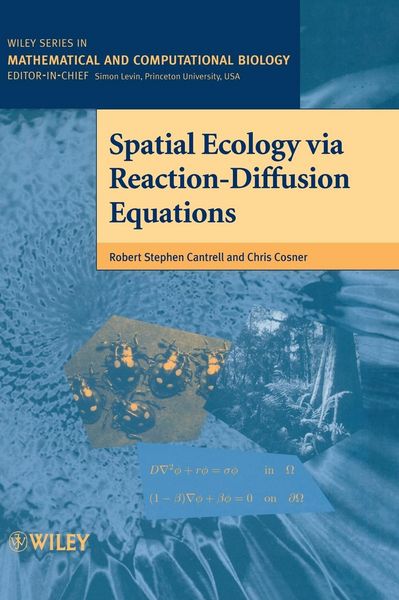
Spatial Ecology Via Reaction-Diffusion Equations
Aus der Reihe
Wiley Series in Mathematical and Computational Biology
Fr. 293.00
inkl. gesetzl. MwSt.,
Beschreibung
Produktdetails
Einband
Gebundene Ausgabe
Erscheinungsdatum
01.10.2003
Verlag
John Wiley & Sons IncSeitenzahl
432
Maße (L/B/H)
26/18.3/2.7 cm
Gewicht
997 g
Auflage
1. Auflage
Sprache
Englisch
ISBN
978-0-471-49301-3
Many ecological phenomena may be modelled using apparently random processes involving space (and possibly time). Such phenomena are classified as spatial in their nature and include all aspects of pollution. This book addresses the problem of modelling spatial effects in ecology and population dynamics using reaction-diffusion models.
* Rapidly expanding area of research for biologists and applied mathematicians
* Provides a unified and coherent account of methods developed to study spatial ecology via reaction-diffusion models
* Provides the reader with the tools needed to construct and interpret models
* Offers specific applications of both the models and the methods
* Authors have played a dominant role in the field for years
Essential reading for graduate students and researchers working with spatial modelling from mathematics, statistics, ecology, geography and biology.
* Rapidly expanding area of research for biologists and applied mathematicians
* Provides a unified and coherent account of methods developed to study spatial ecology via reaction-diffusion models
* Provides the reader with the tools needed to construct and interpret models
* Offers specific applications of both the models and the methods
* Authors have played a dominant role in the field for years
Essential reading for graduate students and researchers working with spatial modelling from mathematics, statistics, ecology, geography and biology.
Noch keine Bewertungen vorhanden
Verfassen Sie die erste Bewertung zu diesem Artikel
Helfen Sie anderen Kundinnen und Kunden durch Ihre Meinung.