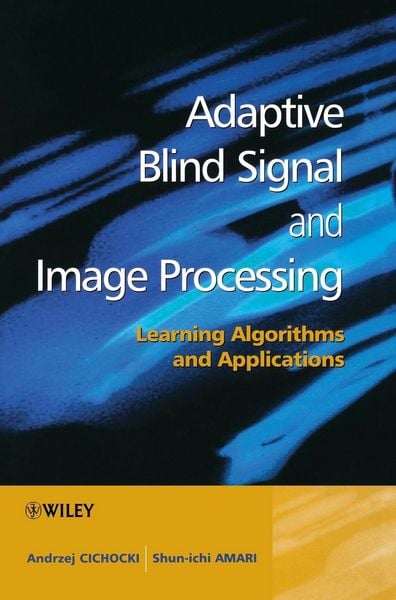
Adaptive Blind Signal Image Proc Learning Algorithms and Applications
-
- Englisch ausgewählt
Fr. 243.00
inkl. gesetzl. MwSt.,
Beschreibung
Produktdetails
Einband
Gebundene Ausgabe
Erscheinungsdatum
06.06.2002
Abbildungen
w. figs.
Verlag
John Wiley & SonsSeitenzahl
528
Maße (L/B/H)
25/17.5/3.6 cm
Gewicht
1182 g
Auflage
1. Auflage
Sprache
Englisch
ISBN
978-0-471-60791-5
With solid theoretical foundations and numerous potential applications, Blind Signal Processing (BSP) is one of the hottest emerging areas in Signal Processing. This volume unifies and extends the theories of adaptive blind signal and image processing and provides practical and efficient algorithms for blind source separation,
Independent, Principal, Minor Component Analysis, and Multichannel Blind Deconvolution (MBD) and Equalization. Containing over 1400 references and mathematical expressions Adaptive Blind Signal and Image Processing delivers an unprecedented collection of useful techniques for adaptive blind signal/image separation, extraction, decomposition and filtering of multi-variable signals and data.
* Offers a broad coverage of blind signal processing techniques and algorithms both from a theoretical and practical point of view
* Presents more than 50 simple algorithms that can be easily modified to suit the reader's specific real world problems
* Provides a guide to fundamental mathematics of multi-input, multi-output and multi-sensory systems
* Includes illustrative worked examples, computer simulations, tables, detailed graphs and conceptual models within self contained chapters to assist self study
* Accompanying CD-ROM features an electronic, interactive version of the book with fully coloured figures and text. C and MATLAB(r) user-friendly software packages are also provided
MATLAB(r) is a registered trademark of The MathWorks, Inc.
By providing a detailed introduction to BSP, as well as presenting new results and recent developments, this informative and inspiring work will appeal to researchers, postgraduate students, engineers and scientists working in biomedical engineering,
communications, electronics, computer science, optimisations, finance, geophysics and neural networks.
Independent, Principal, Minor Component Analysis, and Multichannel Blind Deconvolution (MBD) and Equalization. Containing over 1400 references and mathematical expressions Adaptive Blind Signal and Image Processing delivers an unprecedented collection of useful techniques for adaptive blind signal/image separation, extraction, decomposition and filtering of multi-variable signals and data.
* Offers a broad coverage of blind signal processing techniques and algorithms both from a theoretical and practical point of view
* Presents more than 50 simple algorithms that can be easily modified to suit the reader's specific real world problems
* Provides a guide to fundamental mathematics of multi-input, multi-output and multi-sensory systems
* Includes illustrative worked examples, computer simulations, tables, detailed graphs and conceptual models within self contained chapters to assist self study
* Accompanying CD-ROM features an electronic, interactive version of the book with fully coloured figures and text. C and MATLAB(r) user-friendly software packages are also provided
MATLAB(r) is a registered trademark of The MathWorks, Inc.
By providing a detailed introduction to BSP, as well as presenting new results and recent developments, this informative and inspiring work will appeal to researchers, postgraduate students, engineers and scientists working in biomedical engineering,
communications, electronics, computer science, optimisations, finance, geophysics and neural networks.
Noch keine Bewertungen vorhanden
Verfassen Sie die erste Bewertung zu diesem Artikel
Helfen Sie anderen Kundinnen und Kunden durch Ihre Meinung.