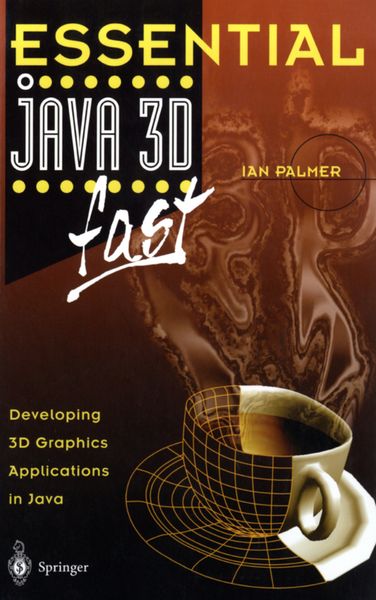
Essential Java 3D fast Developing 3D Graphics Applications in Java
Aus der Reihe
Essential Series
-
- Englisch ausgewählt
Fr. 73.90
inkl. gesetzl. MwSt.,
Beschreibung
Produktdetails
Einband
Taschenbuch
Erscheinungsdatum
08.05.2001
Abbildungen
VIII, 279 p.
Verlag
Springer LondonSeitenzahl
279
Maße (L/B/H)
23.5/15.5/1.9 cm
Gewicht
500 g
Auflage
Softcover reprint of the original 1st edition 2001
Sprache
Englisch
ISBN
978-1-85233-394-2
Packed with lots of examples and illustrations, including an 8-page colour section,
Essential Java 3D fast
is an introductory textbook for those who want to learn Java 3D fast.
The best way to learn any programming language is by writing programs. In this book, Ian Palmer takes you through the steps to write a simple program in Java 3D, and then shows you how to modify and add features to this program, so you learn the key features of Java 3D.
Learn about: Writing a simple Java 3D program;
Creating Shapes;
Defining Appearance;
Animation;
Behaviours.
The examples in this book assume a working knowledge of Java and some background in 3D graphics, in order to explain the new concepts in Java 3D.
Noch keine Bewertungen vorhanden
Verfassen Sie die erste Bewertung zu diesem Artikel
Helfen Sie anderen Kundinnen und Kunden durch Ihre Meinung.