KI-Beratung Beta

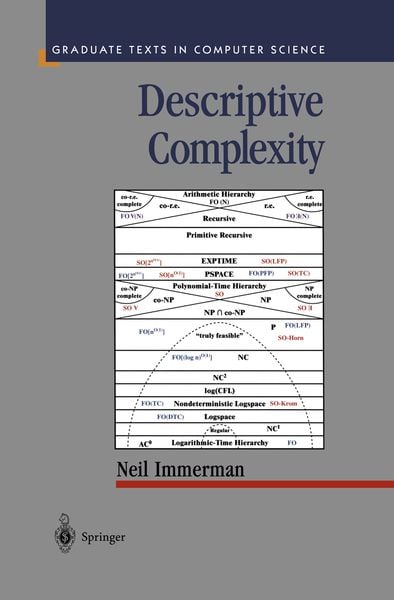
  • Produktbild: Descriptive Complexity
  • Produktbild: Descriptive Complexity

Descriptive Complexity

Fr. 157.00

inkl. gesetzl. MwSt., Versandkostenfrei


Beschreibung

Produktdetails

Einband

Gebundene Ausgabe

Erscheinungsdatum

20.11.1998

Abbildungen

XVI, w. mit 41 Illustrationen 24,5 cm

Verlag

Springer Us

Seitenzahl

268

Maße (L/B/H)

24.2/16/1.8 cm

Gewicht

622 g

Auflage

1999

Sprache

Englisch

ISBN

978-0-387-98600-5

Beschreibung

Produktdetails

Einband

Gebundene Ausgabe

Erscheinungsdatum

20.11.1998

Abbildungen

XVI, w. mit 41 Illustrationen 24,5 cm

Verlag

Springer Us

Seitenzahl

268

Maße (L/B/H)

24.2/16/1.8 cm

Gewicht

622 g

Auflage

1999

Sprache

Englisch

ISBN

978-0-387-98600-5

Herstelleradresse

Libri GmbH
Europaallee 1
36244 Bad Hersfeld
DE

Email: gpsr@libri.de

Noch keine Bewertungen vorhanden

Verfassen Sie die erste Bewertung zu diesem Artikel

Helfen Sie anderen Kundinnen und Kunden durch Ihre Meinung.

Kundinnen und Kunden meinen

Bewertungen (0)

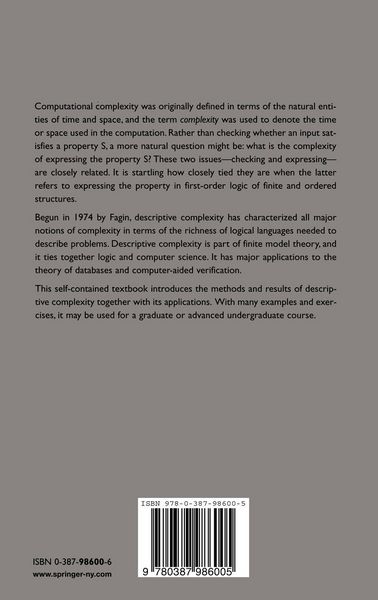
  • Produktbild: Descriptive Complexity
  • Produktbild: Descriptive Complexity
  • 1 Background in Logic.- 1.1 Introduction and Preliminary Definitions.- 1.2 Ordering and Arithmetic.- 1.2.1 FO(BIT) = FO(PLUS, TIMES).- 1.3 Isomorphism.- 1.4 First-Order Queries.- 2 Background in Complexity.- 2.1 Introduction.- 2.2 Preliminary Definitions.- 2.3 Reductions and Complete Problems.- 2.4 Alternation.- 2.5 Simultaneous Resource Classes.- 2.6 Summary.- 3 First-Order Reductions.- 3.1 FO ? L.- 3.2 Dual of a First-Order Query.- 3.3 Complete problems for L and NL.- 3.4 Complete Problems for P.- 4 Inductive Definitions.- 4.1 Least Fixed Point.- 4.2 The Depth of Inductive Definitions.- 4.3 Iterating First-Order Formulas.- 5 Parallelism.- 5.1 Concurrent Random Access Machines.- 5.2 Inductive Depth Equals Parallel Time.- 5.3 Number of Variables Versus Number of Processors.- 5.4 Circuit Complexity.- 5.5 Alternating Complexity.- 5.5.1 Alternation as Parallelism.- 6 Ehrenfeucht-Fraïssé Games.- 6.1 Definition of the Games.- 6.2 Methodology for First-Order Expressibility.- 6.3 First-Order Properties Are Local.- 6.4 Bounded Variable Languages.- 6.5 Zero-One Laws.- 6.6 Ehrenfeucht-Fraïssé Games with Ordering.- 7 Second-Order Logic and Fagin’s Theorem.- 7.1 Second-Order Logic.- 7.2 Proof of Fagin’s Theorem.- 7.3 NP-Complete Problems.- 7.4 The Polynomial-Time Hierarchy.- 8 Second-Order Lower Bounds.- 8.1 Second-Order Games.- 8.2 SO?(monadic) Lower Bound on Reachability.- 8.3 Lower Bounds Including Ordering.- 9 Complementation and Transitive Closure.- 9.1 Normal Form Theorem for FO(LFP).- 9.2 Transitive Closure Operators.- 9.3 Normal Form for FO(TC).- 9.4 Logspace is Primitive Recursive.- 9.5 NSPACE[s(n)] = co-NSPACE[s(n)].- 9.6 Restrictions of SO.- 10 Polynomial Space.- 10.1 Complete Problems for PSPACE.- 10.2 Partial Fixed Points.- 10.3 DSPACE[nk] = VAR[k + 1].- 10.4 Using Second-Order Logic to Capture PSPACE.- 11 Uniformity and Precompulation.- 11.1 An Unbounded Number of Variables.- 11.1.1 Tradeoffs Between Variables and Quantifier Depth.- 11.2 First-Order Projections.- 11.3 Help Bits.- 11.4 Generalized Quantifiers.- 12 The Role of Ordering.- 12.1 Using Logic to Characterize Graphs.- 12.2 Characterizing Graphs Using Lk.- 12.3 Adding Counting to First-Order Logic.- 12.4 Pebble Games for Ck.- 12.5 Vertex Refinement Corresponds to C2.- 12.6 Abiteboul-Vianu and Otto Theorems.- 12.7 Toward a Language for Order-Independent P.- 13 Lower Bounds.- 13.1 Håstad’s Switching Lemma.- 13.2 A Lower Bound for REACHa.- 13.3 Lower Bound for Fixed Point and Counting.- 14 Applications.- 14.1 Databases.- 14.1.1 SQL.- 14.1.2 Catalog.- 14.2 Dynamic Complexity.- 14.2.1 Dynamic Complexity Classes.- 14.3 Model Checking.- 14.3.1 Temporal Logic.- 14.4 Summary.- 15 Conclusions and Future Directions.- 15.1 Languages That Capture Complexity Classes.- 15.1.1 Complexity on the Face of a Query.- 15.1.2 Stepwise Refinement.- 15.2 Why Is Finite Model Theory Appropriate?.- 15.3 Deep Mathematical Problems: P versus NP.- 15.4 Toward Proving Lower Bounds.- 15.4.1 Role of Ordering.- 15.4.2 Approximation and Approximability.- 15.5 Applications of Descriptive Complexity.- 15.5.1 Dynamic Complexity.- 15.5.2 Model Checking.- 15.5.3 Abstract State Machines.- 15.6 Software Crisis and Opportunity.- 15.6.1 How can Finite Model Theory Help?.- References.