Growth and Profitability Optimizing the Finance Function for Small and Emerging Businesses
Fr. 66.90
inkl. gesetzl. MwSt.,
Beschreibung
Produktdetails
Einband
Gebundene Ausgabe
Abbildungen
w. figs.
Verlag
John Wiley & SonsSeitenzahl
258
Maße (H)
23.6 cm
Gewicht
542 g
Auflage
1. Auflage
Sprache
Englisch
ISBN
978-0-471-21216-4
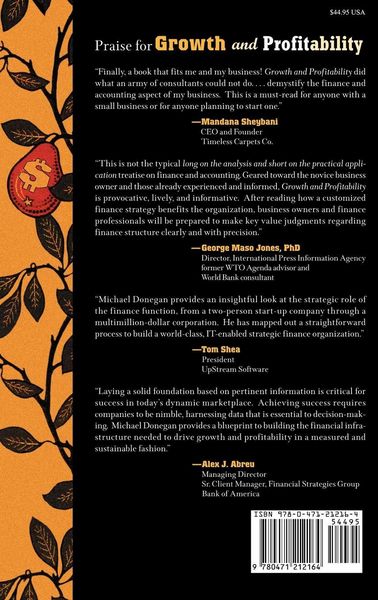
Praise for Growth and Profitability
"Finally, a book that fits me and my business! Growth and Profitability did what an army of consultants could not do. . . . demystify the finance and accounting aspect of my business. This is a must-read for anyone with a small business or for anyone planning to start one."
-- Mandana Sheybani
CEO and Founder
Timeless Carpets Co.
"This is not the typical long on the analysis and short on the practical application treatise on finance and accounting. Geared toward the novice business owner and those already experienced and informed, Growth and Profitability is provocative, lively, and informative. After reading how a customized finance strategy benefits the organization, business owners and finance professionals will be prepared to make key value judgments regarding finance structure clearly and with precision."
-- George Maso Jones, PhD
Director, International Press Information Agency
former WTO Agenda advisor and World Bank consultant
"Michael Donegan provides an insightful look at the strategic role of the finance function, from a two-person start-up company through a multimillion-dollar corporation. He has mapped out a straightforward process to build a world-class, IT-enabled strategic finance organization."
-- Tom Shea
President
UpStream Software
"Laying a solid foundation based on pertinent information is critical for success in today s dynamic marketplace. Achieving success requires companies to be nimble, harnessing data that is essential to decision-making. Michael Donegan provides a blueprint to building the financial infrastructure needed to drive growth and profitability in a measured and sustainable fashion."
-- Alex J. Abreu
Managing Director
Sr. Client Manager, Financial Strategies Group
Bank of America
"Finally, a book that fits me and my business! Growth and Profitability did what an army of consultants could not do. . . . demystify the finance and accounting aspect of my business. This is a must-read for anyone with a small business or for anyone planning to start one."
-- Mandana Sheybani
CEO and Founder
Timeless Carpets Co.
"This is not the typical long on the analysis and short on the practical application treatise on finance and accounting. Geared toward the novice business owner and those already experienced and informed, Growth and Profitability is provocative, lively, and informative. After reading how a customized finance strategy benefits the organization, business owners and finance professionals will be prepared to make key value judgments regarding finance structure clearly and with precision."
-- George Maso Jones, PhD
Director, International Press Information Agency
former WTO Agenda advisor and World Bank consultant
"Michael Donegan provides an insightful look at the strategic role of the finance function, from a two-person start-up company through a multimillion-dollar corporation. He has mapped out a straightforward process to build a world-class, IT-enabled strategic finance organization."
-- Tom Shea
President
UpStream Software
"Laying a solid foundation based on pertinent information is critical for success in today s dynamic marketplace. Achieving success requires companies to be nimble, harnessing data that is essential to decision-making. Michael Donegan provides a blueprint to building the financial infrastructure needed to drive growth and profitability in a measured and sustainable fashion."
-- Alex J. Abreu
Managing Director
Sr. Client Manager, Financial Strategies Group
Bank of America
Noch keine Bewertungen vorhanden
Verfassen Sie die erste Bewertung zu diesem Artikel
Helfen Sie anderen Kundinnen und Kunden durch Ihre Meinung.