Gutscheinbedingungen

*Gültig bis 20.07.2026 auf alle Bücher. Ausgeschlossen sind Zeitschriften, Prozentbücher und Abos | Einlösbar in allen Buchhandlungen von Orell Füssli, Barth Bücher, Buchladen Rapunzel, Papeterie Köhler, Schuler Orell Füssli, Stauffacher und ZAP unter Vorweisung des Gutscheins, auf www.orellfüssli.ch durch Eingabe des Gutscheincodes. Beim Service „eBooks verschenken“ und bei eBook-Käufen via eReader nicht einlösbar | Mindesteinkaufswert: Fr. 30.- | Nicht mit anderen Rabatten kumulierbar.

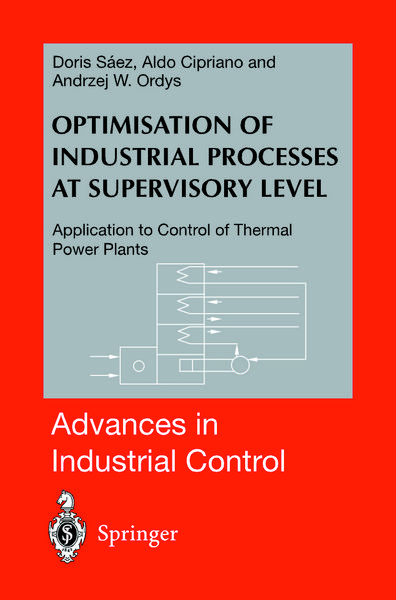
  • Produktbild: Optimisation of Industrial Processes at Supervisory Level
  • Produktbild: Optimisation of Industrial Processes at Supervisory Level

Optimisation of Industrial Processes at Supervisory Level Application to Control of Thermal Power Plants

Fr. 137.00

inkl. gesetzl. MwSt., Versandkostenfrei


Beschreibung

Produktdetails

Einband

Gebundene Ausgabe

Erscheinungsdatum

05.10.2001

Abbildungen

XVI, 60 schwarzweisse Abbildungen

Verlag

Springer London

Seitenzahl

187

Maße (L/B/H)

24.1/16/1.6 cm

Gewicht

1040 g

Auflage

2002

Sprache

Englisch

ISBN

978-1-85233-386-7

Beschreibung

Produktdetails

Einband

Gebundene Ausgabe

Erscheinungsdatum

05.10.2001

Abbildungen

XVI, 60 schwarzweisse Abbildungen

Verlag

Springer London

Seitenzahl

187

Maße (L/B/H)

24.1/16/1.6 cm

Gewicht

1040 g

Auflage

2002

Sprache

Englisch

ISBN

978-1-85233-386-7

Herstelleradresse

Springer-Verlag KG
Sachsenplatz 4-6
1201 Wien
AT

Email: GPSR Kontakt

Noch keine Bewertungen vorhanden

Verfassen Sie die erste Bewertung zu diesem Artikel

Helfen Sie anderen Kundinnen und Kunden durch Ihre Meinung.

Kundinnen und Kunden meinen

Bewertungen (0)

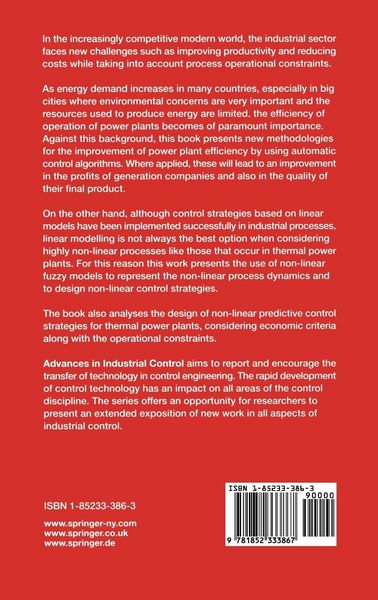
  • Produktbild: Optimisation of Industrial Processes at Supervisory Level
  • Produktbild: Optimisation of Industrial Processes at Supervisory Level
  • Content.- 1. Introduction.- 2. Non-linear Dynamic Modelling for Control Design.- 2.1 Introduction.- 2.2 Fundamentals of Fuzzy Logic.- 2.2.1 Basic Definitions.- 2.2.2 Basic Operations for Fuzzy Sets.- 2.3 Dynamic Models Based on Fuzzy Logic.- 2.3.1 Linguistic Fuzzy Models.- 2.3.2 Takagi-and-Sugeno Models.- 2.3.3 Position Models and Models of Gradient Position.- 2.3.4 Fuzzy Relational Models.- 2.3.5 Radial Basis Function Network - a Fuzzy Approach.- 2.4 Parameters Estimation.- 2.5 Structure Identification.- 2.6 Discussion.- 2.7 A New Structure Identification Method for Fuzzy Models.- 2.7.1 Identification Procedure.- 2.7.2 Sensitivity Analysis.- 2.7.3 Application Examples.- 2.7.4 Application to Thermal Power Plant “Nueva Renca”.- 2.7.5 Analysis of Results.- 3. Non-linear Predictive Control.- 3.1 Fundamentals of Predictive Control.- 3.2 Literature Review.- 3.3 Prediction from Linear Models.- 3.4 Linear Predictive Control Algorithms.- 3.4.1 Generalised Predictive Control.- 3.4.2 Dynamic Matrix Control.- 3.5 Prediction for Non-linear Models.- 3.6 Non-linear Predictive Control.- 3.6.1 MBPC Based on Fuzzy Relational Models.- 3.6.2 Fuzzy Predictive Control Algorithms Based on Takagi-and-Sugeno Models.- 3.7 Discussion.- 4. Supervisory Optimal Control for a Pre-specified Regulatory Level.- 4.1 Problem Statement.- 4.1.1 Process Modelling.- 4.1.2 Modelling of the Regulatory Level.- 4.1.3 General Objective Function and Constraints.- 4.2 Alternative Solutions.- 4.2.1 Direct Method.- 4.2.2 Indirect Method.- 4.3 Supervisory Controller Design Based on Linear Models.- 4.3.1 Problem Statement.- 4.3.2 Supervisory Controller Without Constraints.- 4.3.3 Supervisory Controller with Constraints.- 4.4 Supervisory Controller Design Based on Non-linear Models.- 4.4.1 Problem Statement.- 4.4.2 Non-linear Supervisory Controller Without Constraints.- 4.4.3 Non-linear Supervisory Controller with Constraints.- 4.5 Application to a Boiler System.- 4.5.1 Boiler System Simulator.- 4.5.2 Problem Statement.- 4.5.3 Supervisory Controller.- 4.5.4 Comparative Analysis.- 4.6 Discussion.- 5. Application to the Control of Thermal Power Plants.- 5.1 Modelling and Simulation of a Combined Cycle Power Plant.- 5.1.1 Process Description.- 5.1.2 Analysis of the Different Models.- 5.1.3 Formulation of Combined Cycle Power Plant Model.- 5.1.4 Simulator for MATLAB®-SMMULINK® Environment.- 5.1.5 Simulator Tests.- 5.2 Control of Thermal Power Plant Boiler.- 5.2.1 Analysis of Different Control Strategies.- 5.2.2 Statement of the Supervisory Optimal Control Problem.- 5.2.3 Supervisory Control Based on a Linear Model of the Boiler.- 5.2.4 Supervisory Control Based on a Non-linear Model of the Boiler.- 5.2.5 Analysis of Results.- 6. Discussion and Conclusions.- Appendix A. Sensitivity Analysis Program.- Appendix B. Prediction of Controlled Variables and Manipulated Variables.- B.1 Prediction of Controlled Variables.- B.2 Prediction of Manipulated Variables.- Appendix C. Special Cases of Polynomial Cancellations.- C.1 A Quadratic Objective Function of the Manipulated Variables at the Supervisory Level.- C.2 A GPC Objective Function at the Supervisory Level.- Appendix D. Supervisory Controller Programs.- D.1 Direct Method.- D.2 Indirect Method.- D.3 One-step Fuzzy Predictor.- D.4 Multi-step Fuzzy Predictor.- Appendix E. Main Variables of a Combined Cycle Thermal Power Plant.- E.1 Boiler.- E.1.1 Furnace.- E.1.2 Risers.- E.1.3 Drum.- E.1.4 Superheater.- E.1.5 Reheater.- E.1.6 Economiser.- E.2 Steam Turbine.- E.2.1 The High Pressure Turbine.- E.2.2 The Intermediate Pressure Turbine.- E.2.3 The Low Pressure Turbine.- E.2.4 Steam Turbine.- E.3 Gas Turbine.- E.3.1 Compressor.- E.3.2 Combustion Chamber.- E.3.3 Turbine.- Appendix F. Simulator Programs in MATLAB®-SIMULINK®.- F.1 Boiler.- F.1.1 Furnace.- F.1.2 Risers.- F.1.3 Drum.- F.1.4 Superheater.- F.1.5 Reheater.- F.1.6 Economiser.- F.2 Steam Turbine.- F.2.1 The High Pressure Turbine.- F.2.2 The Intermediate Pressure Turbine.- F.2.3 The Low Pressure Turbine.- F.3 Gas Turbine.- F.3.1 Compressor.- F.3.2 Combustion Chamber.- F.3.3 Turbine.- References.