• Produktbild: Automated Deduction - CADE-11
  • Produktbild: Automated Deduction - CADE-11

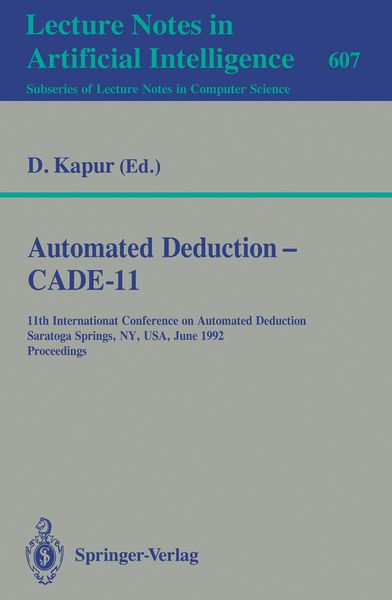
Automated Deduction - CADE-11 11th International Conference on Automated Deduction, Saratoga Springs, NY, USA, June 15-18, 1992. Proceedings.

Fr. 137.00

inkl. gesetzl. MwSt., Versandkostenfrei


Beschreibung

Produktdetails

Einband

Taschenbuch

Erscheinungsdatum

27.05.1992

Herausgeber

Deepak Kapur

Verlag

Springer Berlin

Seitenzahl

800

Maße (L/B/H)

23.5/15.5/4.3 cm

Gewicht

1212 g

Auflage

1992

Sprache

Englisch

ISBN

978-3-540-55602-2

Beschreibung

Produktdetails

Einband

Taschenbuch

Erscheinungsdatum

27.05.1992

Herausgeber

Deepak Kapur

Verlag

Springer Berlin

Seitenzahl

800

Maße (L/B/H)

23.5/15.5/4.3 cm

Gewicht

1212 g

Auflage

1992

Sprache

Englisch

ISBN

978-3-540-55602-2

Herstelleradresse

Springer-Verlag KG
Sachsenplatz 4-6
1201 Wien
AT

Email: ProductSafety@springernature.com

Kundinnen und Kunden meinen

0 Bewertungen

Informationen zu Bewertungen

Zur Abgabe einer Bewertung ist eine Anmeldung im Konto notwendig. Die Authentizität der Bewertungen wird von uns nicht überprüft. Wir behalten uns vor, Bewertungstexte, die unseren Richtlinien widersprechen, entsprechend zu kürzen oder zu löschen.

Die Bewertungen sind nach Format, Anzahl Sterne und Datum sortiert.

Verfassen Sie die erste Bewertung zu diesem Artikel

Helfen Sie anderen Kund*innen durch Ihre Meinung

Kundinnen und Kunden meinen

0 Bewertungen filtern

  • Produktbild: Automated Deduction - CADE-11
  • Produktbild: Automated Deduction - CADE-11
  • The impossibility of the automation of logical reasoning.- Automatic proofs in mathematical logic and analysis.- Proving geometry statements of constructive type.- The central variable strategy of str?ve.- Unification in the union of disjoint equational theories: Combining decision procedures.- Reduction and unification in Lambda calculi with subtypes.- A combinatory logic approach to higher-order E-unification (extended abstract).- Cycle unification.- A parallel completion procedure for term rewriting systems.- Grammar rewriting.- Polynomial interpretations and the complexity of algorithms.- Uniform traversal combinators: Definition, use and properties.- Sorted unification using set constraints.- An abstract view of sorted unification.- Unification in order-sorted algebras with overloading.- Puzzles and paradoxes.- Experiments in automated deduction with condensed detachment.- Caching and lemmaizing in model elimination theorem provers.- LIM+ challenge problems by RUE hyper-resolution.- Computing prime implicates incrementally.- Linear-input subset analysis.- Theoretical study of symmetries in propositional calculus and applications.- Difference matching.- Using middle-out reasoning to control the synthesis of tail-recursive programs.- The use of proof plans to sum series.- Disproving conjectures.- An interval-based temporal logic in a multivalued setting.- A normal form for first-order temporal formulae.- Semantic entailment in non classical logics based on proofs found in classical logic.- Embedding negation as failure into a model generation theorem prover.- Automated correctness proofs of machine code programs for a commercial microprocessor.- Proving the Chinese remainder theorem by the cover set induction.- Automatic program optimization through proof transformation.- Proof search theory and practice in the (former) USSR (Tentative).- Basic paramodulation and superposition.- Theorem proving with ordering constrained clauses.- The special-relation rules are incomplete.- An improved method for adding equality to free variable semantic tableaux.- Proof search in the intuitionistic sequent calculus.- Implementing the meta-theory of deductive systems.- Tactic-based theorem proving and knowledge-based forward chaining: An experiment with Nuprl and Ontic.- Little theories.- Some termination criteria for narrowing and E-narrowing.- Decidable matching for convergent systems.- Free sequentially in orthogonal order-sorted rewriting systems with constructors.- Programming with equations: A framework for lazy parallel evaluation.- A many sorted logic with possibly empty sorts.- Theorem proving in non-standard logics based on the inverse method.- One more logic with uncertainty and resolution principle for it.- A natural deduction automated theorem proving system.- Isabelle-91.- The semantically guided linear deduction system.- The Shunyata system.- A geometry theorem prover for macintoshes.- FRI: Failure-resistant induction in RRL.- Herky: High performance rewriting in RRL.- IMPS: System description.- Proving equality theorems with hyper-linking.- Xpnet: A graphical interface to proof nets with an efficient proof checker.- &: Automated natural deduction.- An overview of Frapps 2.0: A framework for resolution-based automated proof procedure systems.- The GAZER theorem prover.- ROO: A parallel theorem prover.- RVF: An automated formal verification system.- KPROP — An AND-parallel theorem prover for propositional logic implemented in KL1 system abstract.- A report on ICL HOL.- PVS: A prototype verification system.- The KIV system: Systematic construction of verified software.- The tableau-based theorem prover 3 T A P for multiple-valued logics.- Analytica — A theorem prover in mathematica.- The FAUST — prover.- Eves system description.- MGTP: A parallel theorem prover based on lazy model generation.- Benchmark problems in which equality plays the major role.- Computing transitivity tables: A challenge for automated theorem provers.