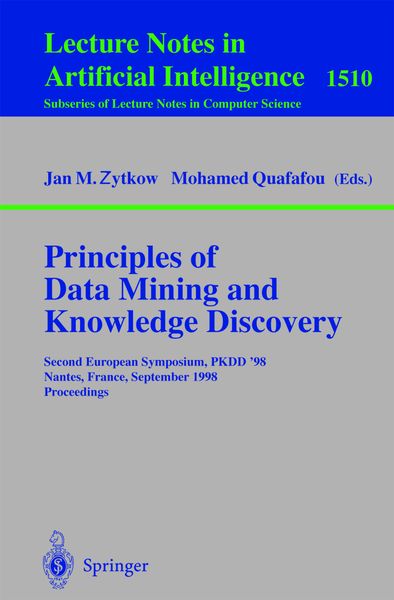
Produktbild: Principles of Data Mining and Knowledge Discovery

Principles of Data Mining and Knowledge Discovery Second European Symposium, PKDD '98, Nantes, France, September 23-26, 1998. Proceedings

Fr. 72.90

inkl. gesetzl. MwSt., Versandkostenfrei


Beschreibung

Produktdetails

Einband

Taschenbuch

Erscheinungsdatum

09.09.1998

Herausgeber

Jan M. Zytkow + weitere

Verlag

Springer Berlin

Seitenzahl

484

Maße (L/B/H)

23.5/15.5/2.6 cm

Gewicht

750 g

Auflage

1998

Sprache

Englisch

ISBN

978-3-540-65068-3

Beschreibung

Produktdetails

Einband

Taschenbuch

Erscheinungsdatum

09.09.1998

Herausgeber

Verlag

Springer Berlin

Seitenzahl

484

Maße (L/B/H)

23.5/15.5/2.6 cm

Gewicht

750 g

Auflage

1998

Sprache

Englisch

ISBN

978-3-540-65068-3

Herstelleradresse

Springer-Verlag KG
Sachsenplatz 4-6
1201 Wien
AT

Email: GPSR Kontakt

Noch keine Bewertungen vorhanden

Verfassen Sie die erste Bewertung zu diesem Artikel

Helfen Sie anderen Kundinnen und Kunden durch Ihre Meinung.

Kundinnen und Kunden meinen

Bewertungen (0)

  • Produktbild: Principles of Data Mining and Knowledge Discovery
  • On objective measures of rule surprisingness.- Discovery of surprising exception rules based on intensity of implication.- A metric for selection of the most promising rules.- For visualization-based analysis tools in knowledge discovery process: A multilayer perceptron versus principal components analysis: A comparative study.- Trend graphs: Visualizing the evolution of concept relationships in large document collections.- Ranked rules and data visualization.- TextVis: An integrated visual environment for text mining.- Text mining at the term level.- A new algorithm for faster mining of generalized association rules.- Knowledge discovery with clustering based on rules. Interpreting results.- Efficient construction of comprehensible hierarchical clusterings.- Cost sensitive discretization of numeric attributes.- Handling KDD process changes by incremental replanning.- Object mining: A practical application of data mining for the construction and maintenance of software components.- A relational data mining tool based on genetic programming.- Inducing cost-sensitive trees via instance weighting.- Model switching for bayesian classification trees with soft splits.- Interactive visualisation for predictive modelling with decision tree induction.- Discovery of diagnostic patterns from protein sequence databases.- The PSP approach for mining sequential patterns.- Knowledge discovery in spatial data by means of ILP.- Querying inductive databases: A case study on the MINE RULE operator.- Classes of four-fold table quantifiers.- Detection of interdependences in attribute selection.- Postponing the evaluation of attributes with a high number of boundary points.- A hybrid approach to feature selection.- Discretization and grouping: Preprocessing steps for data mining.- Fuzzy spatial OQL for fuzzy knowledge discovery in databases.- Extended functional dependencies as a basis for linguistic summaries.- A comparison of batch and incremental supervised learning algorithms.- Knowledge Discovery with qualitative influences and synergies.- Language support for temporal data mining.- Resampling in an indefinite database to approximate functional dependencies.- Knowledge discovery from client-server databases.- Discovery of common subsequences in cognitive evoked potentials.- Improving the discovery of association rules with intensity of implication.- Generalization lattices.- Overcoming fragmentation in decision trees through attribute value grouping.- Data mining at a major bank: Lessons from a large marketing application.- PolyAnalyst data analysis technique and its specialization for processing data organized as a set of attribute values.- Representative association rules and minimum condition maximum consequence association rules.- Discovery of decision rules from databases: An evolutionary approach.- Using loglinear clustering for subcategorization identification.- Exploratory attributes search for time-series data: An experimental system for agricultural application.- A procedure to compute prototypes for data mining in non-structured domains.- From the data mine to the knowledge mill: Applying the principles of lexical analysis to the data mining and knowledge discovery process.- Preprocessing of missing values using robust association rules.- Similarity-driven sampling for data mining.- Modeling the business process by mining multiple databases.- Data transformation and rough sets.- Conceptual Knowledge Discovery in Databases using formal concept analysis methods.- Clasitex+: A tool for knowledge discovery from texts.- Discovery of approximate medical knowledge based on rough set model.- Scalable, high-performance data mining with parallel processing.- Practical text mining.- Industrial applications of data mining.