Gutscheinbedingungen

*Gültig bis 20.09.2026 auf (fast) alles. Ausgeschlossen sind Smartboxen, Zeitschriften, Tickets, Lebensmittel, Gaming-Elektroartikel, Tinte/Toner, Gutscheine, Geschenkkarten, Blumen und Abos | Einlösbar in allen Buchhandlungen von Orell Füssli, Barth Bücher, Buchladen Rapunzel, Schuler Orell Füssli, Stauffacher und ZAP unter Vorweisung des Gutscheins, auf www.orellfüssli.ch durch Eingabe des Gutscheincodes. Beim Service „eBooks verschenken“ und bei eBook-Käufen via eReader nicht einlösbar | Mindesteinkaufswert: Fr. 100.- | Nicht mit anderen Rabatten kumulierbar.

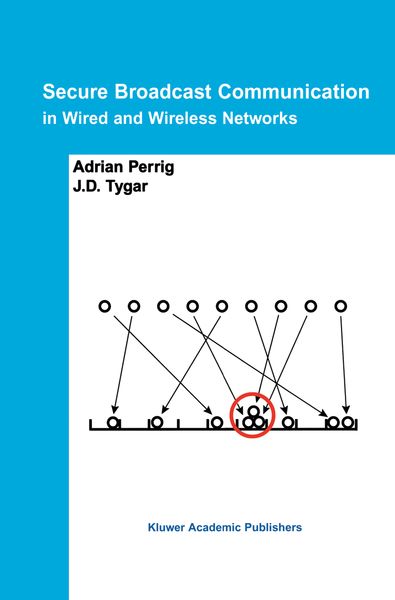
  • Produktbild: Secure Broadcast Communication
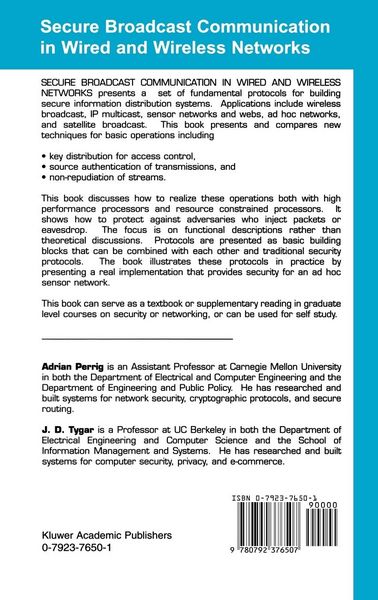
  • Produktbild: Secure Broadcast Communication

Secure Broadcast Communication In Wired and Wireless Networks

Fr. 138.00

inkl. gesetzl. MwSt., Versandkostenfrei


Beschreibung

Produktdetails

Einband

Gebundene Ausgabe

Erscheinungsdatum

30.11.2002

Abbildungen

XIX, 214 p.

Verlag

Springer Us

Seitenzahl

214

Maße (L/B/H)

24.1/16/1.8 cm

Gewicht

535 g

Auflage

2003

Sprache

Englisch

ISBN

978-0-7923-7650-7

Beschreibung

Produktdetails

Einband

Gebundene Ausgabe

Erscheinungsdatum

30.11.2002

Abbildungen

XIX, 214 p.

Verlag

Springer Us

Seitenzahl

214

Maße (L/B/H)

24.1/16/1.8 cm

Gewicht

535 g

Auflage

2003

Sprache

Englisch

ISBN

978-0-7923-7650-7

Herstelleradresse

Springer-Verlag KG
Sachsenplatz 4-6
1201 Wien
AT

Email: ProductSafety@springernature.com

Noch keine Bewertungen vorhanden

Verfassen Sie die erste Bewertung zu diesem Artikel

Helfen Sie anderen Kundinnen und Kunden durch Ihre Meinung.

Kundinnen und Kunden meinen

Bewertungen (0)

  • Produktbild: Secure Broadcast Communication
  • Produktbild: Secure Broadcast Communication
  • 1. Introduction.- 1.1 Challenges of Broadcast Communication.- 1.2 Why is Security for Broadcasts Hard?.- 1.3 Security Requirements for Broadcast Applications.- 1.4 Novel Contributions.- 1.5 Scope of this Book.- 1.6 Book Overview.- 2. Cryptographic Fundamentals.- 2.1 Broadcast Network Requirements.- 2.2 Cryptographic Primitives.- 2.3 Efficiency of Cryptographic Primitives.- 2.4 Commitment Protocols.- 3. Tesla Broadcast Authentication.- 3.1 Requirements for Broadcast Authentication.- 3.2 The Basic TESLA Protocol.- 3.3 TIK: TESLA with Instant Key Disclosure.- 3.4 Time Synchronization.- 3.5 Variations.- 3.6 Denial-of-Service Protection.- 4. Biba Broadcast Authentication.- 4.1 The BiBa Signature Algorithm.- 4.2 The BiBa Broadcast Authentication Protocol.- 4.3 BiBa Broadcast Protocol Extensions.- 4.4 Practical Considerations.- 4.5 Variations and Extensions.- 4.6 One-Round BiBa is as secure as Multi-Round BiBa.- 4.7 Merkle Hash Trees for Ball Authentication.- 5. Emss, Mess, & Htss: Signatures for Broadcast.- 5.1 Efficient Multicast Stream Signature (EMSS).- 5.2 MESS.- 5.3 Variations.- 5.4 HTSS.- 6. Elk Key Distrubution.- 6.1 Introduction.- 6.2 Review of the LKH Key Distribution Protocol.- 6.3 Review of the OFT Key Distribution Protocol.- 6.4 Reliability for Key Update Messages.- 6.5 Four Basic Techniques.- 6.6 ELK: Efficient Large-Group Key Distribution.- 6.7 Applications and Practical Issues.- 6.8 Appendix.- 7. Sensor Network Security.- 7.1 Background.- 7.2 System Assumptions.- 7.3 Requirements for Sensor Network Security.- 7.4 Additional Notation.- 7.5 SNEP and µTESLA.- 7.6 Implementation.- 7.7 Evaluation.- 7.8 Application of SNEP: Node-to-Node Key Agreement.- 8. Related Work.- 8.1 General Broadcast Security.- 8.2 Broadcast Authentication.- 8.3 Broadcast Signature.- 8.4Digital Signatures Based on One-way Functions without Trapdoors.- 8.5 Small-Group Key Agreement.- 8.6 Large-Group Key Distribution.- 9. Conclusion.- 9.1 Open Problems.- 10. Glossary.