Band 49
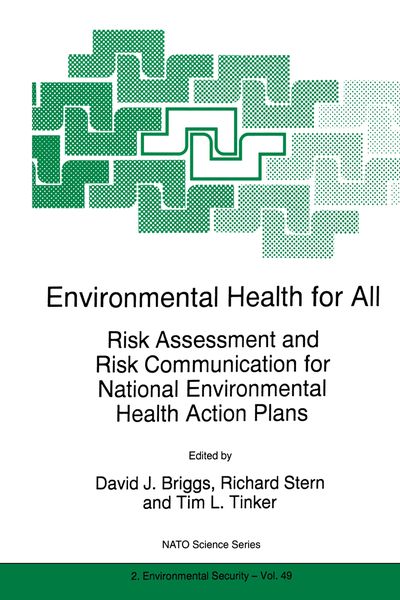
Environmental Health for All Risk Assessment and Risk Communication for National Environmental Health Action Plans
Aus der Reihe
NATO Science Partnership Subseries: 2
-
- Hardcover ausgewählt
- Taschenbuch
- eBook
-
Sprache:Englisch
Fr. 241.00
inkl. gesetzl. MwSt.,
Beschreibung
Produktdetails
Einband
Gebundene Ausgabe
Erscheinungsdatum
31.12.1998
Abbildungen
XI, 278 p.
Herausgeber
David J. Briggs + weitereVerlag
Springer NetherlandSeitenzahl
278
Maße (L/B/H)
24.1/16/2.1 cm
Gewicht
612 g
Auflage
1999
Sprache
Englisch
ISBN
978-0-7923-5452-9
Accurate assessment of environmental hazards and related risks is a primary prerequisite for effective environmental health protection, at both the individual and collective level. National and regional policies on environmental health need to be guided by knowledge about the risks to the populations involved; as the Environmental Action Plan for Europe notes, 'priority setting requires the comparative assessment of risks to health of different environmental factors against the cost of controlling them.' In recent years this has assumed particular importance, for with the encouragement of the World Health Organisation (WHO), all countries in Europe are committed to producing National Environmental Health Action Plans (NEHAPs), which will define priorities and targets for environmental health and the actions needed to achieve them. Reliable information on risks is clearly fundamantal to this process. Individual risk assessment is no less important in this context. Much of the responsibility and capacity to improve public health lies ultimately in the choices (e.g. about diet, smoking, alcohol consumption, sexual activities, sporting activities, travel mode, place of residence and occupation) which we make as individuals. If we are to improve and protect our own health, therefore, and in so doing play our personal role in achieving the targets set by these Plans, we need to be guided by a clear understanding of the risks involved.
Noch keine Bewertungen vorhanden
Verfassen Sie die erste Bewertung zu diesem Artikel
Helfen Sie anderen Kundinnen und Kunden durch Ihre Meinung.