
KI-Beratung Beta

  • Produktbild: Introduction to Infinite Dimensional Stochastic Analysis
  • Produktbild: Introduction to Infinite Dimensional Stochastic Analysis
Band 502

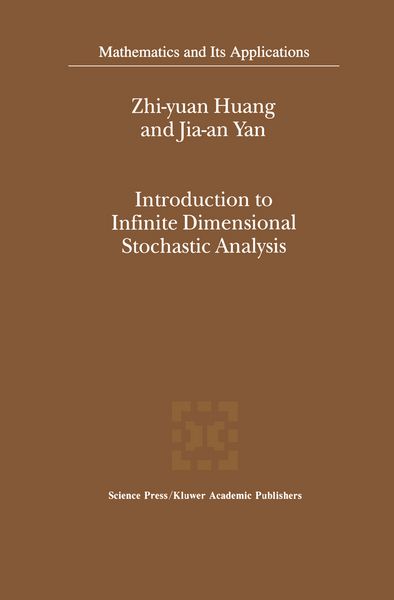
Introduction to Infinite Dimensional Stochastic Analysis

Fr. 137.00

inkl. gesetzl. MwSt., Versandkostenfrei


Beschreibung

The infinite dimensional analysis as a branch of mathematical sciences was formed in the late 19th and early 20th centuries. Motivated by problems in mathematical physics, the first steps in this field were taken by V. Volterra, R. GateallX, P. Levy and M. Frechet, among others (see the preface to Levy[2])....

Beschreibung

The infinite dimensional analysis as a branch of mathematical sciences was formed in the late 19th and early 20th centuries. Motivated by problems in mathematical physics, the first steps in this field were taken by V. Volterra, R. GateallX, P. Levy and M. Frechet, among others (see the preface to Levy[2]). Nevertheless, the most fruitful direction in this field is the infinite dimensional integration theory initiated by N. Wiener and A. N. Kolmogorov which is closely related to the developments of the theory of stochastic processes. It was Wiener who constructed for the first time in 1923 a probability measure on the space of all continuous functions (i. e. the Wiener measure) which provided an ideal math ematical model for Brownian motion. Then some important properties of Wiener integrals, especially the quasi-invariance of Gaussian measures, were discovered by R. Cameron and W. Martin[l, 2, 3]. In 1931, Kolmogorov[l] deduced a second partial differential equation for transition probabilities of Markov processes order with continuous trajectories (i. e. diffusion processes) and thus revealed the deep connection between theories of differential equations and stochastic processes. The stochastic analysis created by K. Ito (also independently by Gihman [1]) in the forties is essentially an infinitesimal analysis for trajectories of stochastic processes. By virtue of Ito's stochastic differential equations one can construct diffusion processes via direct probabilistic methods and treat them as function als of Brownian paths (i. e. the Wiener functionals).

Rezension

'
The book is well written and nicely structured [...] will surely become a valuable resource for specialists in stochastic analysis as well as mathematical physicists.
'
Mathematical Reviews (2002)

Produktdetails

Einband

Gebundene Ausgabe

Erscheinungsdatum

31.01.2001

Abbildungen

XI, 296 p.

Verlag Springer Netherland

Produktdetails

Einband

Gebundene Ausgabe

Erscheinungsdatum

31.01.2001

Abbildungen

XI, 296 p.

Verlag Springer Netherland
Seitenzahl

296

Maße (L/B/H)

24.1/16/2.2 cm

Gewicht

583 g

Auflage

2000

Sprache

Englisch

ISBN

978-0-7923-6208-1

Herstelleradresse

Springer-Verlag GmbH
Europaplatz 3
69115 Heidelberg
DE

Email: ProductSafety@springernature.com

Noch keine Bewertungen vorhanden

Verfassen Sie die erste Bewertung zu diesem Artikel

Helfen Sie anderen Kundinnen und Kunden durch Ihre Meinung.

Kundinnen und Kunden meinen

Bewertungen (0)

  • Produktbild: Introduction to Infinite Dimensional Stochastic Analysis
  • Produktbild: Introduction to Infinite Dimensional Stochastic Analysis
  • I Foundations of Infinite Dimensional Analysis.- §1. Linear operators on Hilbert spaces.- §2. Fock spaces and second quantization.- §3. Countably normed spaces and nuclear spaces.- §4. Borel measures on topological linear spaces.- II Malliavin Calculus.- §1. Gaussian probability spaces and Wiener chaos decomposition.- §2. Differential calculus of functionals, gradient and divergence operators.- §3. Meyer’s inequalities and some consequences.- §4. Densities of non-degenerate functionals.- III Stochastic Calculus of Variation for Wiener Functionals.- §1. Differential calculus of Itô functionals and regularity of heat kernels.- §2. Potential theory over Wiener spaces and quasi-sure analysis.- §3. Anticipating stochastic calculus.- IV General Theory of White Noise Analysis.- §1. General framework for white noise analysis.- §2. Characterization of functional spaces.- §3. Products and Wick products of functionals.- §4. Moment characterization of distributions and positive distributions.- V Linear Operators on Distribution Spaces.- §1. Analytic calculus for distributions.- §2. Continuous linear operators on distribution spaces.- §3. Integral kernel operators and integral kernel representation for operators.- §4. Applications to quantum physics.- Appendix A Hermite polynomials and Hermite functions.- Appendix B Locally convex spaces amd their dual spaces.- 1. Semi-norms, norms and H-norms.- 2. Locally convex topological linear spaces, bounded sets.- 3. Projective topologies and projective limits.- 4. Inductive topologies and inductive limits.- 5. Dual spaces and weak topologies.- 6. Compatibility and Mackey topology.- 7. Strong topologies and reflexivity.- 8. Dual maps.- 9. Uniformly convex spaces and Banach-Saks’ theorem.- Comments.- References.- Index of Symbols.