Gutscheinbedingungen

*Gültig bis 20.07.2026 auf alle Bücher. Ausgeschlossen sind Zeitschriften, Prozentbücher und Abos | Einlösbar in allen Buchhandlungen von Orell Füssli, Barth Bücher, Buchladen Rapunzel, Papeterie Köhler, Schuler Orell Füssli, Stauffacher und ZAP unter Vorweisung des Gutscheins, auf www.orellfüssli.ch durch Eingabe des Gutscheincodes. Beim Service „eBooks verschenken“ und bei eBook-Käufen via eReader nicht einlösbar | Mindesteinkaufswert: Fr. 30.- | Nicht mit anderen Rabatten kumulierbar.

  • Produktbild: Understanding Human Development
  • Produktbild: Understanding Human Development

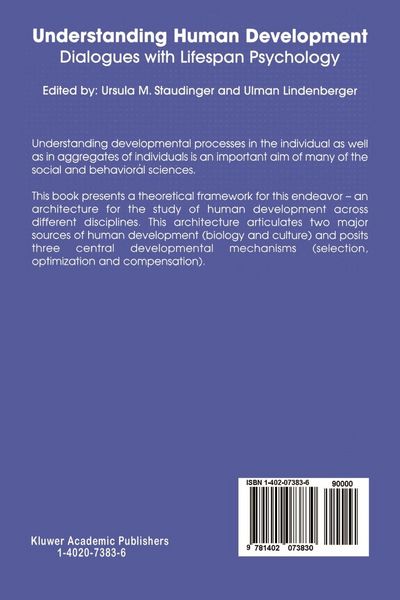
Understanding Human Development Dialogues with Lifespan Psychology

Fr. 202.00

inkl. gesetzl. MwSt., Versandkostenfrei


Beschreibung

Produktdetails

Einband

Taschenbuch

Erscheinungsdatum

31.01.2003

Herausgeber

Ursula M. Staudinger + weitere

Verlag

Springer Us

Seitenzahl

519

Maße (L/B/H)

23.4/15.6/2.9 cm

Gewicht

1660 g

Auflage

Softcover reprint of the original 1st ed. 2003

Sprache

Englisch

ISBN

978-1-4020-7383-0

Beschreibung

Produktdetails

Einband

Taschenbuch

Erscheinungsdatum

31.01.2003

Herausgeber

Verlag

Springer Us

Seitenzahl

519

Maße (L/B/H)

23.4/15.6/2.9 cm

Gewicht

1660 g

Auflage

Softcover reprint of the original 1st ed. 2003

Sprache

Englisch

ISBN

978-1-4020-7383-0

Herstelleradresse

Springer-Verlag KG
Sachsenplatz 4-6
1201 Wien
AT

Email: GPSR Kontakt

Noch keine Bewertungen vorhanden

Verfassen Sie die erste Bewertung zu diesem Artikel

Helfen Sie anderen Kundinnen und Kunden durch Ihre Meinung.

Kundinnen und Kunden meinen

Bewertungen (0)

  • Produktbild: Understanding Human Development
  • Produktbild: Understanding Human Development
  • Foreword; K. Warner Schaie. Acknowledgments. List of Contributors. 1. Why Read Another Book on Human Development? Understanding Human Development Takes a Meta-theory and Multiple Disciplines; U.M. Staudinger, U. Lindenberger. I: The Overall Architecture of Lifespan Development. 2. On the Incomplete Architecture of Human Ontogeny: Selection, Optimization and Compensation as Foundation of Developments/Theory reprint; P.B. Baltes. 3. Age Differences in Evolutionary Selection Benefits; B. Thomas, L. Kirkwood. 4. Age Differences in Longevity in Cultural Efficiency: Secular Trends; H. Maier, J.W. Vaupel. II: Basic Processes of Lifespan Development: Selective Optimization with Compensation (SOC). 5. The Process of Successful Aging: Selection, Optimization, and Compensation; M.M. Baltes, L.L. Carstensen. 6. Intentionality and Time in Human Development and Aging: Compensation and Goal Adjustment in Changing Developmental Contexts; J. Brandtstädter, K. Rothermund. 7. An Economic Perspective on Selection, Optimization, and Compensation (SOC) as Elements in the Conceptualization and Understanding of Lifespan Human Development Processes; J.R. Behrman. III: A Lifespan View of Self and Personality. 8. Completing the Psychobiological Architecture of Human Personality Development: Temperament, Character, and Coherence; C.R. Cloninger. 9. The Cumulative Continuity Model of Personality Development: Striking a Balance Between Continuity and Change in Personality Traits Across the Life Course; B.W. Roberts, A. Caspi. 10. The Gain-Loss Dynamic in Lifespan Development:Implications for Change in Self and Personality During Old and Very Old Age; J. Smith. IV: A Lifespan View of Intelligence and Cognition. 11. Enablement and Constraint; H.M. Wellman. 12. Interrelations of Aging, Knowledge, and Cognitive Performance; T.A. Salthouse. 13. Formal Models of Age Differences in Task-Complexity Effects; R. Kliegl, et al. V: At the Frontiers of Lifespan Methodology. 14. Structuring and Measuring Change over the Lifespan; J.R. Nesselroade, P. Ghisletta. 15. The Relationship Between the Structure of Interindividual and Intraindividual Variability: A Theoretical and Empirical Vindication of Developmental Systems Theory; P.C.M. Molenaar, et al. 16. Combining Molecular and Quantitative Genetics: Decomposing the Architecture of Lifespan Development; G.E. McClearn. VI: The Future of Lifespan Psychology: Comments from Related Fields and Neighboring Disciplines. 17. The Future of Lifespan Developmental Psychology: Perspectives from Control Theory; J. Heckhausen. 18. Without Gender, Without Self; G. Labouvie-Vief. 19. Contributions of Lifespan Psychology to the Future Elaboration of Developmental Systems Theory; R.M. Lerner, et al. 20. The Adaptive Toolbox and Lifespan Development: Common Questions? G. Gigerenzer. 21. The Nature-Nurture Problem Revisited; W. Singer. 22. Development in Adolescence Under the Restriction of Secondary School; O. Köller, et al. 23. The Sociology of the Life Course and Lifespan Psychology: Diverging or Converging Pathways? K.U. Mayer. 24.