Gutscheinbedingungen

*Gültig bis 05.07.2026 auf (fast) alles. Ausgeschlossen sind Smartboxen, Zeitschriften, Tickets, Lebensmittel, Gaming-Elektroartikel, Tinte/Toner, Gutscheine, Geschenkkarten, Blumen und Abos | Einlösbar in allen Buchhandlungen von Orell Füssli, Barth Bücher, Buchladen Rapunzel, Papeterie Köhler, Schuler Orell Füssli, Stauffacher und ZAP unter Vorweisung des Gutscheins, auf www.orellfüssli.ch durch Eingabe des Gutscheincodes. Beim Service „eBooks verschenken“ und bei eBook-Käufen via eReader nicht einlösbar | Mindesteinkaufswert: Fr. 30.- | Nicht mit anderen Rabatten kumulierbar.

  • Produktbild: Semi-Markov Models
  • Produktbild: Semi-Markov Models

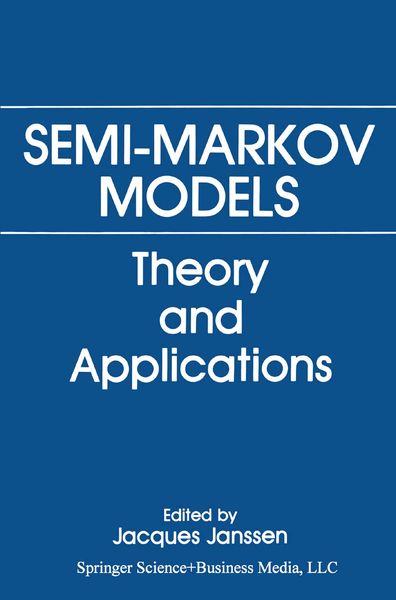
Semi-Markov Models Theory and Applications

Fr. 191.00

inkl. gesetzl. MwSt., Versandkostenfrei


Beschreibung

Produktdetails

Einband

Gebundene Ausgabe

Erscheinungsdatum

22.03.1999

Verlag

Springer Us

Seitenzahl

588

Maße (L/B/H)

26/18.3/3.7 cm

Gewicht

1356 g

Auflage

1986

Sprache

Englisch

ISBN

978-0-306-42362-8

Beschreibung

Produktdetails

Einband

Gebundene Ausgabe

Erscheinungsdatum

22.03.1999

Verlag

Springer Us

Seitenzahl

588

Maße (L/B/H)

26/18.3/3.7 cm

Gewicht

1356 g

Auflage

1986

Sprache

Englisch

ISBN

978-0-306-42362-8

Herstelleradresse

Springer-Verlag GmbH
Tiergartenstr. 17
69121 Heidelberg
DE

Email: GPSR Kontakt

Noch keine Bewertungen vorhanden

Verfassen Sie die erste Bewertung zu diesem Artikel

Helfen Sie anderen Kundinnen und Kunden durch Ihre Meinung.

Kundinnen und Kunden meinen

Bewertungen (0)

  • Produktbild: Semi-Markov Models
  • Produktbild: Semi-Markov Models
  • Section I. Markov Additive Processes and Regenerative Systems.- Some limit theorems for Markov additive processes.- Stationary regenerative processes.- Asymptotic analysis of some non-homogeneous semi-Markov processes.- Section II. Semi-Markov Decision Processes.- Markov and semi-Markov decision models and optimal stopping.- Markov decision drift processes.- The functional equations of undiscounted denumerable state Markov renewal programming.- Section III. Algorithmic and Computer-Oriented Approach.- Recursive moment formulas for regenerative simulation.- Computation of the state probabilities in a class of semi-regenerative queueing systems.- The superposition of two PH-renewal processes.- Section IV. Semi-Markov Models in Economy and Insurance.- Pension accumulation as a semi-Markov reward process, with applications to pension reform.- The structure of a firm’s optimal non-decreasing wage policy when recruitment is a wage dependent Poisson process.- Section V. Semi-Markov Processes and Reliability Theory.- Markov renewal processes in reliability analysis.- Deterioration processes.- Stochastic processes with an embedded point process and their application to system reliability analysis.- Section VI. Simulation and Statistics for Semi-Markov Processes.- Semi-Markov models for manpower planning.- Statistical analysis of semi-Markov processes based on the theory of counting processes.- Section VII. Semi-Markov Processes and Queueing Theory.- Approximation of stochastic models.- The method of renovating events and its applications in queueing theory.- On non-time homogeneity.- A semi-Markov queue vith exponential service times.- Section VIII. Branching.- Estimation theory for multitype branching processes.- Exact distribution of kin number in multitype Galton-Watson process.- Arbres de Galton-Watson.- Section IX. Applications in Medicine.- Some remarks on semi-Markov processes in medical statistics.- Semi-Markov and non-homogeneous Markov models in medicine.- Application of semi-Markov processes to health care planning: a model to study the flow of patients following the dialysis-transplantation plan.- Section X. Applications in Other Fields.- Applications of semi-Markov processes: a miscellany.- Social applications of semi-Markov processes.- Language modelling using a hidden Markov chain with application to automatic transcription of French stenotypy.- Semi-Markov processes in seismic risk analysis.- Section XI.- A second bibliography on semi-Markov processes.