Band 523
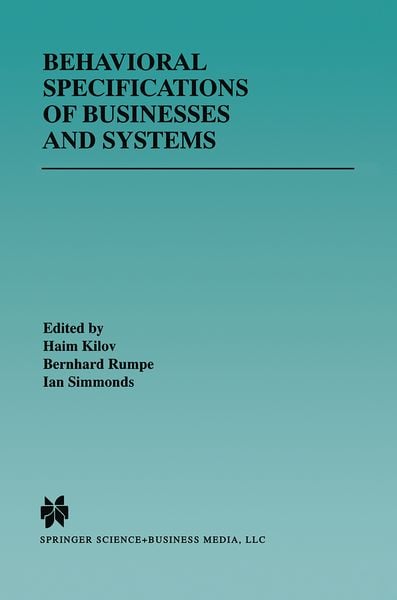
Behavioral Specifications of Businesses and Systems
-
- Hardcover ausgewählt
- Taschenbuch
-
Sprache:Englisch
Fr. 191.00
inkl. gesetzl. MwSt.,
Beschreibung
Produktdetails
Einband
Gebundene Ausgabe
Erscheinungsdatum
31.10.1999
Herausgeber
Haim Kilov + weitereVerlag
Springer UsSeitenzahl
315
Maße (L/B/H)
23.4/15.6/1.9 cm
Gewicht
642 g
Auflage
1999
Sprache
Englisch
ISBN
978-0-7923-8629-2
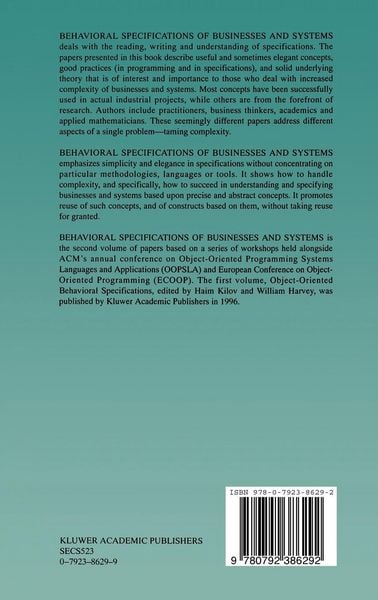
Behavioral Specifications of Businesses and Systems deals with the reading, writing and understanding of specifications. The papers presented in this book describe useful and sometimes elegant concepts, good practices (in programming and in specifications), and solid underlying theory that is of interest and importance to those who deal with increased complexity of business and systems. Most concepts have been successfully used in actual industrial projects, while others are from the forefront of research. Authors include practitioners, business thinkers, academics and applied mathematicians. These seemingly different papers address different aspects of a single problem - taming complexity.
Behavioral Specifications of Businesses and Systems emphasizes simplicity and elegance in specifications without concentrating on particular methodologies, languages or tools. It shows how to handle complexity, and, specifically, how to succeed in understanding and specifying businesses and systems based upon precise and abstract concepts. It promotes reuse of such concepts, and of constructs based on them, without taking reuse for granted.
Behavioral Specifications of Businesses and Systems is the second volume of papers based on a series of workshops held alongside ACM's annual conference on Object-Oriented Programming Systems Languages and Applications (OOPSLA) and European Conference on Object-Oriented Programming (ECOOP). The first volume, Object-Oriented Behavioral Specifications , edited by Haim Kilov and William Harvey, was published by Kluwer Academic Publishers in 1996.
Behavioral Specifications of Businesses and Systems emphasizes simplicity and elegance in specifications without concentrating on particular methodologies, languages or tools. It shows how to handle complexity, and, specifically, how to succeed in understanding and specifying businesses and systems based upon precise and abstract concepts. It promotes reuse of such concepts, and of constructs based on them, without taking reuse for granted.
Behavioral Specifications of Businesses and Systems is the second volume of papers based on a series of workshops held alongside ACM's annual conference on Object-Oriented Programming Systems Languages and Applications (OOPSLA) and European Conference on Object-Oriented Programming (ECOOP). The first volume, Object-Oriented Behavioral Specifications , edited by Haim Kilov and William Harvey, was published by Kluwer Academic Publishers in 1996.
Noch keine Bewertungen vorhanden
Verfassen Sie die erste Bewertung zu diesem Artikel
Helfen Sie anderen Kundinnen und Kunden durch Ihre Meinung.