Gutscheinbedingungen

*Gültig bis 05.07.2026 auf (fast) alles. Ausgeschlossen sind Smartboxen, Zeitschriften, Tickets, Lebensmittel, Gaming-Elektroartikel, Tinte/Toner, Gutscheine, Geschenkkarten, Blumen und Abos | Einlösbar in allen Buchhandlungen von Orell Füssli, Barth Bücher, Buchladen Rapunzel, Papeterie Köhler, Schuler Orell Füssli, Stauffacher und ZAP unter Vorweisung des Gutscheins, auf www.orellfüssli.ch durch Eingabe des Gutscheincodes. Beim Service „eBooks verschenken“ und bei eBook-Käufen via eReader nicht einlösbar | Mindesteinkaufswert: Fr. 30.- | Nicht mit anderen Rabatten kumulierbar.

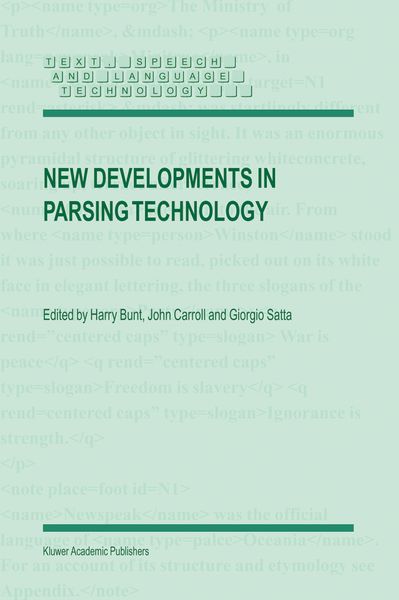
Produktbild: New Developments in Parsing Technology
Band 23

New Developments in Parsing Technology

Fr. 191.00

inkl. gesetzl. MwSt., Versandkostenfrei


Beschreibung

Produktdetails

Einband

Taschenbuch

Erscheinungsdatum

15.02.2005

Herausgeber

H. Bunt + weitere

Verlag

Springer Netherland

Seitenzahl

403

Maße (L/B/H)

23.3/15.5/2.3 cm

Gewicht

628 g

Auflage

2004

Sprache

Englisch

ISBN

978-1-4020-2294-4

Beschreibung

Rezension

From the reviews:


"New Developments in Parsing Technology is a collection of papers based on contributions to the International workshop on Parsing Technology in the years 2000 and 2001. … Collin’s invited contribution is so outstanding that it alone makes it worthwhile to get hold of a copy of the book. Each of the selected workshop papers is a worthwhile read in itself … ." (Stefan Riezler, Computational Linguistics, Vol. 32 (3), 2006)

Produktdetails

Einband

Taschenbuch

Erscheinungsdatum

15.02.2005

Herausgeber

Verlag

Springer Netherland

Seitenzahl

403

Maße (L/B/H)

23.3/15.5/2.3 cm

Gewicht

628 g

Auflage

2004

Sprache

Englisch

ISBN

978-1-4020-2294-4

Herstelleradresse

Springer-Verlag KG
Sachsenplatz 4-6
1201 Wien
AT

Email: GPSR Kontakt

Noch keine Bewertungen vorhanden

Verfassen Sie die erste Bewertung zu diesem Artikel

Helfen Sie anderen Kundinnen und Kunden durch Ihre Meinung.

Kundinnen und Kunden meinen

Bewertungen (0)

  • Produktbild: New Developments in Parsing Technology
  • Preface.
    1: Developments in Parsing Technology: From Theory to Application; H. Bunt, J. Carroll, G. Satta.
    1. Introduction. 2. About this book.
    2: Parameter Estimation for Statistical Parsing Models: Theory and Practice of Distribution-Free Methods; M. Collins.
    1. Introduction. 2. Linear Models. 3. Probabilistic Context-Free Grammars. 4. Statistical Learning Theory. 5. Convergence Bounds for Finite Sets of Hypotheses. 6. Convergence Bounds for Hyperplane Classifiers. 7. Application of Margin Analysis to Parsing. 8. Algorithms. 9. Discussion. 10. Conclusions.
    3: High Precision Extraction of Grammatical Relations; J. Carroll, T. Briscoe.
    1. Introduction. 2. The Analysis System. 3. Empirical Results. 4. Conclusions and Further Work.
    4: Automated Extraction of TAGs from the Penn Treebank; J. Chen, K.V. Shanker. 1. Introduction. 2. Tree Extraction Procedure. 3. Evaluation. 4. Extended Extracted Grammars. 5. Related Work. 6. Conclusions.
    5: Computing the Most Probable Parse for a Discontinuous Phrase-Structure Grammar; O. Plaehn. 1. Introduction. 2. Discontinuous Phrase-Structure Grammar. 3. The Parsing Algorithm. 4. Computing the Most Probable Parse. 5. Experiments. 6. Conclusion and Future Work.
    6: A Neural Network Parser that Handles Sparse Data; J. Henderson.
    1. Introduction. 2. Simple Synchrony Networks. 3. A Probabilistic Parser for SSNs. 4. Estimating the Probabilities with a Simple Synchrony Network. 5. Generalizing from Sparse Data. 6. Conclusion.
    7: An Efficient LR Parser Generator for Tree-Adjoining Grammars; C.A. Prolo.
    1. Introduction. 2. TAGS. 3. On Some Degenerate LR Models for TAGS. 4. Proposed Algorithm. 5. Implementation. 6. Example. 7. Some Properties Of the Algorithms. 8. Evaluation. 9. Conclusions.
    8: Relating Tabular Parsing Algorithms for LIG and TAG; M.A. Alonso, E. de la Clergerie, V.J. Díaz, M. Vilares.
    1. Introduction. 2. Tree-Adjoining Grammars. 3. Linear Indexed Grammars. 4. Bottom-upParsing Algorithms. 5. Barley-like Parsing Algorithms. 6. Barley-like Parsing Algorithms Preserving the Correct Prefix Property. 7. Bidirectional Parsing. 8. Specialized TAG parsers. 9. Conclusion.
    9: Improved Left-Corner Chart Parsing for Large Context-Free Grammars; R.C. Moore.
    1. Introduction. 2. Evaluating Parsing Algorithms. 3. Terminology and Notation. 4. Test Grammars. 5. Left-Corner Parsing Algorithms and Refinements. 6. Grammar Transformations. 7. Extracting Parses from the Chart. 8. Comparison to Other Algorithms. 9. Conclusions.
    10: On Two Classes of Feature Paths in Large-Scale Unification Grammars; L. Ciortuz. 1. Introduction. 2. Compiling the Quick Check Filter. 3. Generalised Rule Reduction. 4. Conclusion.
    11: A Context-Free Superset Approximation of Unification-Based Grammars; B. Kiefer, H.-U. Krieger.
    1. Introduction. 2. Basic Inventory. 3. Approximation as Fixpoint Construction. 4. The Basic Algorithm. 5. Implementation Issues and Optimizations. 6. Revisiting the Fixpoint Construction. 7. Three Grammars. 8. Disambiguation of UBGs via Probabilistic Approximations.
    12: A Recognizer for Minimalist Languages; H. Harkema.
    1. Introduction. 2. Minimalist Grammars. 3. Specification of the Recognizer. 4. Correctness. 5. Complexity Results. 6. Conclusions and Future Work.
    13: Range Concatenation Grammars; P. Boullier.
    1. Introduction. 2. Positive Range Concatenation Grammars. 3. Negative Range Concatenation Grammars. 4. A Parsing Algorithm for RCGs. 5. Closure Properties and Modularity. 6. Conclusion.
    14: Grammar Induction by MDL-Based Distributional Classification; Yikun Guo, Fuliang Weng, Lide Wu.
    1. Introduction. 2. Grammar Induction with the MDL Principle. 3. Induction Strategies. 4. MDL Induction by Dynamic Distributional Classification (DCC). 5. Comparison and Conclusion. Appendix.
    15: Optimal Ambiguity Packing in Context-Free Parsers with Interleaved Unification; A. Lavie, C. Penstein Rosé.
    1.