Beschreibung
Produktdetails
Einband
Gebundene Ausgabe
Erscheinungsdatum
23.07.2007
Abbildungen
Charts: 2 B&W, 0 Color; Drawings: 32 B&W, 0 Color; Graphs: 117 B&W, 0 Color
Verlag
John Wiley & Sons IncSeitenzahl
608
Maße (L/B/H)
24/16.1/3.7 cm
Gewicht
1070 g
Auflage
1. Auflage
Sprache
Englisch
ISBN
978-0-471-75044-4
A unique introduction to distribution logistics that focuses on both quantitative modeling and practical business issues
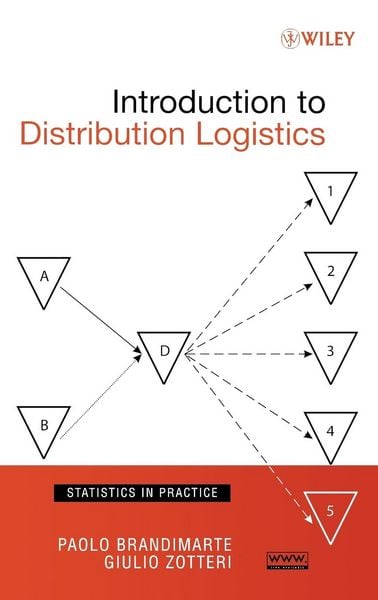
Introduction to Distribution Logistics presents a complete and balanced treatment of distribution logistics by covering both applications and the required theoretical background, therefore extending its reach to practitioners and students in a range of disciplines such as management, engineering, mathematics, and statistics. The authors emphasize the variety and complexity of issues and sub-problems surrounding distribution logistics as well as the limitations and scope of applicability of the proposed quantitative tools. Throughout the book, readers are provided with the quantitative approaches needed to handle real-life management problems, and areas of study include:
*
Supply chain management
*
Network design and transportation
*
Demand forecasting
*
Inventory control in single- and multi-echelon systems
*
Incentives in the supply chain
*
Vehicle routing
Complete with extensive appendices on probability and statistics as well as mathematical programming, Introduction to Distribution Logistics is a valuable text for distribution logistics courses at both the advanced undergraduate and beginning graduate levels in a variety of disciplines, and prior knowledge of production planning is not assumed. The book also serves as a useful reference for practitioners in the fields of applied mathematics and statistics, manufacturing engineering, business management, and operations research. The book's related Web site includes additional sections and numerical illustrations.
Introduction to Distribution Logistics presents a complete and balanced treatment of distribution logistics by covering both applications and the required theoretical background, therefore extending its reach to practitioners and students in a range of disciplines such as management, engineering, mathematics, and statistics. The authors emphasize the variety and complexity of issues and sub-problems surrounding distribution logistics as well as the limitations and scope of applicability of the proposed quantitative tools. Throughout the book, readers are provided with the quantitative approaches needed to handle real-life management problems, and areas of study include:
*
Supply chain management
*
Network design and transportation
*
Demand forecasting
*
Inventory control in single- and multi-echelon systems
*
Incentives in the supply chain
*
Vehicle routing
Complete with extensive appendices on probability and statistics as well as mathematical programming, Introduction to Distribution Logistics is a valuable text for distribution logistics courses at both the advanced undergraduate and beginning graduate levels in a variety of disciplines, and prior knowledge of production planning is not assumed. The book also serves as a useful reference for practitioners in the fields of applied mathematics and statistics, manufacturing engineering, business management, and operations research. The book's related Web site includes additional sections and numerical illustrations.
Noch keine Bewertungen vorhanden
Verfassen Sie die erste Bewertung zu diesem Artikel
Helfen Sie anderen Kundinnen und Kunden durch Ihre Meinung.