
Band 25
Material Culture and Technology in Everyday Life Ethnographic Approaches
Aus der Reihe
Intersections in Communications and Culture
-
- Hardcover
- Taschenbuch ausgewählt
-
Sprache:Englisch
Fr. 53.90
inkl. gesetzl. MwSt.,
Beschreibung
Produktdetails
Einband
Taschenbuch
Erscheinungsdatum
06.02.2009
Herausgeber
Phillip VanniniVerlag
Peter Lang Publishing Inc. New YorkSeitenzahl
256
Maße (L/B/H)
22.6/14.9/2 cm
Gewicht
390 g
Auflage
1
Sprache
Englisch
ISBN
978-1-4331-0301-8
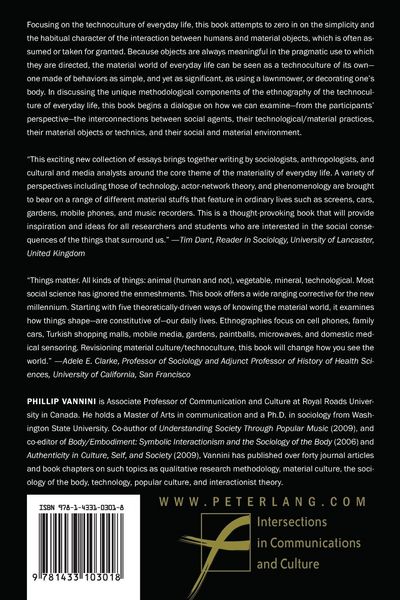
Focusing on the technoculture of everyday life, this book attempts to zero in on the simplicity and the habitual character of the interaction between humans and material objects, which is often assumed or taken for granted. Because objects are always meaningful in the pragmatic use to which they are directed, the material world of everyday life can be seen as a technoculture of its own – one made of behaviors as simple, and yet as significant, as using a lawnmower, or decorating one’s body. In discussing the unique methodological components of the ethnography of the technoculture of everyday life, this book begins a dialogue on how we can examine – from the participants’ perspective – the interconnections between social agents, their technological/material practices, their material objects or technics, and their social and material environment.
Noch keine Bewertungen vorhanden
Verfassen Sie die erste Bewertung zu diesem Artikel
Helfen Sie anderen Kundinnen und Kunden durch Ihre Meinung.