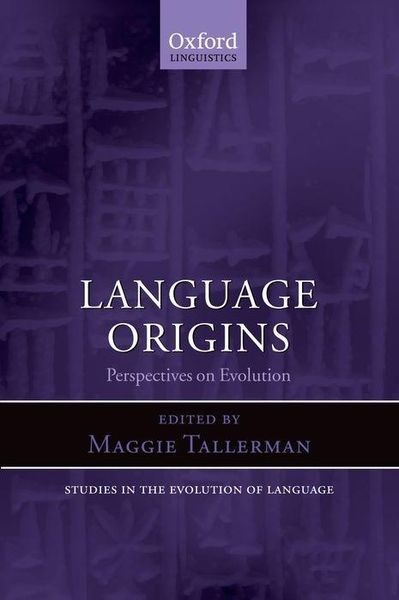
Language Origins Perspectives on Evolution
Aus der Reihe
Studies in the Evolution of Language
-
- Hardcover
- Taschenbuch ausgewählt
-
Sprache:Englisch
Fr. 69.90
inkl. gesetzl. MwSt.,
Beschreibung
Produktdetails
Einband
Taschenbuch
Erscheinungsdatum
26.05.2005
Abbildungen
Figures
Herausgeber
Maggie TallermanVerlag
Oxford University PressSeitenzahl
446
Maße (H)
23.4 cm
Gewicht
674 g
Sprache
Englisch
ISBN
978-0-19-927904-3
This book addresses central questions in the evolution of language: where it came from; how it relates to primate communication; how and why it evolved; how it came to be culturally transmitted; and how languages diversified. The chapters are written from the perspective of the latest work in linguistics, neuroscience, psychology, and computer science, and reflect the idea that various cognitive, physical, neurological, social, and cultural prerequisites led to the development of full human language. Some of these evolutionary changes were preadaptations for language, while others were adaptive changes allowing the development of particular linguistic characteristics. The authors consider a broad spectrum of ideas about the conditions that led to the evolution of protolanguage and full language. Some examine changes that occurred in the course of evolution to Homo sapiens; others consider how languages themselves have adapted by evolving to be learnable. Some chapters look at the workings of the brain, and others deploy sophisticated computer simulations that model such aspects as the emergence of speech sounds and the development of grammar. All make use of the latest methods and theories to probe into the origins and subsequent development of the only species that has language.
The book will interest a wide range of linguists, cognitive scientists, biologists, psychologists, neuroscientists, and experts in artificial intelligence, as well as all those fascinated by issues, puzzles, and problems raised by the evolution of language.
The book will interest a wide range of linguists, cognitive scientists, biologists, psychologists, neuroscientists, and experts in artificial intelligence, as well as all those fascinated by issues, puzzles, and problems raised by the evolution of language.
Noch keine Bewertungen vorhanden
Verfassen Sie die erste Bewertung zu diesem Artikel
Helfen Sie anderen Kundinnen und Kunden durch Ihre Meinung.