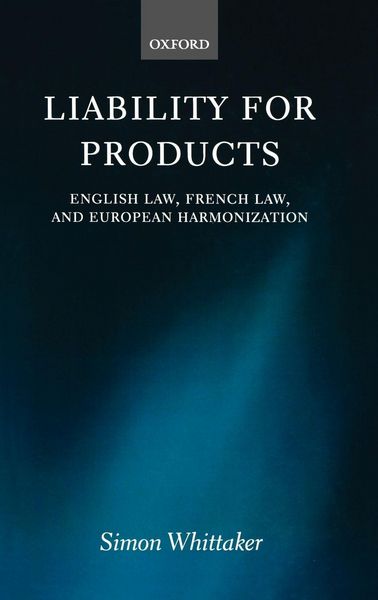
Liability for Products English Law, French Law, and European Harmonization
-
- Englisch ausgewählt
Fr. 359.00
inkl. gesetzl. MwSt.,
Beschreibung
Produktdetails
Einband
Gebundene Ausgabe
Erscheinungsdatum
29.09.2005
Verlag
Oxford University PressSeitenzahl
752
Maße (L/B/H)
24/16.1/4.4 cm
Gewicht
1280 g
Sprache
Englisch
ISBN
978-0-19-825613-7
The EU has been active in attempting to harmonize the laws of product liability and sale of goods to consumers, with the aim of promoting fair competition, developing the internal market, and protecting consumers. But how do the resulting laws relate to existing national laws of liability and compensation? Is the resulting harmonization genuine or merely formal? Has implementation of the EC directives changed the law, but left claimants and defendants as differently treated as ever in different Member States?
This comparative study considers the French and English laws governing all those who may be liable for products: their producers, their suppliers, their users and their regulators. To do so, it examines in each system the private law of tort and contract and aspects of the civil process which are important in determining liability; the administrative law concerning failures to regulate or control product safety; and the liability for products of suppliers of public services, such as water or healthcare. It considers how the substantive criminal offences affecting product safety, whether particular to products or under more general law, relate to civil liability or to compensation. The emerging picture reveals two complex and significantly different patterns of liability for products in the English and French systems, cutting across the traditional boundaries of private law, public law and criminal law.
Implementation of the Product Liability Directive and Consumer Guarantees Directive required the insertion into these patterns of new elements, disharmonious with existing wider legal strategies and techniques. This study considers various problems of these directives' implementation in the French and English systems, the main issues of their proper interpretation, and the relationship of the new laws which they create with existing bases of liability. It explains the different significances given to 'fault,' 'negligence' and 'defect' (whether of safety or of contractual conformity); the relationship between judicial institutions and legal procedures in the determination of substantive legal issues; and the different relationships in the two laws studied between public and private, civil and criminal law. It concludes by offering wider comments on legal harmonisation based on the French and English experience in relation to these two directives.
This comparative study considers the French and English laws governing all those who may be liable for products: their producers, their suppliers, their users and their regulators. To do so, it examines in each system the private law of tort and contract and aspects of the civil process which are important in determining liability; the administrative law concerning failures to regulate or control product safety; and the liability for products of suppliers of public services, such as water or healthcare. It considers how the substantive criminal offences affecting product safety, whether particular to products or under more general law, relate to civil liability or to compensation. The emerging picture reveals two complex and significantly different patterns of liability for products in the English and French systems, cutting across the traditional boundaries of private law, public law and criminal law.
Implementation of the Product Liability Directive and Consumer Guarantees Directive required the insertion into these patterns of new elements, disharmonious with existing wider legal strategies and techniques. This study considers various problems of these directives' implementation in the French and English systems, the main issues of their proper interpretation, and the relationship of the new laws which they create with existing bases of liability. It explains the different significances given to 'fault,' 'negligence' and 'defect' (whether of safety or of contractual conformity); the relationship between judicial institutions and legal procedures in the determination of substantive legal issues; and the different relationships in the two laws studied between public and private, civil and criminal law. It concludes by offering wider comments on legal harmonisation based on the French and English experience in relation to these two directives.
Noch keine Bewertungen vorhanden
Verfassen Sie die erste Bewertung zu diesem Artikel
Helfen Sie anderen Kundinnen und Kunden durch Ihre Meinung.