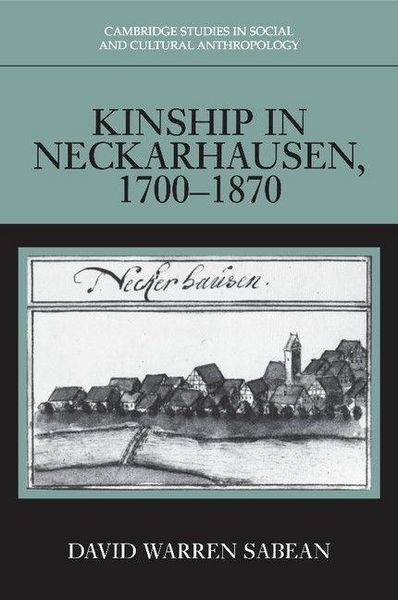
Kinship in Neckarhausen, 1700-1870
-
- Hardcover
- Taschenbuch ausgewählt
-
Sprache:Englisch
Fr. 82.90
inkl. gesetzl. MwSt.,
Beschreibung
Produktdetails
Einband
Taschenbuch
Erscheinungsdatum
27.04.2015
Verlag
Cambridge AcademicSeitenzahl
658
Maße (L/B/H)
22.9/15.2/3.6 cm
Gewicht
870 g
Sprache
Englisch
ISBN
978-0-521-58657-3
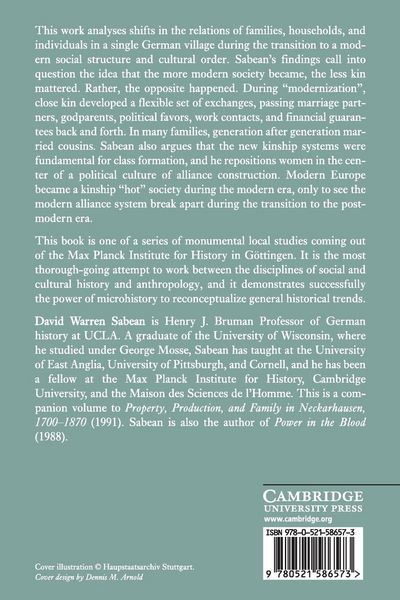
This work analyses shifts in the relations of families, households, and individuals in a single German village during the transition to a modern social structure and cultural order. The findings call into question the idea that the more modern society became, the less kin mattered. Rather, the opposite happened. During 'modernization', close kin developed a flexible set of exchanges, passing marriage partners, godparents, political favors, work contacts, and financial guarantees back and forth. Sabean also argues that the new kinship systems were fundamental for class formation, and he repositions women in the center of a political culture of alliance construction. One of a series of important local studies coming out of the Max Planck Institute for History, it is the most thorough-going attempt to work between the disciplines of social and cultural history and anthropology, and it demonstrates the power of microhistory to reconceptualize general historical trends.
Noch keine Bewertungen vorhanden
Verfassen Sie die erste Bewertung zu diesem Artikel
Helfen Sie anderen Kundinnen und Kunden durch Ihre Meinung.