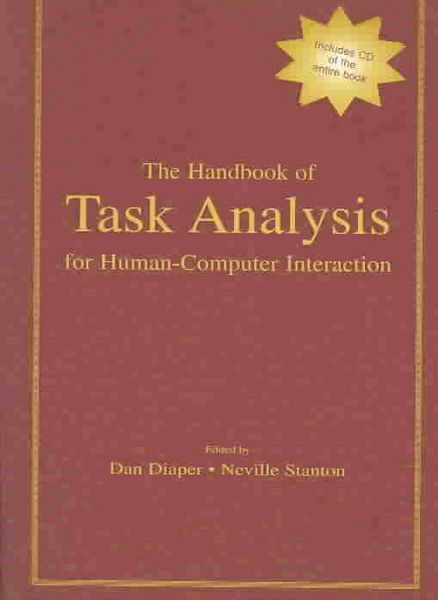
The Handbook of Task Analysis for Human-Computer Interaction
-
- Englisch ausgewählt
Fr. 148.00
inkl. gesetzl. MwSt.,
Beschreibung
Produktdetails
Einband
Taschenbuch
Erscheinungsdatum
01.09.2003
Abbildungen
farbige, schwarzweisse Abbildungen
Herausgeber
Dan Diaper + weitereVerlag
ErlbaumSeitenzahl
568
Maße (L/B/H)
25.2/18.2/3.6 cm
Gewicht
1184 g
Sprache
Englisch
ISBN
978-0-8058-4433-7
A comprehensive review of the current state of research and use of task analysis for Human-Computer Interaction (HCI), this multi-authored and diligently edited handbook offers the best reference source available on this diverse subject whose foundations date to the turn of the last century. Each chapter begins with an abstract and is cross-referenced and indexed to other chapters. Divided into five parts--each prefaced with a rationale and brief summary of its chapters--this volume presents contemporary thinking about task analysis together with a representative set of methods. Part I opens with seven chapters that form a book-within-a-book and introduce most of the main concepts, methods, and techniques discussed in more detail in later parts. Part II describes the use of task analysis in commercial IT projects and recognizes some of the important constraints on its use. Part III primarily concentrates on human issues--most relying on some particular psychological or ergonomic model. Part IV presents task analysis methods targeted at software engineering development. These methods, particularly where supported by CASE tools, are therefore practical for use in commercial projects. Lastly, Part V focuses on outstanding issues associated with task analysis, highlighting the main problems with it and analyzing how these might be resolved in due course. Academic researchers, post-graduate students and final year undergraduates, as well as practicing HCI professionals and hardcore task analysts, including industrialists, psychologists, and computer scientists all benefit from this Handbook.
Noch keine Bewertungen vorhanden
Verfassen Sie die erste Bewertung zu diesem Artikel
Helfen Sie anderen Kundinnen und Kunden durch Ihre Meinung.