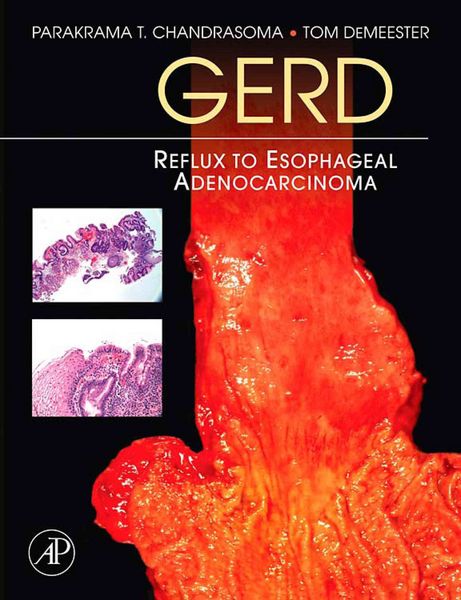
Gerd Reflux to Esophageal Adenocarcinoma
-
- Hardcover ausgewählt
- Taschenbuch
- eBook
-
Sprache:Englisch
-
Verlag:Elsevier Science & Technology
Fr. 169.00
inkl. gesetzl. MwSt.,
Beschreibung
Produktdetails
Einband
Gebundene Ausgabe
Erscheinungsdatum
18.09.2006
Abbildungen
Approx. 350 illustrations
Verlag
Elsevier Science & TechnologySeitenzahl
464
Maße (L/B/H)
28.1/22.1/2.3 cm
Gewicht
1334 g
Sprache
Englisch
ISBN
978-0-12-369416-4
Gastroesophageal Reflux Disease (GERD) is one of the most common maladies of mankind. Approximately 40% of the adult population of the USA suffers from significant heartburn and the numerous antacids advertised incessantly on national television represents a $8 billion per year drug market. The ability to control acid secretion with the increasingly effective acid-suppressive agents such as the H2 blockers (pepcid, zantac) and proton pump inhibitors (nexium, prevacid) has given physicians an excellent method of treating the symptoms of acid reflux.
Unfortunately, this has not eradicated reflux disease. It has just changed its nature. While heartburn, ulceration and strictures have become rare, reflux-induced adenocarcinoma of the esophagus is becoming increasingly common. Adenocarcinoma of the esophagus and gastric cardia is now the most rapidly increasing cancer type in the Western world.
The increasing incidence of esophageal adenocarcinoma has created an enormous interest and stimulus for research in this area. GERD brings together a vast amount of disparate literature and presents the entire pathogenesis of reflux disease in one place. In addition to providing a new concept of how gastroesophageal reflux causes cellular changes in the esophagus, GERD also offers a complete solution to a problem that has confused physicians for over a century. Both clinical and pathological information about reflux disease and its treatment are presented. GERD is meant to be used as a comprehensive reference for gastroenterologists, esophageal surgeons, and pathologists alike.
Unfortunately, this has not eradicated reflux disease. It has just changed its nature. While heartburn, ulceration and strictures have become rare, reflux-induced adenocarcinoma of the esophagus is becoming increasingly common. Adenocarcinoma of the esophagus and gastric cardia is now the most rapidly increasing cancer type in the Western world.
The increasing incidence of esophageal adenocarcinoma has created an enormous interest and stimulus for research in this area. GERD brings together a vast amount of disparate literature and presents the entire pathogenesis of reflux disease in one place. In addition to providing a new concept of how gastroesophageal reflux causes cellular changes in the esophagus, GERD also offers a complete solution to a problem that has confused physicians for over a century. Both clinical and pathological information about reflux disease and its treatment are presented. GERD is meant to be used as a comprehensive reference for gastroenterologists, esophageal surgeons, and pathologists alike.
Noch keine Bewertungen vorhanden
Verfassen Sie die erste Bewertung zu diesem Artikel
Helfen Sie anderen Kundinnen und Kunden durch Ihre Meinung.