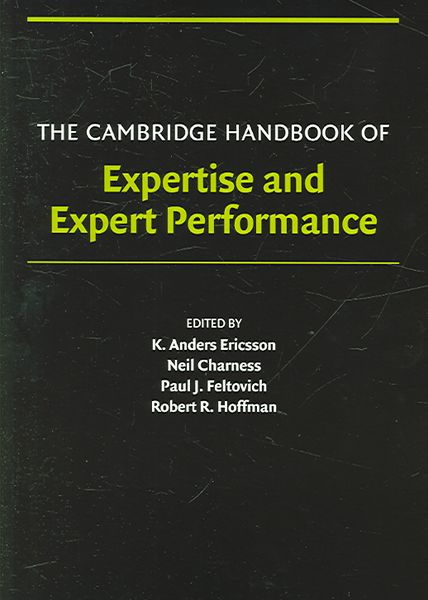
Produktbild: The Cambridge Handbook of Expertise and Expert Performance

The Cambridge Handbook of Expertise and Expert Performance

Fr. 107.00

inkl. gesetzl. MwSt., Versandkostenfrei


Beschreibung

Produktdetails

Einband

Taschenbuch

Erscheinungsdatum

26.06.2006

Herausgeber

K. Anders Ericsson + weitere

Verlag

Cambridge University Press

Seitenzahl

918

Maße (L/B/H)

25.2/17.9/4.2 cm

Gewicht

1682 g

Sprache

Englisch

ISBN

978-0-521-60081-1

Beschreibung

Produktdetails

Einband

Taschenbuch

Erscheinungsdatum

26.06.2006

Herausgeber

Verlag

Cambridge University Press

Seitenzahl

918

Maße (L/B/H)

25.2/17.9/4.2 cm

Gewicht

1682 g

Sprache

Englisch

ISBN

978-0-521-60081-1

Noch keine Bewertungen vorhanden

Verfassen Sie die erste Bewertung zu diesem Artikel

Helfen Sie anderen Kundinnen und Kunden durch Ihre Meinung.

Kundinnen und Kunden meinen

Bewertungen (0)

Die Leseprobe wird geladen.
  • Produktbild: The Cambridge Handbook of Expertise and Expert Performance
  • Part I. Introduction and Perspective: 1. An introduction to Cambridge handbook of expertise and expert performance: its development, organization, and content; 2. Two approaches to the study of experts' characteristics; 3. Expertise, talent, and social encouragement; Part II. Overview of Approaches to the Study of Expertise - Brief Historical Accounts of Theories and Methods: 4. Studies of expertise from psychological perspectives; 5. Overview of approaches to the study of expertise: brief historical accounts of theories and methods; 6. Expert systems: a perspective from computer science; 7. Professionalization, scientific expertise, and elitism - a sociological perspective; Part III. Methods for Studying the Structure of Expertise: 8. Observation of work practices in natural settings; 9. Methods for studying the structure of expertise: psychometric approaches; 10. Methods to assess the representations of experts' and novices' knowledge; 11. Task analysis; 12. Eliciting and representing the knowledge of experts; 13. Protocol analysis and expert thought: concurrent verbalizations of thinking during experts' performance on representative tasks; 14. Simulation for performance and training; Part IV. Methods for Studying the Acquisition and Maintenance of Expertise: 15. Laboratory studies of training, skill acquisition, and retention of performance; 16. Retrospective interviews in the study of expertise and expert performance; 17. Time budgets, diaries and analyses of concurrent practice activities; 18. Historiometric methods; Part V. Domains of Expertise: A. Professional Domains: 19. Expertise in medicine and surgery; 20. Expertise and transportation; 21. Expertise in software design; 22. Professional writing expertise; 23. Professional judgments and 'naturalistic decision making'; 24. Decision making expertise; 25. The making of a dream team: when expert teams do best; B. Arts, Sports and Motor Skills: 26. Music; 27. Expert performance in sport: a cognitive perspective; 28. Artistic performance: acting, ballet, and contemporary dance; 29. Perceptual-motor expertise; C. Games and Other Types of Expertise: 30. Expertise in chess; 31. Exceptional memory; 32. Mathematical expertise; 33. Expertise in history; Part VI. Generalizable Mechanisms Mediating Expertise and General Issues: 34. A merging theory of expertise and intelligence; 35. Tacit knowledge, practical intelligence and expertise; 36. Situational awareness; 37. Brain changes in the development of expertise: neuroanatomical and neurophysiological evidence about skill-based adaptations; 38. The influence of experience and deliberate practice on the development of superior expert performance; 39. Development and Adaptation of expertise: the role of self-regulatory processes and beliefs; 40. Aging and expertise; 41. Social and sociological factors in the development of expertise; 42. Expertise and creativity.