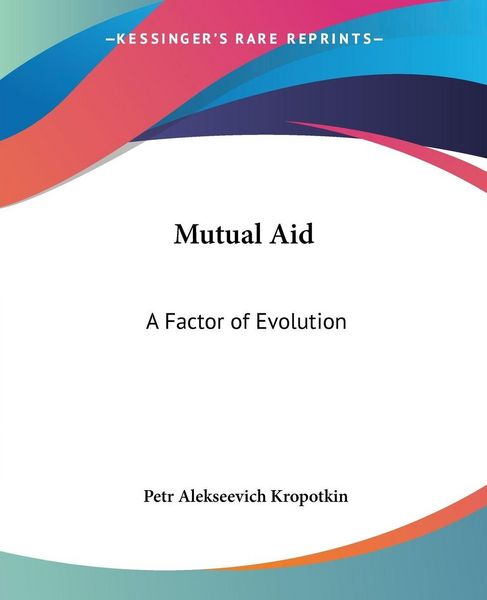
Mutual Aid A Factor of Evolution
-
- Hardcover
- Taschenbuch ausgewählt
- eBook
-
Sprache:Englisch
-
Verlag:Kessinger Publishing, LLC
- Read & Co. Great Essays Fr. 36.90
- Cambridge Scholars Publishing Fr. 39.90
- Tredition Fr. 23.90
- Dover Publications Inc. Fr. 33.90
- Sanage Publishing House Llp Fr. 34.90
- Bibliotech Pr Fr. 17.90
- Les prairies numériques Fr. 36.90
- Culturea Fr. 36.90
- Martino Fine Books Fr. 19.90
- Creative Media Partners, LLC Fr. 31.90
- Cosimo Classics Fr. 33.90
- Aziloth Books Fr. 22.90
- Freedom Press Fr. 37.90
- Kessinger Publishing, LLC Fr. 42.90 ausgewählt
- Critical Editions Fr. 24.90
- Repro India Limited Fr. 31.90
- Turnaround Fr. 29.90
- Indoeuropeanpublishing.Com Fr. 24.90
- Penguin Books Ltd Fr. 19.90
Fr. 42.90
inkl. gesetzl. MwSt.,
Beschreibung
Produktdetails
Einband
Taschenbuch
Erscheinungsdatum
17.06.2004
Verlag
Kessinger Publishing, LLCSeitenzahl
212
Maße (L/B/H)
23.5/19.1/1.2 cm
Gewicht
406 g
Sprache
Englisch
ISBN
978-1-4191-3592-7
Mutual Aid: A Factor of Evolution is a book written by the Russian anarchist and evolutionary theorist, Peter Kropotkin. The book was first published in 1902 and is considered a classic work in the field of evolutionary biology. In this book, Kropotkin challenges the popular notion that evolution is solely driven by competition and the survival of the fittest. He argues that cooperation and mutual aid also play a significant role in the process of evolution. Kropotkin draws on a wide range of examples from the animal kingdom and human societies to support his argument. The book is divided into eight chapters, each of which explores a different aspect of mutual aid in nature and human societies. Kropotkin examines how mutual aid has contributed to the survival and success of different species, from insects to mammals. He also looks at how mutual aid has been a driving force in the development of human societies, from primitive communities to modern industrial societies. Mutual Aid: A Factor of Evolution is a thought-provoking and insightful work that challenges many of the assumptions about the nature of evolution. It remains relevant today as a critique of the social Darwinism that still pervades many aspects of modern society.Sociability and need of mutual aid and support are such inherent parts of human nature that at no time of history can we discover men living in small isolated families, fighting each other for the means of subsistence. On the contrary, modern research, as we saw it in the two preceding chapters, proves that since the very beginning of their prehistoric life men used to agglomerate into gentes, clans, or tribes, maintained by an idea of common descent and by worship of common ancestors.This scarce antiquarian book is a facsimile reprint of the old original and may contain some imperfections such as library marks and notations. Because we believe this work is culturally important, we have made it available as part of our commitment for protecting, preserving, and promoting the world's literature in affordable, high quality, modern editions, that are true to their original work.
Noch keine Bewertungen vorhanden
Verfassen Sie die erste Bewertung zu diesem Artikel
Helfen Sie anderen Kundinnen und Kunden durch Ihre Meinung.