Gutscheinbedingungen

*Gültig bis 20.09.2026 auf (fast) alles. Ausgeschlossen sind Smartboxen, Zeitschriften, Tickets, Lebensmittel, Gaming-Elektroartikel, Tinte/Toner, Gutscheine, Geschenkkarten, Blumen und Abos | Einlösbar in allen Buchhandlungen von Orell Füssli, Barth Bücher, Buchladen Rapunzel, Schuler Orell Füssli, Stauffacher und ZAP unter Vorweisung des Gutscheins, auf www.orellfüssli.ch durch Eingabe des Gutscheincodes. Beim Service „eBooks verschenken“ und bei eBook-Käufen via eReader nicht einlösbar | Mindesteinkaufswert: Fr. 100.- | Nicht mit anderen Rabatten kumulierbar.

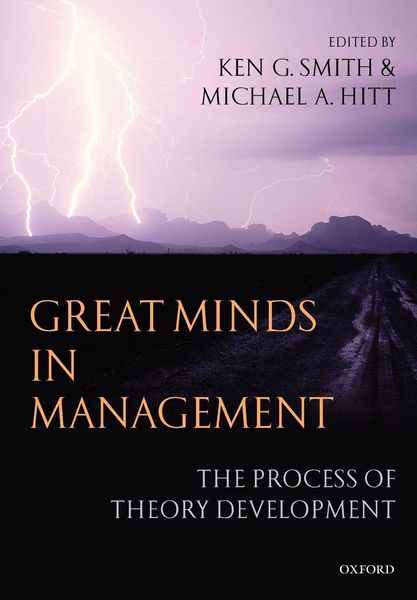
Produktbild: Great Minds in Management

Great Minds in Management The Process of Theory Development

Fr. 98.90

inkl. gesetzl. MwSt., Versandkostenfrei


Beschreibung

Produktdetails

Einband

Taschenbuch

Erscheinungsdatum

05.07.2007

Herausgeber

Smith Ken G. + weitere

Verlag

Oxford University Press

Seitenzahl

616

Maße (L/B/H)

24.4/17/3.3 cm

Gewicht

1047 g

Sprache

Englisch

ISBN

978-0-19-927682-0

Beschreibung

Produktdetails

Einband

Taschenbuch

Erscheinungsdatum

05.07.2007

Herausgeber

Verlag

Oxford University Press

Seitenzahl

616

Maße (L/B/H)

24.4/17/3.3 cm

Gewicht

1047 g

Sprache

Englisch

ISBN

978-0-19-927682-0

Herstelleradresse

Libri GmbH
Europaallee 1
36244 Bad Hersfeld
DE

Email: gpsr@libri.de

Noch keine Bewertungen vorhanden

Verfassen Sie die erste Bewertung zu diesem Artikel

Helfen Sie anderen Kundinnen und Kunden durch Ihre Meinung.

Kundinnen und Kunden meinen

Bewertungen (0)

Die Leseprobe wird geladen.
  • Produktbild: Great Minds in Management
    • Introduction
    • 1: Michael A. Hitt and Ken G. Smith: The Process of Developing Mangement Theory
    • Part I: Individuals and Their Environment
    • 2: Albert Bandura: The Evolution of Social Cognitive Theory
    • 3: Lee R. Beach and Terrence R. Mitchell: Image Theory
    • 4: Robert Folger: The Road to Fairness and Beyond
    • 5: Michael Frese: Proactive Individualism
    • 6: Donald C. Hambrick: Upper Echelons Theory: Origins, Twists and Turns, and Lessons Learned
    • 7: Edwin A. Locked and Gary P. Latham: Goal Setting Theory: Theory Building by Induction
    • 8: Greg R. Oldham and J. Richard Hackman: How Job Characteristics Theory Happened
    • 9: Lyman W. Porter, Richard M. Steers, and Richard T. Mowday: Do Employee Attitudes Towards Organizations Matter? The Study of Employee Commitment to Organizations
    • 10: Denise M. Rousseau: Developing Psychological Contract Theory
    • 11: Barry M. Staw: The Escalation of Commitment: Steps Toward an Organizational Theory
    • 12: Victor H. Vroom: On the Origins of Expectancy Theory
    • Part II: Behavior of Organizations
    • 13: Chris Argyris: Double-Loop Learning in Organizations: A Theory of Action Perspective
    • 14: Jay B. Barney: Where Does Inequality Come From? The Personal and Intellectual Roots of Resource-Based Theory
    • 15: Kim Cameron: Organizational Effectiveness: Its Demise and Re-Emergence Through Positive Organizational Scholarship
    • 16: Anne S. Huff: Managerial and Organizational Cognition: Islands of Coherence
    • 17: Henry Mintzberg: Develping Theory About the Development of Theory
    • 18: Ikujiro Nonaka: Managing Organizational Knowledge: Theoretical and Methodological Foundations
    • 19: Karl E. Weick: The Experience of Theorizing: Sensemaking as Topic and Resource
    • Part III: Environmental Contingencies and Organizations
    • 20: R. Edward Freeman: The Development of Stakeholder Theory: An Idiosyncratic Approach
    • 21: Jeffrey Pfeffer: Developing Resouce Dependence Theory: How Theory is Affected by its Environment
    • 22: W. Richard Scott: Institutional Theroy: Contributing to a Theoretical Research Program
    • 23: Oliver E. Williamson: Transaction Cost Economics: The Process of Theory Development
    • 24: Sidney G. Winter: Developing Evolutionary Theory for Economics and Management
    • 25: Lynn Zucker and Michael R. Darby: An Evolutionary Approach to Institutions and Social Construction: Process and Structure
    • Conclusion
    • 26: Ken G. Smith and Michael A. Hitt: Learning How to Develop Theory from the Masters